Rising Food Prices Make Dining Out Burdensome... "Office Workers Are Crying"
[Asia Economy Reporter Lim Chun-han] Lee, an office worker in Yeouido, Seoul, heads to a convenience store every lunchtime. Even buying a bowl of naengmyeon (cold noodles) feels burdensome at the price of 16,000 won. He lamented, "These days, I'm almost scared to go to restaurants," adding, "It feels like everything except my salary has gone up."
Due to the rise in major food ingredient prices, restaurants have all raised their prices, leading to a rapid increase in office workers seeking convenience store lunchboxes. Among office workers, a new term combining lunch and inflation, ‘lunchflation,’ has even emerged. The convenience store industry forecasts that, in the long term, lunchbox culture will spread further in Korea, similar to Japan.
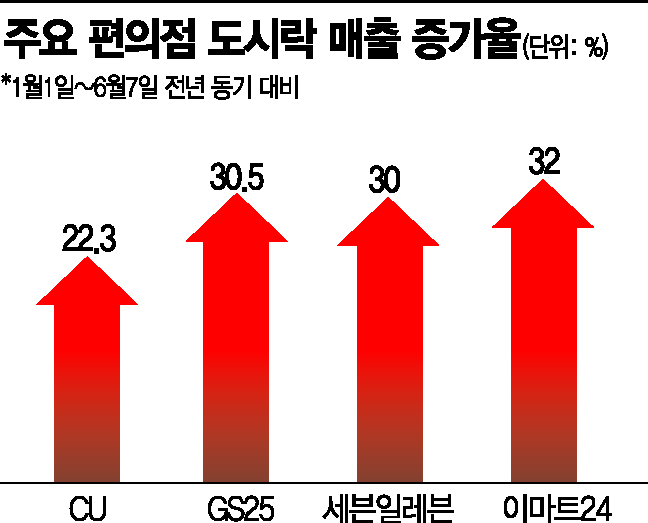
On the 13th, CU reported that lunchbox sales from January 1 to the 7th of this month increased by 22.3% compared to the same period last year. During the same period, GS25 saw a 30.5% increase, Seven Eleven 30%, and Emart24 32%. Particularly, lunchbox sales surged in office districts. Analyzing CU’s lunchbox sales data in Seoul last month by region (at the eup, myeon, dong level), Yeoksam-dong, Sindang-dong, and Gasan-dong ranked first to third. These areas have large office complexes and the Seoul Digital Industrial Complex, making them regions with many office workers. GS25 and Seven Eleven also saw lunchbox sales in office districts jump by 34.6% and 40%, respectively.
Due to continuous price increases, the monthly growth rate of lunchbox sales is also rising. CU reported that lunchbox sales increased by 8.6% in January compared to the previous year, 9.1% in February, 17.8% in March, 20.8% in April, and 24.1% in May. GS25 showed increases of 16.5% in January, 17.7% in February, 30.8% in March, 36.3% in April, and 48.3% in May. By age group, lunchbox purchases were highest among those in their 20s to 40s. At CU, the breakdown was 26.5% for people in their 30s, 24.6% for those in their 40s, 24.1% for those in their 20s, and 14.5% for those in their 50s. At GS25, it was 33.3% for people in their 20s, 32% for those in their 30s, 21.6% for those in their 40s, and 13.1% for those in their 50s.
According to the Korea Consumer Agency’s price information site Chamgagyeok, the price of naengmyeon in Seoul last month was 10,269 won, up 9.87% from 9,346 won last year. The price of jajangmyeon (black bean noodles) rose 15.56% to 6,223 won compared to the same period last year, and gimbap (Korean sushi rolls) increased 8.02% to 2,908 won. The price of kimchi jjigae set meals surpassed 7,000 won in September last year and steadily rose to 7,308 won last month. As a result, more office workers are feeling the burden of lunch costs. According to a survey conducted by HR tech company Incruit with 1,004 office worker respondents, 95.5% (56% very burdensome, 39.5% burdensome) said lunch costs were burdensome.
A convenience store industry official said, "In Japan, the proportion of office workers buying lunchboxes at convenience stores during lunch hours is very high," adding, "Recently, as food prices have risen significantly in Korea as well, more customers are resolving their meals at convenience stores. We will closely analyze customer purchasing trends and provide differentiated purchase benefits."
© The Asia Business Daily(www.asiae.co.kr). All rights reserved.
![Clutching a Stolen Dior Bag, Saying "I Hate Being Poor but Real"... The Grotesque Con of a "Human Knockoff" [Slate]](https://cwcontent.asiae.co.kr/asiaresize/183/2026021902243444107_1771435474.jpg)
















