Japan, Canada, Australia, New Zealand, and Other US Allies Join in Criticizing China
Zelensky's Surprise Video Speech
North Korean Threat, South Korea-US and South Korea-US-Japan Responses
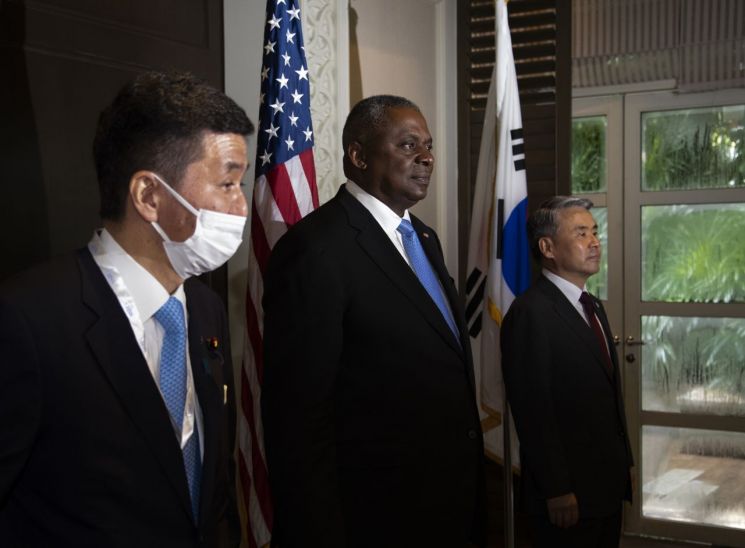 Defense Minister Lee Jong-seop (far right), attending the 19th Asia Security Conference (Shangri-La Dialogue), poses for a commemorative photo on the 11th at the Shangri-La Hotel in Singapore with U.S. Secretary of Defense Lloyd Austin (center) and Japanese Defense Minister Kishi Nobuo before the South Korea-U.S.-Japan defense ministers' meeting. (Photo by Yonhap News)
[Asia Economy Reporter Moon Chaeseok] The Asia Security Conference (Shangri-La Dialogue), held for the first time in three years due to the COVID-19 pandemic, concluded on the 12th afternoon after a two-night, three-day schedule. At the conference, the defense chiefs of the United States and China, whose strategic competition is intensifying, attended side by side and clashed over current issues such as the Taiwan issue, the U.S. Indo-Pacific (Indo-Pacific) strategy, and the Russia-Ukraine war.
The highlight was the clash between the U.S. and China. The two countries confronted each other over the Taiwan issue throughout the three days. On the first day of the conference, the 10th, U.S. Secretary of Defense Lloyd Austin and Chinese Minister of National Defense Wei Fenghe held their first face-to-face meeting. During the hour-long meeting, Secretary Austin reportedly urged Minister Wei to refrain from further security destabilizing actions toward Taiwan. Minister Wei was reported to have said, "If anyone dares to split Taiwan (separate it from China), the Chinese military will definitely not hesitate to fight."
The next day, Secretary Austin publicly criticized in his keynote speech, saying, "Provocative and destabilizing military activities near Taiwan have increased," and "China's actions pose a threat that undermines the security, stability, and prosperity of the Indo-Pacific." Minister Wei responded in his speech on the last day of the conference, mentioning "not hesitating to fight" as well. He raised his voice, saying, "If anyone dares to split Taiwan (separate it from China), the Chinese military will fight to the end at any cost."
Clashes also continued over the U.S. Indo-Pacific strategy aimed at containing China. In his speech, Secretary Austin said, "Today, the Indo-Pacific is at the center of the U.S. grand strategy," expressing his intention to actively assert presence. Secretary Austin also emphasized the necessity of the Indo-Pacific strategy during the South Korea-U.S. and South Korea-U.S.-Japan defense minister meetings.
General John Aquilino, Commander of the U.S. Indo-Pacific Command, pointed out in a separate meeting that the world is experiencing the most dangerous period potentially since World War II, and that China, along with Russia and North Korea, is bringing global instability. In response, Lieutenant General Zhang Zhenzhong, Deputy Chief of the Joint Staff Department of the Central Military Commission, rebutted, saying, "The U.S. Indo-Pacific strategy is aimed at maintaining U.S. hegemony and fostering division and confrontation," according to the Global Times, a sister publication of the Chinese Communist Party's official newspaper, the People's Daily.
After Secretary Austin mentioned that China threatens security and stability in the Indo-Pacific region, Japan, Canada, Australia, and New Zealand joined in 'criticizing China.' Nobuo Kishi, Japan's Minister of Defense, said in his speech at the second plenary session, "There are attempts to strengthen military power without transparency, without giving up the possibility of using force against Taiwan." Japanese Prime Minister Fumio Kishida, in his keynote speech on the first day, said, "There is a warning that today's Ukraine could become tomorrow's East Asia," which was interpreted as targeting China's increasing military demonstrations against Taiwan.
Anita Anand, Canada's Minister of Defense, criticized in an interview with major foreign media the incident last month where Chinese military fighter jets interfered with a Canadian Air Force patrol aircraft monitoring North Korea's compliance with UN sanctions in the Indo-Pacific airspace. According to major foreign media, New Zealand expressed concerns about China's attempts to expand its influence over Pacific island countries.
The Ukraine war was also a major focus. In his speech, Secretary Austin pointed out, "What happens when great powers decide that imperialistic ambitions are more important than the rights of peaceful neighbors." Earlier, during his bilateral meeting with Minister Wei, Secretary Austin reportedly requested China not to provide material support to Russia.
According to major foreign media, Singapore's Minister of Defense Ng Eng Hen said that China-Russia relations were discussed in a closed meeting among defense ministers, and there was an opinion that China should work to restrain Russia. In response, Minister Wei said in his speech, "China has never provided material support to Russia," and suggested that everyone knows who is fueling such conflicts, indirectly targeting the U.S. Lieutenant General Zhang Zhenzhong also expressed dissatisfaction to the media, saying, "There are many groundless accusations targeting China."
Ukrainian President Volodymyr Zelensky made a 'surprise' video speech on the second day of the conference. The schedule had not been officially listed until the 9th. President Zelensky appealed for continued international support, saying the outcome of the war would affect not only Ukraine but also the future of the international order. He said Russia's blockade of ports in the Black Sea and the Sea of Azov is preventing Ukraine's grain exports, warning that "many countries in Asia and Africa will face extreme and severe food crises and hunger," urging international intervention. He also said, "Today's situation in Ukraine is an example for the whole world," and preventive measures must be taken to avoid war.
Amid rumors of North Korea's imminent seventh nuclear test, the defense ministers of South Korea, the U.S., and Japan held a series of meetings on the 11th to discuss responses to the North Korean threat. According to the South Korean Ministry of National Defense, the South Korea-U.S. defense minister meeting mainly dealt with joint response measures, including the rapid provision of extended deterrence in case of North Korea's nuclear test provocations. The South Korea-U.S.-Japan defense ministers also met face-to-face for the first time in two years and seven months since the ASEAN Defense Ministers' Meeting-Plus (ADMM-Plus) in November 2019.
© The Asia Business Daily(www.asiae.co.kr). All rights reserved.
![Clutching a Stolen Dior Bag, Saying "I Hate Being Poor but Real"... The Grotesque Con of a "Human Knockoff" [Slate]](https://cwcontent.asiae.co.kr/asiaresize/183/2026021902243444107_1771435474.jpg)















