Police Consider "Public Interest" as Reason for Non-Prosecution
Not Specified in Legal Provisions
Civic Group Files Objection
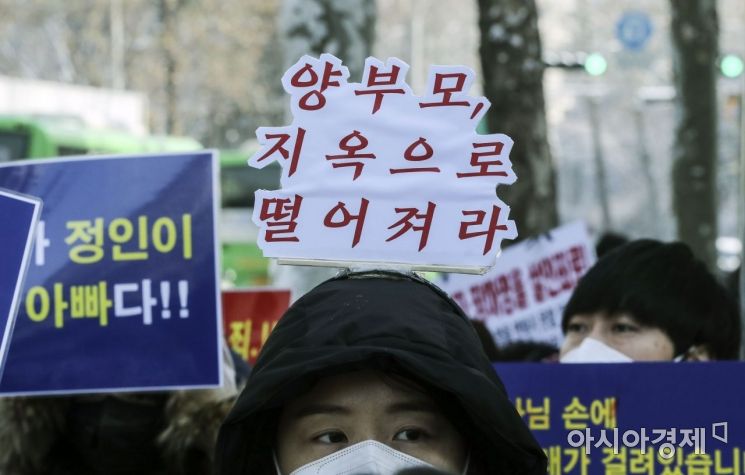 The first trial of the 'Jung-in case,' in which the adopted child died due to abuse by the adoptive mother, was held on the 13th at the Southern District Court in Yangcheon-gu, Seoul. Citizens gathered in front of the courthouse are demanding that the adoptive parents be charged with murder. Photo by Hyunmin Kim kimhyun81@
[Asia Economy Reporter Oh Gyumin] After the police decided not to prosecute Lee Dong-won, the SBS 'Unanswered Questions' PD who was accused of revealing the face of ‘Jeong-in,’ a child who died in 2020 due to abuse by adoptive parents, the citizen group that filed the complaint has submitted an objection. Experts pointed out that there are legal issues with the police's stated reasons for non-prosecution.
On the 3rd of last month, the Seoul Seodaemun Police Station decided not to prosecute Lee Dong-won, SBS PD, who was charged with violating the Special Act on the Punishment of Child Abuse Crimes (breach of confidentiality obligation), citing ‘no charges.’ In response, on the 8th, the complainant citizen group ‘Mothers Who Do Politics’ submitted an objection. The purpose of the objection is that the charge is punishable without exceptions, yet the police arbitrarily applied an exception.
The reasons for the police’s non-prosecution of PD Lee can be understood through the objection letter. The police cited ▲clear public interest purpose ▲many visible signs of abuse on the victim child’s face and body, making full facial exposure inevitable ▲use of the pseudonym ‘Jeong-in’ to prevent exposure of the victim child’s personal information ▲and the fact that since the victim child died, preventing secondary damage is impossible, so the confidentiality obligation has no practical effect.
Looking at Article 35 Paragraph 2 and Article 62 Paragraph 3 of the Special Act on the Punishment of Child Abuse, it states that journalists and broadcasters have an obligation not to disclose personal information of the victim child to protect them, and that violation is punishable. In other words, the law only specifies what acts constitute a crime and what punishments follow, but does not provide exceptions.
Ultimately, the issue is whether ‘even though the law specifies no exceptions to the punishment, can a public interest purpose justify a non-prosecution decision?’
The public reaction aligns with the production team’s stance. The production team stated, “The Jeong-in case is not a simple child abuse case but a murder case, so the face was disclosed for public interest reasons.” Office worker Lee (30) expressed strong agreement with the police’s non-prosecution reasons, saying, “The face disclosure helped bring more public attention to the case, so I think it was necessary.”

However, experts held different opinions. The reason journalists have a confidentiality obligation is that, considering the purpose of the Special Act on the Punishment of Child Abuse, broadcasting the face can cause unwanted harm to the child. Attorney Kim Suhyun (Onhwa Law Firm) said, “Emotionally, one might think ‘Is it really punishable just because the face was revealed?’ but since the law does not provide an exception for public interest, the police’s use of that condition may have legal issues.”
Attorney Kim also commented on the other reasons for non-prosecution, saying, “It seemed possible to mosaic (blur) Jeong-in’s face, and simply using a pseudonym cannot be considered a sufficient effort to prevent exposure of personal information.”
Regarding the reason that “since Jeong-in has already died, the confidentiality obligation to prevent secondary damage has no practical effect,” Attorney Kim said, “Crimes against children are considered violations of their personality rights. Instead, adults should protect those rights, and if Jeong-in’s biological parents had known this fact, that harm should also be considered.”
Meanwhile, some questioned the fundamental authority of the police to decide on non-prosecution. Attorney Kim Yewon of the Disability Rights Law Center stated about this case, “Public interest can be a mitigating factor in sentencing but cannot be a legal justification for illegality under this law.”
She added, “The reasons for non-prosecution in this case are relatively kind, but since the role of making legal judgments is excessively entrusted to the police, many citizens suffer because they do not receive proper reasons for non-prosecution and cases are dismissed without charges.”
© The Asia Business Daily(www.asiae.co.kr). All rights reserved.
![Clutching a Stolen Dior Bag, Saying "I Hate Being Poor but Real"... The Grotesque Con of a "Human Knockoff" [Slate]](https://cwcontent.asiae.co.kr/asiaresize/183/2026021902243444107_1771435474.jpg)















