Food Supply Crisis Worsens Due to Climate Change
Hamburger Franchise's 'French Fries and Lettuce Disappearance Incident'
Ukraine War and Severe Drought Increase Hunger in Africa
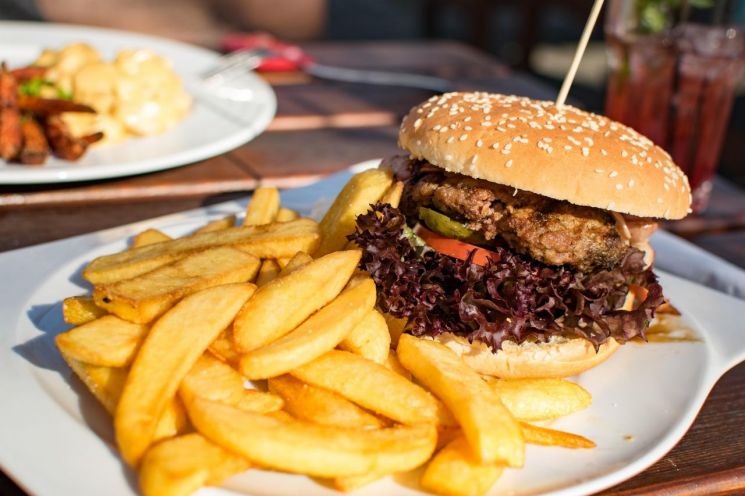 Due to the climate crisis causing instability in food supply, hamburger franchises did not provide French fries and lettuce for a certain period last year. The photo is unrelated to specific expressions in the article. Photo by Pixabay
[Asia Economy Reporter Park Hyun-joo] The warning that the climate crisis would strike humanity as a terrible disaster in the form of food shortages once seemed like a story of the distant future, but it has already become our present reality. The dining table, which used to feature a variety of ingredients, is becoming increasingly sparse due to food supply difficulties.
The recent surge in food supply issues caused by the climate crisis in South Korea began with the "Lettuce Disappearance Incident." At the end of last year, due to an unusual cold wave, the supply of lettuce became unstable, leading hamburger franchises and others to offer products without lettuce. Because of the shortage of lettuce, hamburgers became smaller and thinner, prompting jokes calling them "Macaron Burgers." In January and February, the food supply shortage worsened with the climate crisis compounded by the COVID-19 logistics crisis, causing shortages of lettuce and French fries. At that time, some stores like McDonald's and Lotteria faced difficulties supplying French fries and informed customers that they could choose between McNuggets and cheese sticks instead of fries.
The spicy flavors on the table are also at risk of disappearing. According to the Associated Press on the 9th (local time), the manufacturer of Sriracha sauce, "Huy Fong," sent an email to customers on April 19th announcing a production halt for about five months. This was due to poor harvests of jalape?o peppers, the raw material, caused by the worst drought recently experienced in California. Sriracha sauce has been loved by many for its addictive spiciness.
Huy Fong explained, "Unfortunately, this is beyond our control," adding, "Without essential ingredients (peppers), we cannot produce any products." The company has sourced peppers from farms in California, New Mexico, and Mexico. However, severe droughts and abnormal temperatures in California and other areas have caused not only quality issues but also production disruptions.
The climate crisis is also cited as the reason for the disappearance of pollock, once considered the nation's fish. In the late 1980s, tens of thousands of tons of pollock were caught annually in South Korean waters, but rising water temperatures due to climate change have caused a sharp decline in catches.
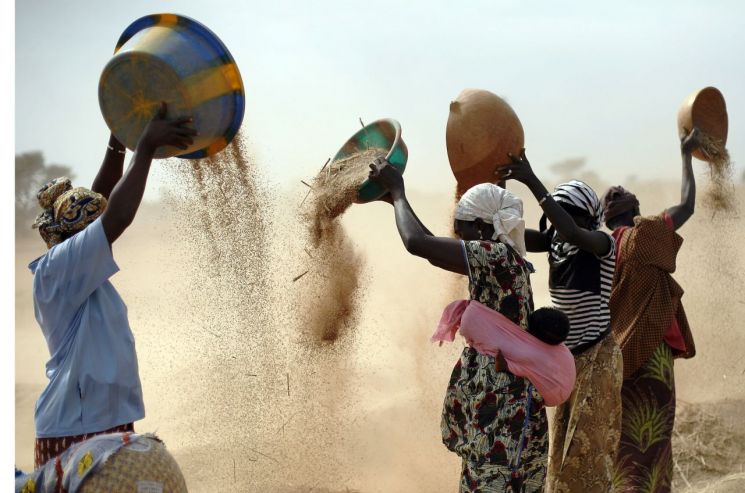 Concerns have been raised that the number of people facing hunger in Africa will surge due to the Ukraine war and the worst drought in 40 years. The photo shows Malian women winnowing wheat in a field near S?gou in central Mali.
 [Photo by AP S?gou]
Food supply shortages caused by the climate crisis are not limited to South Korea. As the global food map changes due to climate change, adverse factors such as the COVID-19 logistics crisis and the Ukraine war have compounded the situation. The World Food Programme (WFP) and the Food and Agriculture Organization (FAO), UN-affiliated agencies, released a report on the 6th (local time) on the food crisis, diagnosing that "millions of people have been driven to hunger due to the ripple effects of the Ukraine war, extreme weather, and COVID-19."
In particular, Africa is currently facing the worst food shortage. The combination of rising prices caused by COVID-19 and the Ukraine war, along with the worst drought in 40 years, has left countless people starving. Ukraine is a global granary producing wheat and corn, and Africa has depended on Russia and Ukraine for 40% of its wheat. However, as the war prolongs, Ukraine's crop yields have significantly decreased, and Russian forces' control of Black Sea ports has blocked grain export routes.
Meanwhile, the United Nations Food and Agriculture Organization (UNFAO) warned in its "State of the World's Plant Genetic Resources for Food and Agriculture" report that "by 2055, 22% of wild seeds of important food resources for humans, such as peanuts, tomatoes, and soybeans, will become extinct." According to the report, between 1900 and 2000, 75% of edible plants worldwide disappeared due to climate change.
© The Asia Business Daily(www.asiae.co.kr). All rights reserved.
![Clutching a Stolen Dior Bag, Saying "I Hate Being Poor but Real"... The Grotesque Con of a "Human Knockoff" [Slate]](https://cwcontent.asiae.co.kr/asiaresize/183/2026021902243444107_1771435474.jpg)
















