Decrease of 70,000 Wage Workers and Increase of 26,000 Self-Employed in Southeast Region from 2019 to 2021
Expansion of Elderly Self-Employed Aged 60 and Over, Significant Rise in Small-Scale Self-Employment Without Employment
[Asia Economy Yeongnam Reporting Headquarters Reporter Kim Yong-woo] During the COVID-19 period when the economic sentiment was at its worst, why did the number of self-employed individuals decrease nationwide but increase in the Dongnam region?
A noteworthy report investigating changes in self-employment in the Busan, Ulsan, and Gyeongnam areas from 2019, when the COVID-19 outbreak began, through 2021, has been released.
The report stated that during this period, wage workers in the Dongnam region decreased while the number of self-employed individuals increased, with a higher proportion of self-employed people aged 60 and above. It also explained that the number of small-scale self-employed without employees increased significantly.
On the 9th, BNK Economic Research Institute of BNK Financial Group published a research report titled "Characteristics of Changes in Self-Employment in the Dongnam Region after COVID-19."
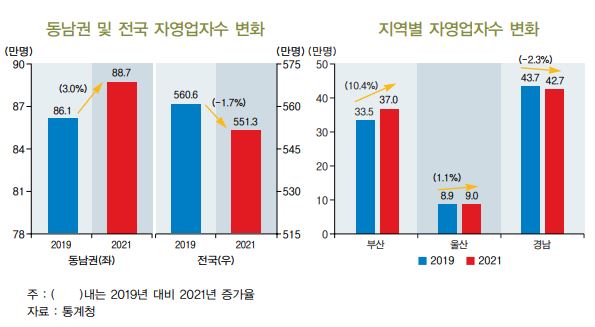
According to the report, the number of self-employed in the Dongnam region increased by 26,000 (3.0%) between 2019 and 2021.
This is presumed to be because a significant portion of wage workers in the Dongnam region newly entered the self-employment market. During the same period, the number of wage workers in the Dongnam region decreased by 70,000, with a decline rate of -2.5%.
Nationwide, during the same period, the number of self-employed decreased by 93,000 (-1.7%), but the number of wage workers increased by 310,000 (1.5%), showing a contrasting trend.
The main reason for the decrease in wage workers in the Dongnam region was attributed to deteriorating employment conditions due to sluggish performance in the region's key manufacturing industries. During the same period, employment in the Dongnam automobile and shipbuilding industries decreased by -9.5% and -13.3%, respectively, due to production disruptions and reduced demand caused by COVID-19.
By industry, the number of telecommunication sales businesses recorded the highest growth rate of 65.8%, supported by the strengthening of non-face-to-face trends and the activation of e-commerce. This was followed by coffee and beverage shops (40.7%), pensions and guesthouses (40.3%), tutoring centers and study rooms (35.5%), and sports facility operations (31.8%), which showed high growth rates.
On the other hand, due to strengthened social distancing and changes in workplace dining culture, simple pubs (-26.3%), hop specialty bars (-17.0%), and PC rooms (-16.4%) significantly decreased, while karaoke rooms and company cafeterias also recorded decreases of -11.9% and -11.2%, respectively.
By age group, the proportion of elderly self-employed individuals increased significantly. The proportion of self-employed aged 60 and above rose from 28.4% in 2019 to 31.6% in 2021, an increase of 3.2 percentage points, continuing to show the characteristic of having the highest proportion of elderly self-employed among economic regions.
The number of self-employed without employees, classified as small-scale self-employed, also increased rapidly. The number of self-employed without employees in the Dongnam region rose from 630,000 in 2019 to 687,000 in 2021, a 9.0% increase, significantly exceeding the national average growth rate of 3.4%.
After COVID-19, the small business owners' economic sentiment index in the Dongnam region decreased by -26.8% in 2021 compared to 2019, indicating a worsening perception of the self-employment economy.
The production indices for accommodation and food services and leisure services, which are face-to-face service sectors in the Dongnam region, also decreased by -19.2% and -24.1%, respectively. Compared to the overall service industry production index (-0.4%) during the same period, this represents a much larger decline, indicating that self-employed individuals in face-to-face service industries suffered greater damage.
Additionally, the self-employment downturn negatively affected the local commercial real estate market. The vacancy rate of commercial spaces in the Dongnam region increased from 13.1% in the fourth quarter of 2019 to 16.4% in the fourth quarter of 2021, a rise of 3.3 percentage points, which is a higher increase than the national average (2.2 percentage points).
Jung Young-doo, head of BNK Economic Research Institute, said, "With the recent lifting of social distancing measures, improving consumer sentiment, and revitalization of local tourism, expectations for the recovery of self-employment are rising." He added, "It is important for not only the government and local governments but also local communities and businesses to show interest and support so that self-employment can regain vitality."
© The Asia Business Daily(www.asiae.co.kr). All rights reserved.
![Clutching a Stolen Dior Bag, Saying "I Hate Being Poor but Real"... The Grotesque Con of a "Human Knockoff" [Slate]](https://cwcontent.asiae.co.kr/asiaresize/183/2026021902243444107_1771435474.jpg)
















