Number of Test Takers Decreased but Repeaters Increased by 9,570 Compared to Last Year
Repeater Ratio at 16.2%, Highest Since 2011
Clear Expansion in Participation Rates for Korean Language and Mathematics Calculus Exams
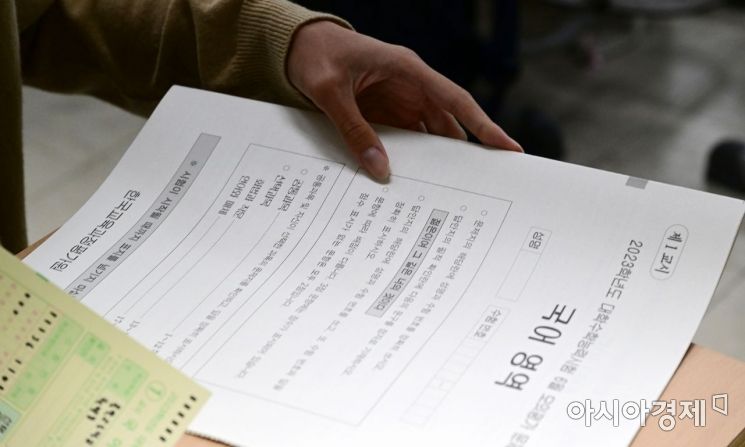 On the 9th, the day the June mock test for the 2023 College Scholastic Ability Test was held, third-year students at Yongsan High School in Seoul were preparing for the exam. Photo by Kim Hyun-min kimhyun81@
From 8:40 a.m. on the 9th, the June mock CSAT will be held at 2,092 high schools and 451 designated academies nationwide. This is the first mock CSAT of the second year of the integrated CSAT.
According to the Korea Institute for Curriculum and Evaluation, the administering organization, the number of test takers is 477,148, a decrease of 5,751 compared to last year. Among them, 400,473 (83.9%) are current students, and 76,676 (16.1%) are graduates and other examinees. The number of current students decreased by 15,321 compared to the previous year, but the number of graduates and others increased by 9,570.
The proportion of repeat test takers is the highest since the 2011 academic year when the registration statistics were first announced. It increased by 1.6 percentage points compared to the previous highest in the 2020 academic year (14.5%). Including those retaking after a gap year, the proportion of repeat test takers for the November CSAT is expected to exceed 30%. As the proportion of repeat test takers increases, the participation rates in Language and Media and Calculus, subjects mainly taken by top-ranking students, are also expected to rise significantly.
As of June last year, the selection rate for Language and Media was 27.8%, but this year it is expected to reach the mid-30% range, and Calculus is expected to record the mid-40% range, a significant increase from last year's 37.1%. During the March academic assessment, the participation rate for Language and Media was 34.7%, significantly higher than last year's CSAT (30%). The participation rate for Calculus already exceeded last year's CSAT (39.7%) at the April mock exam (41.1%).
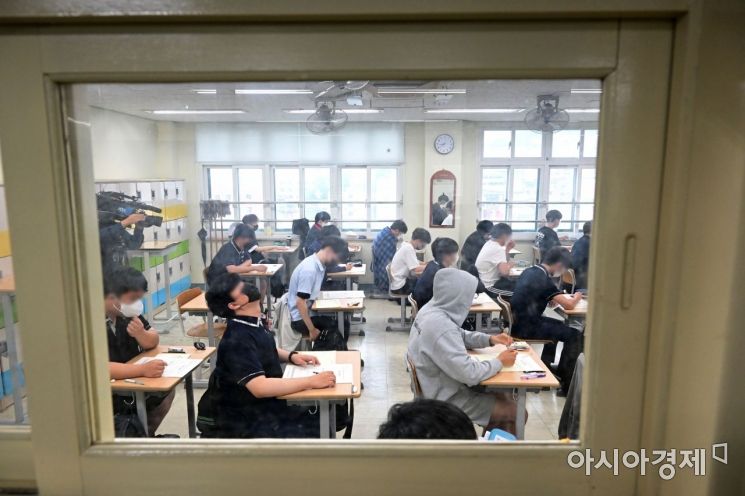 On the 9th, students at Yongsan High School in Seoul were preparing for the 2023 College Scholastic Ability Test June mock exam. Photo by Hyunmin Kim kimhyun81@
The increase in the selection rates for these two subjects is because they have more top-ranking examinees than other elective subjects, resulting in higher average scores and potentially leading to an increase in standard scores. Based on the March academic assessment, the highest standard scores were 144 for Language and Media and 139 for Speech and Composition, a 5-point difference. In mathematics, the maximum difference was 7 points (Geometry 165, Calculus 164, Probability and Statistics 158). Due to the large influx of repeat test takers and changes in elective subject participation rates, it is expected that score fluctuations will be greater than in the March and April mock exams.
From this mock evaluation, improvements to the objection review system will be implemented. The chairperson of the objection review committee will be appointed from outside personnel, and additional external members such as teachers, parents, and legal professionals will be appointed. The objection submission period is from the 9th to 6 p.m. on the 12th. The objection review period is from the 13th to the 21st, and the final answer announcement will be at 5 p.m. on the 21st.
The score notification date is July 6. The score report will include standard scores, percentiles, grades by subject and area, and the number of test takers per area. Those who do not take the Korean History section will have their entire score invalidated and will not receive a score report.
Kim Won-jung, head of the admissions strategy office at Gangnam Daesung Academy, said, "Since graduates participate in the June mock exam, the grades by subject for current students are likely to be lower compared to the education office mock exams. Based on the mock exam results, students should comprehensively evaluate their academic grades and their preparation for university-specific exams to establish their early admission application strategies. Given that students who chose Probability and Statistics in mathematics found it difficult to achieve high grades, humanities students should prepare early admission strategies that meet the minimum CSAT academic standards."
© The Asia Business Daily(www.asiae.co.kr). All rights reserved.
![Clutching a Stolen Dior Bag, Saying "I Hate Being Poor but Real"... The Grotesque Con of a "Human Knockoff" [Slate]](https://cwcontent.asiae.co.kr/asiaresize/183/2026021902243444107_1771435474.jpg)
















