KOSPI and KOSDAQ Fluctuate Before Closing
Exchange Rates and Interest Rates Stable Despite Stagflation Concerns
Decline Amid Uncertain Outlook Ahead of China Export-Import Data Release
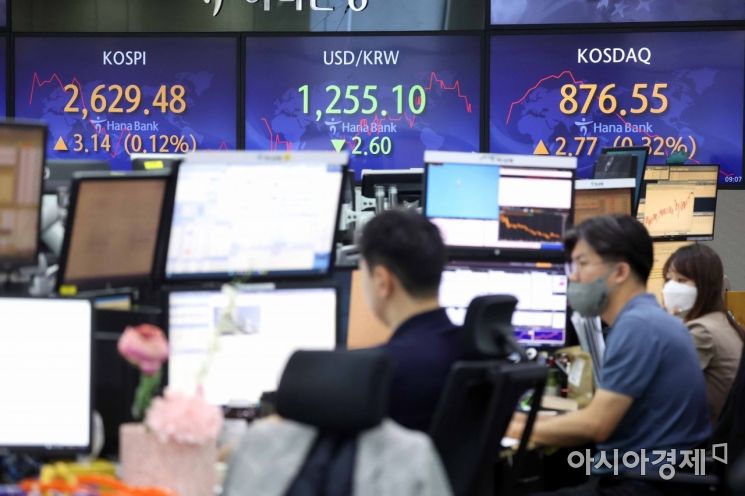 On the 8th, the KOSPI index opened at 2,633.53, up 7.19 points (0.27%), as dealers were busy working in the Hana Bank dealing room in Euljiro, Seoul. The won-dollar exchange rate started at 1,255.0 won, down 2.7 won. Photo by Moon Honam munonam@
[Asia Economy Reporter Hwang Junho] On the 8th, the KOSPI showed mixed trends, giving up its gains in the afternoon before rising again and closing mixed. Despite the decline in the won-dollar exchange rate and government bond yields, concerns about inflation and caution over China's export-import indicators increased, resulting in a more cautious market stance.
KOSPI Closes Mixed... Cautious Stance on China Indicators
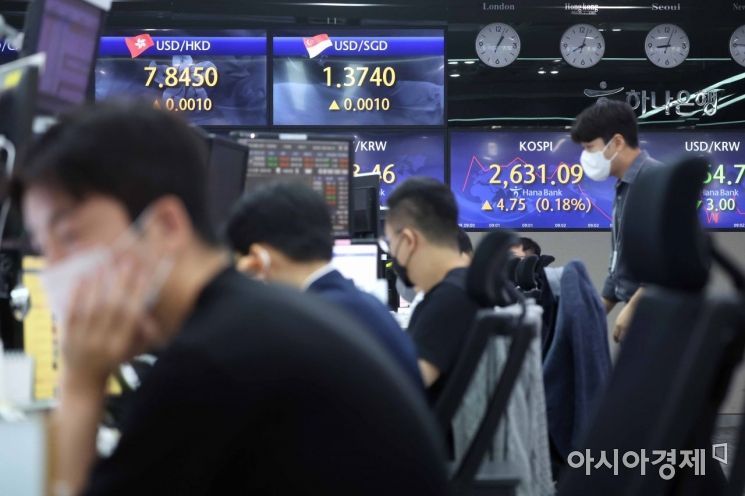 On the 8th, the KOSPI index opened at 2,633.53, up 7.19 points (0.27%), as dealers were busy working in the Hana Bank dealing room in Euljiro, Seoul. The won-dollar exchange rate started at 1,255.0 won, down 2.7 won. Photo by Moon Honam munonam@
On the day, the KOSPI closed at 2,626.15, down 0.19 points (0.01%). Individual investors led the market rise by net buying worth 139.2 billion KRW for the second consecutive day. However, foreign investors and institutions sold shares worth 104.7 billion KRW and 74.8 billion KRW respectively, causing the market to fluctuate.
Kim Seok-hwan, a researcher at Mirae Asset Securities, stated, "Despite Target, a retailer in the US stock market, raising stagflation concerns the previous day, the rebound buying that occurred seemed to have positively influenced the domestic market as well."
However, the Chinese stock market turned downward on the day, impacting the Korean market. Lee Kyung-min, a researcher at Daishin Securities, analyzed, "Ahead of China's May export-import statistics release on the 9th, the Chinese government has been stirring economic anxiety, increasing pressure on both the Chinese mainland and Korean stock markets."
On the day, the Deputy Minister of Commerce of China assessed that China's foreign trade stabilization is facing significant pressure due to uncertainties and domestic and international variables ahead of the export-import statistics release. He also pointed out that the slowdown in trade growth is pressured by transportation issues and soaring raw material prices.
China's exports in April increased by 3.9% year-on-year, falling more than 10 percentage points from March's 14.7%. The market expects May exports to rise by 8.0% month-on-month, showing some recovery. Imports are forecasted to increase by 2% compared to the previous year, remaining flat. However, based on these remarks, there is an analysis that related figures could shrink further. This could re-highlight recession issues, posing a threat to the stock market.
The won-dollar exchange rate, which surged the previous day, closed at 1,253.80 won, down 0.31% from the previous day. South Korea's government bond yields also reversed the previous day's rise and declined. The 3-year bond yield recorded 3.199% in the morning, and the 10-year bond yield was at 3.480%.
SK Hynix, LG Chem Lose Momentum in Late Trading
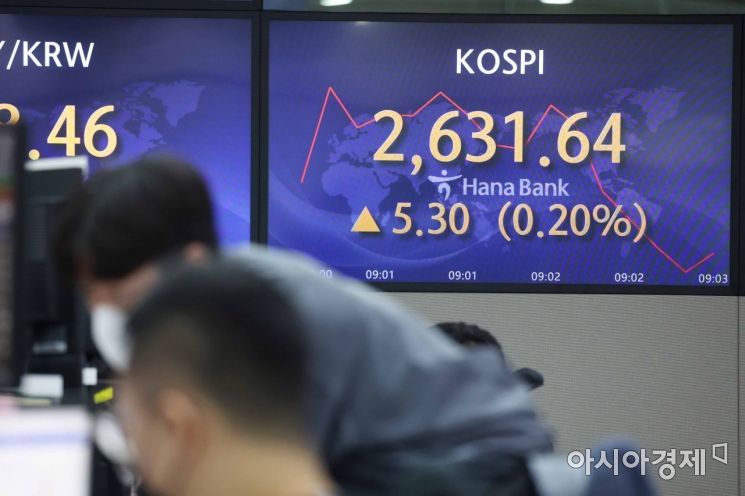 On the 8th, the KOSPI index opened at 2,633.53, up 7.19 points (0.27%), as dealers were busy working in the Hana Bank dealing room in Euljiro, Seoul. The won-dollar exchange rate started at 1,255.0 won, down 2.7 won. Photo by Moon Honam munonam@
Among all stocks, 358 stocks rose. Among the top market capitalization stocks, SK Hynix (1.92%) and LG Chem (4.50%) showed notable gains but gradually reduced their gains in the late session. Samsung Electronics, the perennial market leader, fluctuated and closed down 0.31% at 65,300 won.
Among the top KOSPI stocks on the day, Kakao Pay's stock price plunged. At the time of its listing in November last year, concerns about overhang from Alipay, the second-largest shareholder, were dismissed, but news emerged the previous day that Alipay would dispose of some of its Kakao Pay shares through a block deal, causing the stock to slide. It recorded a 15.57% drop in one day, closing at 89,500 won.
On the day, in the KOSPI, machinery sector company Samhwa Crown and small-scale retailer Hanchang each hit the upper price limit.
The KOSDAQ also showed mixed trends, turning downward during the session. However, foreign investors turned to net buying in the late session, leading to a positive close. It closed at 874.95, up 1.17 points (0.13%) from the previous session. Foreign and institutional investors net bought 24.7 billion KRW and 34.5 billion KRW respectively, while individuals net sold 51.8 billion KRW, barely maintaining the upward trend.
Among the top market capitalization stocks, bio stocks stood out with gains. Celltrion Healthcare (2.33%) and Celltrion Pharm (3.68%) showed notable increases. In contrast, HLB fell by 6.28%.
© The Asia Business Daily(www.asiae.co.kr). All rights reserved.
![Clutching a Stolen Dior Bag, Saying "I Hate Being Poor but Real"... The Grotesque Con of a "Human Knockoff" [Slate]](https://cwcontent.asiae.co.kr/asiaresize/183/2026021902243444107_1771435474.jpg)


















