UNIST Research Team Develops Novel Cancer Treatment Technology
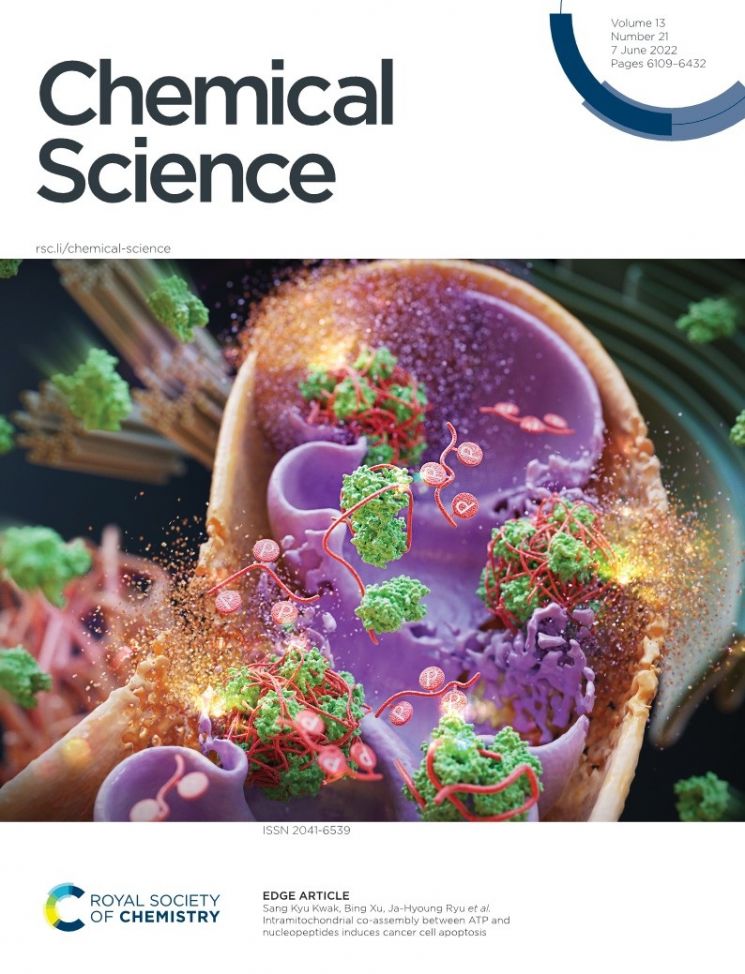
[Asia Economy Reporter Kim Bong-su] A cancer treatment technology that selectively kills cancer cells by infiltrating them, removing their energy source (ATP), and causing mitochondrial dysfunction has been developed.
Ulsan National Institute of Science and Technology (UNIST) announced on the 7th that Professor Yu Ja-hyung's chemistry research team, together with Professor Kwak Sang-gyu's energy chemical engineering team, developed an anticancer inducer that binds to cancer cell ATP inside the mitochondria of cancer cells to create giant molecular aggregates. Cancer cells treated with this substance stop growing as ATP is depleted during the formation of these giant molecular aggregates. Additionally, as the aggregates grow large, they physically damage the mitochondrial membrane, causing mitochondrial dysfunction, which further inhibits cancer cell growth.
The research team stated, "This study demonstrated that inducing the formation of 'giant self-assemblies' that simultaneously remove the cellular energy source ATP and cause mitochondrial dysfunction can be an effective anticancer strategy," and added, "It is expected to become a new platform for developing mitochondria-targeted drug therapies in the future."
Since ATP, the cellular energy source, is produced in mitochondria, a shortage of ATP or damage to mitochondria that produce ATP leads to metabolic disorders and cell death. Although normal cells also produce ATP, rapidly proliferating cancer cells have higher ATP concentrations. The research team focused on this point and developed an anticancer inducer that can bind to high concentrations of ATP to form molecular aggregates. In normal cells, where ATP concentration is low, such molecular aggregates do not form.
These molecular aggregates grow to a size of several hundred nanometers, physically damaging mitochondrial membranes of similar size. Another distinguishing feature is that ATP is incorporated into these aggregates during their synthesis, thereby removing intracellular ATP. Experiments using cancer cells confirmed that cancer cell growth slowed compared to normal cells.
The results of this study were published on June 2 as the cover article of the international journal Chemical Science.
© The Asia Business Daily(www.asiae.co.kr). All rights reserved.
![Clutching a Stolen Dior Bag, Saying "I Hate Being Poor but Real"... The Grotesque Con of a "Human Knockoff" [Slate]](https://cwcontent.asiae.co.kr/asiaresize/183/2026021902243444107_1771435474.jpg)















