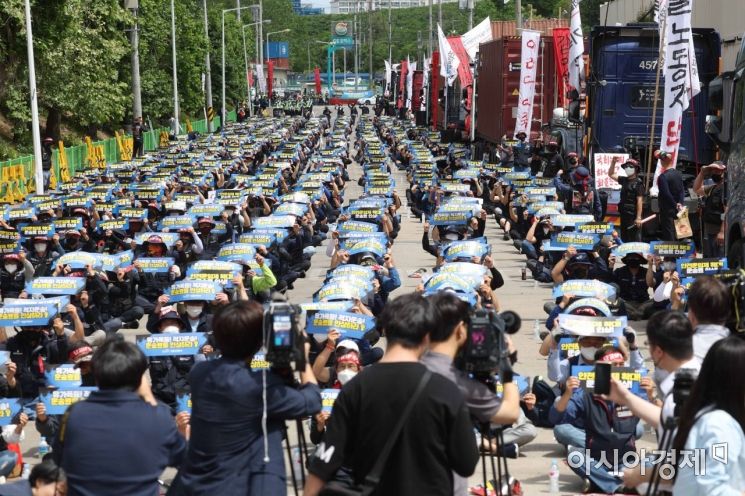
 On the 7th, a kickoff rally for the general strike was held near the Inland Container Depot (ICD) in Uiwang-si, Gyeonggi Province, as the Cargo Solidarity Union launched a general strike demanding the abolition of the sunset clause on safe freight rates and an increase in transportation fees due to high oil prices. Photo by Moon Honam munonam@
The core demand of the Cargo Solidarity Headquarters of the Public Transport Union under the Korean Confederation of Trade Unions, which began an indefinite general strike at midnight on the 7th, is the abolition of the 'sunset clause of the Safe Freight Rate System.' The Safe Freight Rate System, which serves as the minimum wage equivalent for cargo workers, is a measure to prevent overwork, overloading, and speeding, and to ensure traffic safety. It has been operated with a three-year sunset clause (ending on December 31 this year) since 2020 for certain items such as containers and cement. The Cargo Solidarity argues not only for the abolition of the sunset clause but also for the expansion of the system to all vehicle types and items. The biggest reason is the surge in oil prices. Due to the skyrocketing diesel prices, it is said that it is difficult to maintain livelihoods without the Safe Freight Rate System.
According to Opinet of the Korea National Oil Corporation, the average diesel retail price at gas stations nationwide on that day recorded 2,025.2 KRW per liter, up 1.3 KRW from the previous day. At a gas station in Yongsan, Seoul, diesel prices have risen to 2,990 KRW, with an unprecedented breakthrough of the 3,000 KRW mark anticipated. Diesel prices have been rising for over a month since the 3rd of last month, surpassing gasoline prices, causing freight transport and diesel vehicle drivers to suffer from cost burdens.
Diesel prices in the United States and Europe have also surged sharply, spreading shockwaves globally. The average retail price of diesel in the U.S. has risen more than 55% this year, recording a larger increase than the rise in international oil prices (35%, based on WTI). In Europe, where diesel vehicles are relatively common, wholesale diesel prices have increased by 88% over the past year.
The global surge in diesel prices is fundamentally due to the Russia-Ukraine conflict. Russian diesel has accounted for 14% of Europe's total diesel consumption, and sanctions banning imports of Russian crude oil have driven up international prices. Another cause of the high diesel prices is that global refiners have increased jet fuel production this year. Jet fuel, a type of kerosene, has a boiling point similar to diesel and is produced using the same facilities, allowing production volumes to be adjusted. In this situation, it is not easy for the Korean government to unilaterally lower diesel prices to remove the justification for the strike.
In fact, the government has not presented a proper solution other than a strong warning to "strictly crack down on illegal activities." The Ministry of Land, Infrastructure and Transport, the competent authority, is passing the responsibility to the National Assembly, saying, "This is an issue that must be resolved through legislation." However, the National Assembly has also failed to find a breakthrough to resolve the situation. The amendment bill containing the abolition of the sunset clause is currently pending in the National Assembly, but the Assembly is in a state of confusion after the elections, and even the formation of standing committees for the second half of the year is uncertain.
© The Asia Business Daily(www.asiae.co.kr). All rights reserved.
![Clutching a Stolen Dior Bag, Saying "I Hate Being Poor but Real"... The Grotesque Con of a "Human Knockoff" [Slate]](https://cwcontent.asiae.co.kr/asiaresize/183/2026021902243444107_1771435474.jpg)















