Disputes Over Safe Freight Rates... Persistent Differences Between Cargo Solidarity and Ministry of Land, Infrastructure and Transport
First Large-Scale Strike Since New Government Inauguration... Labor Policy Put to the Test
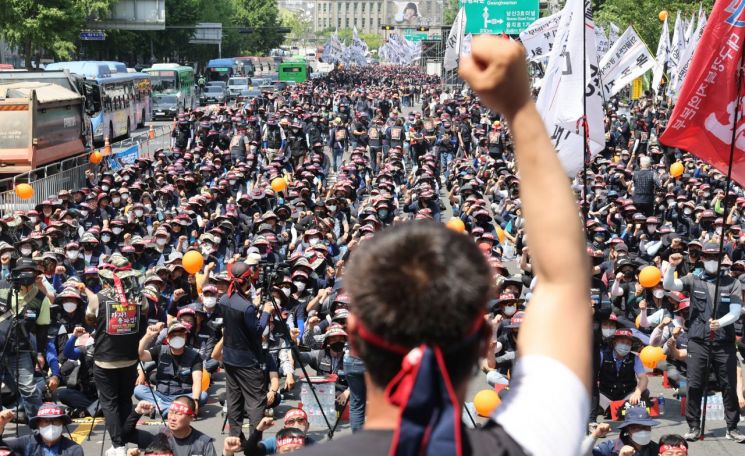
[Asia Economy Reporter Yoo Byung-don] The Cargo Solidarity has announced that it will launch a general strike starting at midnight on the 7th, drawing attention to the new government's response. The government's handling of the first large-scale strike predicted about a month after President Yoon Seok-yeol's inauguration could set the standard for labor-management-government relations over the next five years.
According to the labor sector on the 5th, the Cargo Solidarity Headquarters under the Public Transport Union of the Korean Confederation of Trade Unions (KCTU) has announced an indefinite, full-scale general strike demanding the abolition of the sunset clause on the cargo truck safety freight system, its expansion, and an increase in transportation fees due to high oil prices.
A Cargo Solidarity official explained the reason for the general strike, saying, "Before declaring the general strike, we hoped the government would prepare responsible measures to resolve the situation, but the government has virtually made no effort."
The recent surge in diesel prices is behind Cargo Solidarity's declaration of the general strike.
According to Opinet, the oil price information site of the Korea National Oil Corporation, the nationwide average price of diesel, mainly used for cargo transport vehicles, was 1,213 KRW per liter as of the 3rd, more than 50% higher than a year ago (around 1,300 KRW).
Cargo Solidarity argues that cargo drivers cannot bear the losses caused by rising oil prices and that the safety freight system must be maintained and expanded.
The safety freight system, introduced in 2020 to reduce accidents caused by cargo drivers being forced into overwork or speeding due to low freight rates, is set to expire at the end of this year. If this system is maintained, transportation fees fluctuate in line with fuel costs, so even if oil prices surge as recently, cargo drivers' incomes do not decrease.
If Cargo Solidarity proceeds with the general strike, logistics disruptions are inevitable.
Especially as the prolonged Russia-Ukraine war intensifies the global supply shortage, and domestically, the consumer price inflation rate in May reached 5.4%, the highest in 14 years, the economic situation is unfavorable.
President Yoon has made efforts to broaden contact with the labor sector, but it is true that he has been evaluated as having a strong pro-business stance since his candidacy.
In March this year, economic leaders who met President Yoon, then president-elect, urged that "public authority must be decisively enforced against illegal strikes by labor unions."
Prime Minister Han Duck-soo also ordered strict measures regarding Cargo Solidarity's announcement of collective transport refusal, saying, "It will impose a heavy burden on our economy and people."
The Ministry of Employment and Labor is closely monitoring the situation to prevent the general strike from spreading throughout the labor sector and becoming a source of instability.
A Ministry of Employment and Labor official said, "We will strictly deal with illegal acts that obstruct transportation in cooperation with related agencies such as the Ministry of Land, Infrastructure and Transport and the National Police Agency," adding, "We will observe the progress of the situation and, if necessary, engage in behind-the-scenes contact with the labor sector."
© The Asia Business Daily(www.asiae.co.kr). All rights reserved.
![Clutching a Stolen Dior Bag, Saying "I Hate Being Poor but Real"... The Grotesque Con of a "Human Knockoff" [Slate]](https://cwcontent.asiae.co.kr/asiaresize/183/2026021902243444107_1771435474.jpg)















