Trade Deficit Expected to Narrow Starting in the Second Half of the Year
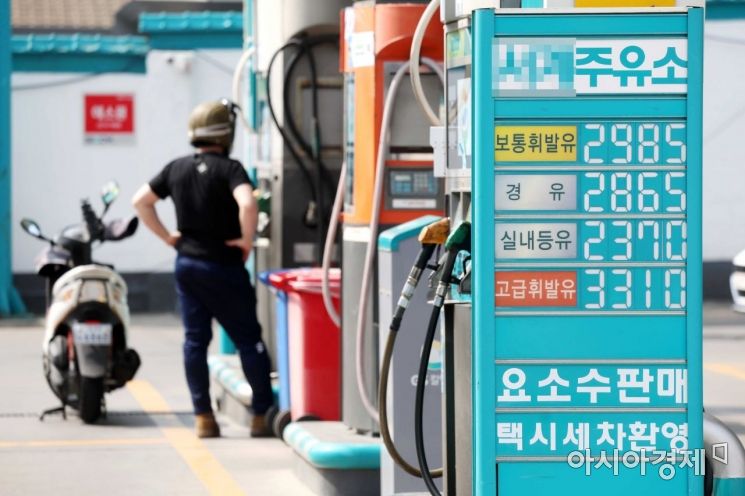 On the 25th, as international oil prices surged sharply, domestic fuel prices for gasoline and diesel continued their upward trend, with fuel price information displayed at a gas station in Seoul. According to the Korea National Oil Corporation's oil price information system, Opinet, the average diesel price at gas stations nationwide recorded 2,000.93 KRW per liter the previous day. This is the first time diesel prices have exceeded 2,000 KRW since nationwide sales price statistics began being compiled in April 2008. Photo by Moon Honam munonam@
[Asia Economy Reporter Kim Jin-ho] An analysis has emerged that the 'international oil price,' recently identified as the main culprit of the inflation crisis, will stabilize soon. Since Russia's invasion of Ukraine, international oil prices have been hitting new highs daily. Additionally, South Korea's trade deficit is also expected to gradually shrink.
According to the report titled ‘Recent Evaluation and Outlook of Trade Balance Deficit’ recently released by the Korea International Trade Association's International Trade and Commerce Research Institute on the 4th, the recent deterioration in the trade balance is a common phenomenon among manufacturing export countries such as Germany, Japan, and China. It is forecasted that from the second half of the year, along with the decline in oil prices, the trade deficit will gradually improve.
First, the report evaluated that the occurrence of a trade deficit despite robust exports, as seen this year, is a very unusual phenomenon. Among the five trade deficits that have occurred since 2000, except for this year, the trade deficits were caused by export declines, such as during the 2008 global financial crisis.
Furthermore, this year's trade deficit phenomenon was explained as a result of a combination of cyclical and structural factors. The cyclical factors include the rising momentum of international raw material prices such as crude oil, copper, and zinc, driven by expectations of economic recovery spreading since last year, and the expanded import demand of domestic manufacturing companies to replenish inventories depleted due to supply chain bottlenecks.
In particular, as structural causes, the report analyzed that the surge in oil prices following the Russia-Ukraine situation and the increase in natural gas imports due to the expansion of eco-friendly and low-carbon demand contributed to the deterioration of the trade balance.
It added that manufacturing countries with a high proportion of intermediate goods imports generally experience significant trade balance deterioration during periods of high oil prices and recover their trade balance during periods of low oil prices. South Korea's proportion of intermediate goods imports accounts for more than half (50.9%) of total imports. Over the past 10 years, South Korea, China, and Japan have repeatedly shown a pattern where their trade balances fluctuate inversely with international oil price changes.
However, despite the recent trade deficit, the current account balance and foreign exchange reserves have been maintaining a stable situation. The current account balance maintained a surplus of $1.9 billion even in January this year when the trade balance recorded a large deficit of $4.74 billion, and the service balance deficit has significantly decreased since 2017, contributing to the current account surplus. The scale of foreign exchange reserves also ranked 8th in the world as of the end of March this year, following Hong Kong.
Hong Ji-sang, a research fellow at the Korea International Trade Association's International Trade and Commerce Research Institute, said, “We expect a gradual decline in oil prices from the second half of the year,” adding, “From June, Saudi Arabia's crude oil will be introduced at a better official selling price, and accordingly, the trade balance is expected to quickly return to normal.”
© The Asia Business Daily(www.asiae.co.kr). All rights reserved.
![Clutching a Stolen Dior Bag, Saying "I Hate Being Poor but Real"... The Grotesque Con of a "Human Knockoff" [Slate]](https://cwcontent.asiae.co.kr/asiaresize/183/2026021902243444107_1771435474.jpg)
















