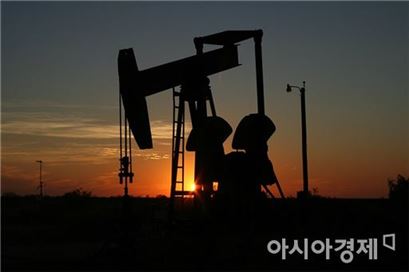
 Oil drilling equipment=Asia Economy DB
[Asia Economy Reporter Hwang Junho] On the 2nd, the OPEC+ meeting, which includes Russia and other oil-producing countries, was held and decided to increase oil production quotas by 648,000 barrels per day for next month and August. The securities industry views this production increase as insufficient to curb soaring international oil prices but places hope on improved relations between the United States and Saudi Arabia.
International oil prices rose to $120 per barrel for West Texas Intermediate (WTI) on the 31st of last month following the European Union (EU) agreement to ban Russian oil imports. However, after news on the 1st that OPEC+ was discussing production increases, prices fell to $113 per barrel and have since hovered around $110 as of the 3rd.
The market reaction to this production increase is divided. One opinion is that the scale of the increase is insufficient to stop rising oil prices. Jaeyoung Oh, a researcher at KB Securities, analyzed, "The additional increase is 200,000 barrels more than the existing 432,000 barrels per day increase," adding, "The additional production volume is significantly below the expected reduction in Russian oil supply."
The prevailing view is that this additional increase refers to an expansion of quotas and will not necessarily translate into actual production increases. Since the Russia-Ukraine war began in March, the gap between quotas and actual production has been widening. Countries that can increase actual production through this quota expansion are Saudi Arabia, UAE, Iraq, and Kuwait, whose quota increases amount to about 100,000 barrels per day. This level is insufficient to lower international oil prices. Especially considering that the peak oil demand season, the driving season (June to August), is underway, opinions that this production increase will have little impact on lowering prices are gaining traction.
However, some see significance in this being the first production increase decision, marking the first step toward improving relations between the United States and Saudi Arabia. Byungjin Hwang, a researcher at NH Investment & Securities, stated, "While Western demands for production increases were partially accepted, the 29th OPEC+ meeting confirmed strong cooperation between Saudi Arabia and Russia," and predicted, "Under the Western sanctions on Russian oil deferred until the end of this year, the accelerated normalization of OPEC+ supply compared to May and June will likely limit the possibility of oil prices exceeding the March peak (over $130 per barrel)."
© The Asia Business Daily(www.asiae.co.kr). All rights reserved.
![Clutching a Stolen Dior Bag, Saying "I Hate Being Poor but Real"... The Grotesque Con of a "Human Knockoff" [Slate]](https://cwcontent.asiae.co.kr/asiaresize/183/2026021902243444107_1771435474.jpg)














