Constitutional Court's 'Yoon Chang-ho Act Unconstitutional' Ruling...Supreme Court Remands Related Case
'High Recidivism Rate of Drunk Driving' Issue...Recidivism Rate Stays Around 44.5% Over 5 Years
Police to Expand Mandatory Education Hours for Habitual Drunk Drivers
Attention on Introduction of Drunk Driving Prevention Devices...Overseas Have Legal Grounds for Operation
 The Constitutional Court ruled the 'Yoon Chang-ho Act' unconstitutional, and the Supreme Court has accepted this decision, overturning and remanding the original trial related to the case. Attention is focused on whether preventive measures such as safeguards will be implemented. The photo is unrelated to any specific expressions in the article.
[Asia Economy Reporter Kim Jung-wan] The Constitutional Court (Constitutional Tribunal) has ruled the so-called 'Yoon Chang-ho Act,' which includes aggravated punishment provisions for refusing a breathalyzer test more than twice, unconstitutional. The Supreme Court has accepted this ruling and announced that it will overturn and remand the related case. Attention is focused on whether preventive measures against drunk driving, which has recorded a high recidivism rate of about 44% over the past five years, will be implemented.
The Supreme Court's 3rd Division (Presiding Justice Noh Jung-hee) overturned the original sentence of four years in prison and sent the case back to the Jeju District Court on the 2nd in the appeal trial of Mr. A, who is charged with violating the Act on the Aggravated Punishment of Specific Crimes (dangerous driving causing death) and other charges. Mr. A is accused of causing an accident while driving in a drunken state in Seogwipo City, Jeju, in January last year and subsequently refusing the police officer's request for a breathalyzer test. Previously, Mr. A had received a summary order for a fine of 2 million won for drunk driving in 2007.
The 'Yoon Chang-ho Act' is a legal provision that imposes aggravated punishment on those who violate drunk driving-related prohibitions two or more times. The Constitutional Court ruled on November 25 last year that the aggravated punishment clause for 'two or more drunk driving offenses' was unconstitutional, and on the 26th of last month, it also ruled unconstitutional the aggravated punishment for cases combining refusal of breathalyzer tests and drunk driving. Accordingly, it has become difficult to impose aggravated punishment on cases where a person who refused a breathalyzer test or committed drunk driving subsequently committed drunk driving or refused a breathalyzer test, causing the 'Yoon Chang-ho Act,' which is the aggravated punishment provision related to drunk driving, to lose its effect.
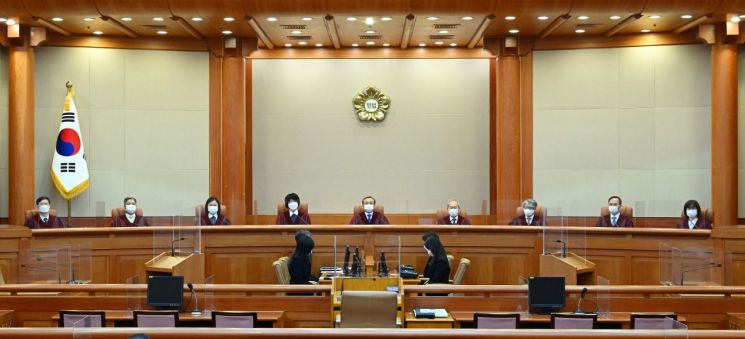 The Constitutional Court ruled on November 25 last year that the aggravated punishment clause for "two or more instances of drunk driving" is unconstitutional. The photo shows Chief Justice Yoo Nam-seok of the Constitutional Court along with other justices entering the courtroom at the Constitutional Court in Jongno-gu, Seoul, and taking their seats. [Photo by Yonhap News]
Initially, the prosecution applied both the Act on the Aggravated Punishment of Specific Crimes and the Yoon Chang-ho Act to Mr. A, and both the first and second trial courts accepted this and sentenced Mr. A to four years in prison. However, due to the Constitutional Court's ruling of unconstitutionality, which made it possible to impose aggravated punishment only on those who repeatedly refused breathalyzer tests two or more times, the Supreme Court concluded that the Yoon Chang-ho Act could not be applied to Mr. A.
However, there are calls for supplementary measures against drunk driving, which has recorded an average recidivism rate of about 44.5% over the past five years among traffic violations. In fact, the total number of drunk driving accident enforcement cases decreased by nearly half from 205,187 cases in 2017 to 115,882 cases in 2021. However, the recidivism rate for drunk driving over the past five years has remained around 44%, with △44.2% in 2017 △44.7% in 2018 △43.7% in 2019 △45.4% in 2020 △44.8% in 2021.
Accordingly, the police have decided to expand the mandatory education hours for habitual drunk drivers. The National Police Agency and the Korea Road Traffic Authority announced on the 30th of last month that, starting July 1, they will implement an up to threefold increase in mandatory drunk driving education hours in accordance with the revised Road Traffic Act Enforcement Decree. The mandatory education targets are those who have had their driver's licenses suspended or revoked within the last five years, and the education hours will increase as follows: △6 hours to 12 hours for first-time offenders △8 hours to 16 hours for second-time offenders △16 hours to 48 hours for third-time offenders.
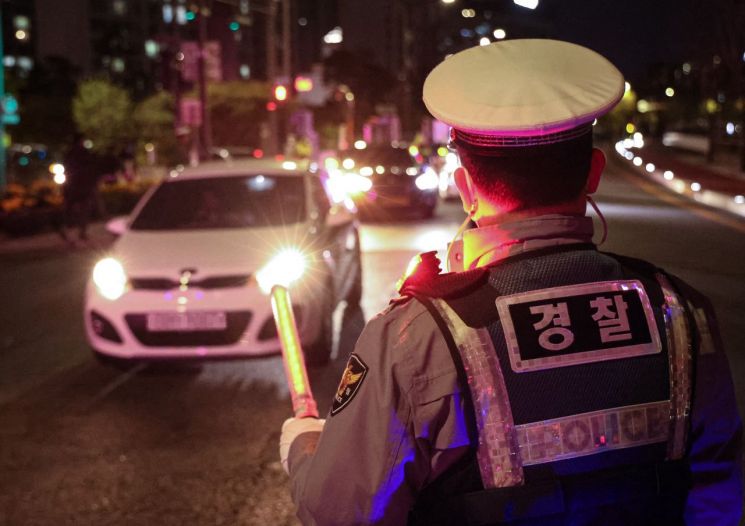 Starting from July, the mandatory education hours for habitual drunk drivers will be expanded up to three times the current duration, drawing attention to the potential introduction of preventive measures such as drunk driving prevention devices.
 [Image source=Yonhap News]
Attention is also focused on whether preventive devices against drunk driving, a preemptive measure, will be introduced. Earlier, the Constitutional Court mentioned the introduction of preventive devices against drunk driving as a preemptive measure along with post-treatment, stating that "uniformly imposing aggravated punishment on relatively minor types of drunk driving or refusal to take a test without sufficient consideration of non-punitive measures such as alcohol treatment or the introduction of drunk driving prevention devices exceeds the original function of punishment." Therefore, it is expected that discussions will continue on the 'mandatory installation of prevention devices' that prevent intoxicated individuals from taking the wheel from the outset.
Meanwhile, countries such as the United States have established legal grounds for operating alcohol ignition interlock devices. The alcohol ignition interlock device, first introduced in the United States in 1986 as part of drunk driver management measures, has since expanded to Canada, Australia, and recently to Europe through legal amendments for installation and operation.
In the United States, drivers whose licenses have been revoked due to drunk driving are required to install alcohol ignition interlock devices that prevent the vehicle from starting if the blood alcohol concentration exceeds a certain level when they reacquire their driver's licenses. In Europe, voluntary participation is encouraged by reducing the period required to reacquire a driver's license if an alcohol ignition interlock device is installed.
South Korea has yet to pass related legislation and is currently unable even to conduct pilot operations. Currently, the National Assembly's Administrative Safety Committee has pending bills, including amendments to the Road Traffic Act that maintain aggravated punishment for drunk driving while specifying a 10-year period for recognizing drunk driving recidivism to eliminate constitutional issues, and amendments requiring the installation of ignition interlock devices on vehicles of habitual drunk drivers.
© The Asia Business Daily(www.asiae.co.kr). All rights reserved.
![Clutching a Stolen Dior Bag, Saying "I Hate Being Poor but Real"... The Grotesque Con of a "Human Knockoff" [Slate]](https://cwcontent.asiae.co.kr/asiaresize/183/2026021902243444107_1771435474.jpg)


















