Miryang Wildfire Uncontrolled for Over 48 Hours... Dozens of Helicopters and Over 2,000 Firefighters Deployed
March Uljin Wildfire Lasted Record 213 Hours
Damage Area Equivalent to About 30,000 Soccer Fields
Number of Wildfires This Year Already Exceeds Last Year... Damage Area 30 Times Larger
Dry Weather and Wind Cited as Causes
Korea Forest Service Plans to Reinforce Equipment and Personnel
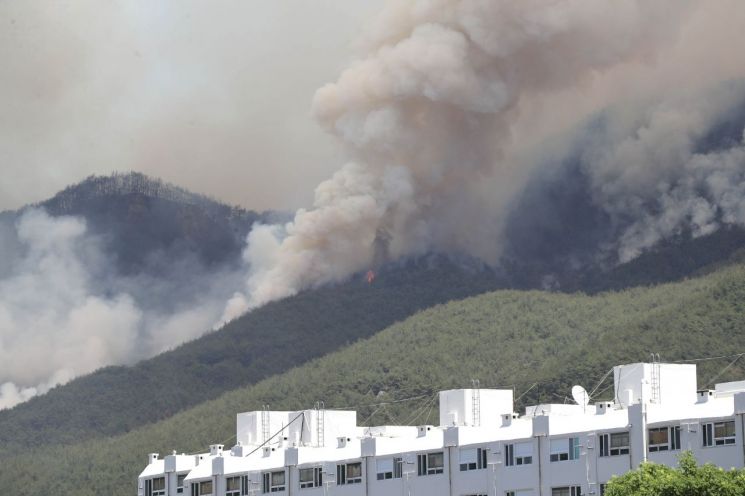 A wildfire that broke out on the afternoon of the 31st of last month in Chunhwa-ri, Bubuk-myeon, Miryang-si, Gyeongnam, is spreading with the wind.
 [Image source=Yonhap News]
[Asia Economy Reporter Kang Woo-seok] This year, large-scale wildfires have been relentlessly engulfing forests one after another. As a result, severe damage to nearby residents and the environment has drawn attention to future wildfire aftermath measures and prevention strategies.
As of the morning of the 31st of last month, firefighting efforts for the wildfire that broke out in Bubuk-myeon, Miryang-si, Gyeongnam, have continued for four days, and the flames are expected to be contained by this morning. On the 3rd, the Korea Forest Service announced that after deploying about 1,300 personnel from special firefighting teams and aerial firefighting units during the previous night's operations, the containment rate was raised to 92%.
The wildfire-affected area (impact zone) is 752 hectares, with remaining fire lines stretching 1.2 kilometers. This area is equivalent to more than 1,000 soccer fields. Thanks to the evacuation of residents around the wildfire site, there have been no casualties or damage to facilities so far.
The cause of this wildfire has not yet been identified, but it is believed to be a man-made fire caused by individual negligence. Nam Sung-hyun, head of the Korea Forest Service, stated at a briefing at the Miryang wildfire site on the 31st of last month, "Although the investigation is ongoing, natural ignition is almost nonexistent in our country," adding, "Most wildfires are caused by human negligence."
In March, a wildfire occurred in Uljin, Gyeongbuk, resulting in the longest firefighting duration since the Korea Forest Service began compiling related statistics in 1986, lasting 213 hours without containment. Previously, the longest wildfire was recorded in 2000 on the East Coast of Gangwon, lasting 191 hours.
This wildfire gradually spread over time, extending to Samcheok in Gangwon, ultimately damaging approximately 18,000 hectares in the Uljin area and about 2,500 hectares in the Samcheok area. This size is equivalent to about 30,000 soccer fields.
Another wildfire broke out in Uljin on the 28th of last month. This fire was extinguished in about 23 hours, leaving a damage area of approximately 145 hectares.
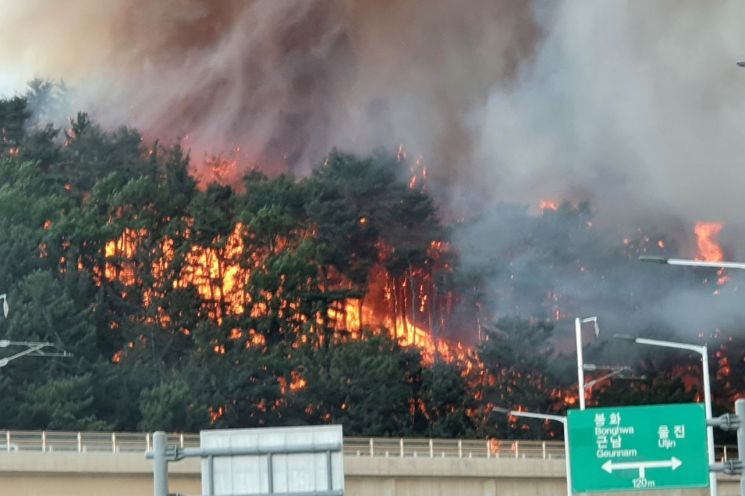 A fire is spreading around the area at the wildfire site in Uljin, Gyeongbuk. [Image source=Yonhap News]
Recently, large-scale wildfires causing severe damage have occurred consecutively. According to the Korea Forest Service, a total of 586 wildfires, both large and small, have occurred this year, already surpassing last year's wildfire count (349) even though only half of the year has passed. The damaged area also reached 23,918.07 hectares, about 30 times last year's damage area (766 hectares). Compared to 2019, the year with the largest wildfire damage area in the past decade (3,255 hectares), this is about seven times larger.
The frequent occurrence of wildfires this year is attributed to continued dry weather. According to the Korea Meteorological Administration, the nationwide average precipitation in May was 5.8 mm, only 6.1% of the 30-year average (101.7 mm). The six-month precipitation from last November to last month was 225 mm, about 58.6% of the 30-year average (385.9 mm). Severe drought conditions persist.
In particular, the influence of wind is considered the biggest factor in the occurrence of large-scale wildfires. A wildfire prevention official from the Korea Forest Service explained in a phone interview with Asia Economy, "Strong winds have the greatest impact on wildfires becoming large-scale. The recent large wildfires occurred in the East Coast areas of Gangwon and Gyeongbuk, where winds are very strong in spring," adding, "If there is no wind, immediate measures can be taken using helicopters, but when the wind is strong, the situation changes, making it difficult to respond."
The abundance of flammable materials in forests is also cited as a reason. The official said, "Since the war, Korea has done well in reforestation, so the forests are dense with trees. Consequently, there is a lot of fallen leaves, which means a large accumulation of combustible materials in the forest," adding, "Naturally, this increases the likelihood of large fires."
Currently, the Korea Forest Service is taking measures to prepare for wildfires, including setting wildfire caution periods during high-risk times, conducting wildfire prevention campaigns through public service advertisements and social network services (SNS), providing wildfire prevention guidance via rural village broadcasts and community meetings, deploying wildfire surveillance drones and personnel, and pre-positioning response personnel in high-risk areas.
Considering the recent simultaneous outbreaks of large wildfires, the Korea Forest Service plans to further reinforce firefighting equipment and personnel. An official stated, "To prepare for such (large wildfire) situations in the future, we plan to recruit and supplement equipment such as helicopters and drones, as well as special firefighting personnel to enhance response capabilities," adding, "Discussions regarding related ministries and budgets are currently underway."
© The Asia Business Daily(www.asiae.co.kr). All rights reserved.
![Clutching a Stolen Dior Bag, Saying "I Hate Being Poor but Real"... The Grotesque Con of a "Human Knockoff" [Slate]](https://cwcontent.asiae.co.kr/asiaresize/183/2026021902243444107_1771435474.jpg)
















