Massive Disposal of Election Flyers and Banners Each Election
Banners Mainly Made of Synthetic Fibers Have Low Recycling Rates, Causing Headaches
"Is It Necessary to Spend Tax Money... Should Be Replaced If Alternatives Exist," Voters Point Out
Recycled Paper and Online Alternatives Bill Pending in Parliament
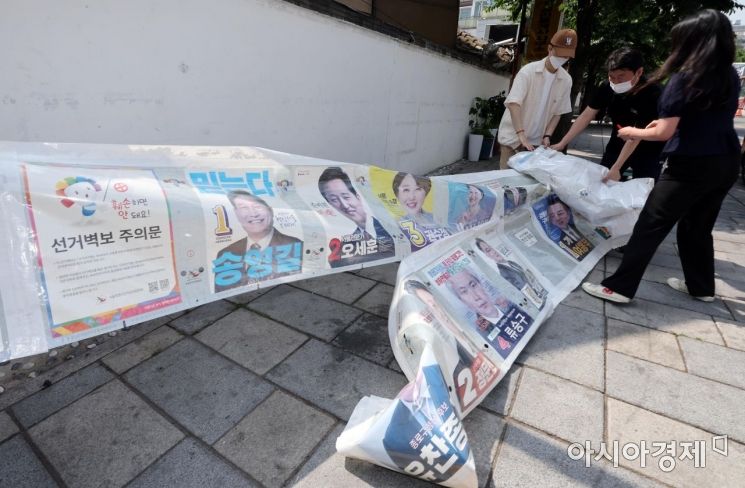 On the 2nd, the day after the 8th nationwide local elections, public officials from the community center are removing election posters on the streets of Sajik-dong, Jongno-gu, Seoul. Photo by Hyunmin Kim kimhyun81@
[Asia Economy Reporter Kim Jung-wan] As the counting of the 8th nationwide simultaneous local elections has concluded, the disposal of the massive amounts of promotional banners and campaign materials used during the campaign period remains an issue. Every election generates so-called 'election waste' in large quantities, but recycling rates are limited, prompting calls for discussions on related legislation. Among voters, there are also criticisms that the actual promotional effect felt is minimal compared to the volume of campaign materials and banners.
According to the 'Numbers on the 8th Nationwide Simultaneous Local Elections' recently released by the National Election Commission (NEC), this local election alone produced approximately 790,000 election posters, 580 million campaign materials, and about 128,000 banners.
If about 790,000 election posters were gathered together, they would cover 159,710㎡, which is six times the size of Jamsil Baseball Stadium. Collecting about 580 million campaign materials would fill an area estimated at 29㎢, ten times the size of Yeouido. The amount of paper used for printing election campaign materials and posters reached 11,953 tons. Since producing one ton of paper requires 17 trees aged 30 years, this local election consumed approximately 210,000 trees aged 30 years.
Also, if 10-meter-long campaign banners were lined up end to end, they would stretch 1,281 km, a distance that can reach from Seoul to Tokyo. Particularly, banners made mainly of polyester (PE), a plastic synthetic fiber, are considered more problematic due to their low recycling rates. In fact, the recycling rate of banners generated during the 2018 local elections (9,220 tons) was only 33%, and during the 2020 general elections, the recycling rate remained at about 23.5%.
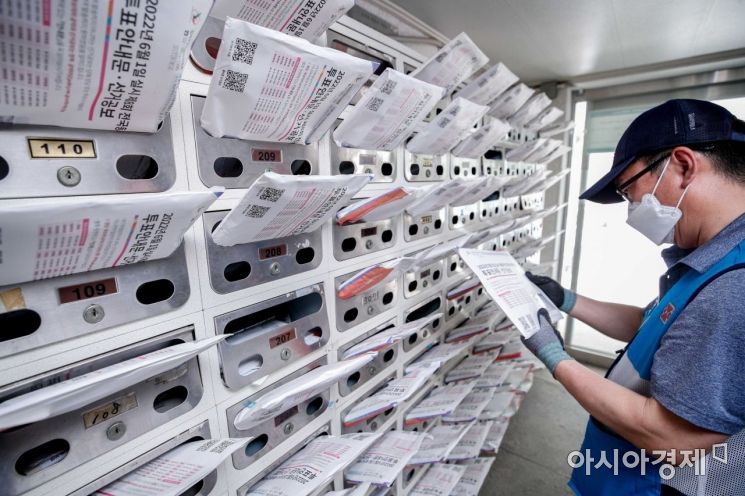 On the 22nd of last month, ten days before the June 1 local elections, a postal worker was delivering voting information and election brochures at an apartment complex in Gangseo-gu, Seoul. Photo by Jinhyung Kang aymsdream@
Controversy over 'election waste,' which is used once and discarded, has continued with every election. According to environmental groups such as the Green Korea United, the number of banners used in the 20th presidential election reached 105,090, and the amount of greenhouse gases (CO2e) emitted due to promotional materials is estimated at 7,312 tons. Additionally, during the 2018 local elections, the paper used for ballots, campaign materials, and posters amounted to 14,728 tons, and the greenhouse gas emissions from promotional materials were analyzed to be 20,772 tons.
Among voters, there are also criticisms that the actual promotional effect felt is not commensurate with the volume of mass-produced campaign materials and banners. Kim (27), a resident of Seongbuk-gu, Seoul, said, "When the banners cover the way to work, I used to feel that the election was approaching, but recently I feel that it only serves that limited role." He added, "Banners are posted nationwide, but what voters can grasp from them is limited. I don't feel there is a real promotional effect compared to the costs involved."
Complaints were also detected regarding the inclusion of printing costs and banner posting fees in election campaign expense reimbursements. Park (53), an office worker, said, "They write just one line besides the party, name, and face on the banners. When I think that these are made with taxes, I wonder if they are really necessary." He emphasized, "I hope that replaceable items are changed, and only essential items are included in the election expenses to be supported." When a candidate or party obtains 10-15% of the vote share in an election, the state reimburses half of the election expenses; if over 15%, the full amount is reimbursed. The reimbursement includes costs for campaign materials, business cards, and banners, effectively meaning that election promotional materials are produced with taxpayers' money.
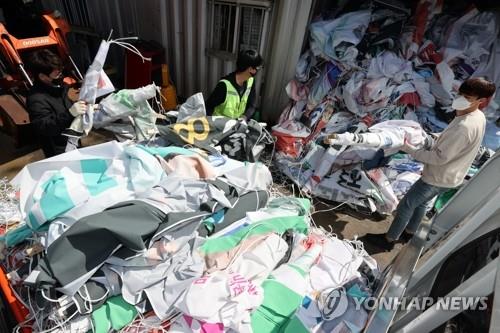 Election campaign material waste generated during the election campaign period of the April 7 by-election last year. [Image source=Yonhap News]
As a result, environmental groups have consistently pointed out the issue of election waste. On the 18th of last month, Green Korea United issued a statement saying, "Although the problem of election promotional materials remaining as waste for decades has been pointed out, it has not been improved, and tax money is used for these items every election season," emphasizing, "Tax money should no longer be wasted on paper campaign materials that are discarded without being opened and on election banners that exacerbate plastic pollution."
© The Asia Business Daily(www.asiae.co.kr). All rights reserved.
![Clutching a Stolen Dior Bag, Saying "I Hate Being Poor but Real"... The Grotesque Con of a "Human Knockoff" [Slate]](https://cwcontent.asiae.co.kr/asiaresize/183/2026021902243444107_1771435474.jpg)

















