The First Ever 4-Term Seoul Mayor's Promises and Challenges
Selective Basic Income Pilot Project Begins Supportee Selection Process... 'Seoul Run' Also Expanded in Cooperation with Private Sector
Rental Housing Focused on Quantity to Be Supplied with Improved Quality at Private Sector Level
Conflicts with Civic Groups and Metropolitan Landfill Issues Remain Challenges to Address
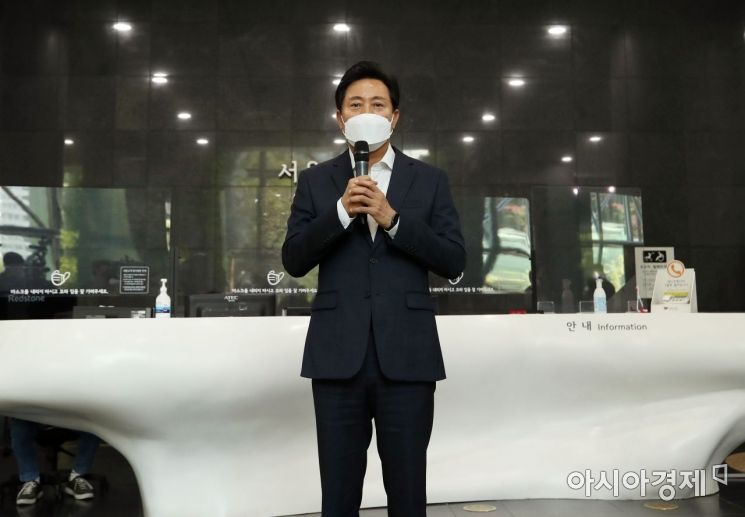 On the 2nd, Mayor Oh Se-hoon, who was elected as the Seoul mayor for the fourth term, expressed his election sentiments while arriving at the city hall main building. Photo by Moon Ho-nam munonam@
[Asia Economy Reporter Lim Cheol-young] "I sincerely pledge once again to keep each and every promise made during the campaign."
On the 2nd, Oh Se-hoon, who became the four-term mayor of Seoul, went to Seoul City Hall and said this to the staff. Since the 38th mayoral term ends this month, Oh is currently the mayor-elect of the 39th term as well as the incumbent mayor. The 39th term will begin in July. Oh placed the focus of his fourth term administration on "walking together with the vulnerable." He plans to prioritize four major policies for the vulnerable, reorganizing the policies promised during last year's by-election. In an interview immediately after his election, Oh said, "Over the next four years, various new policies aimed at supporting socially disadvantaged groups in the four major areas of livelihood, housing, education, and healthcare will be introduced," adding, "I will personally lead the four major vulnerable group policies to ensure smooth progress."
Some policies have already begun laying the groundwork. The selective "Safe Income" policy, which provides more support to low-income households, has started the process of selecting 500 households to receive Safe Income support for three years. To supplement weaknesses in public education, "Seoul Learn," which offers unlimited online lectures to low-income students, is being gradually expanded in cooperation with private companies. The Seoul-style high-quality rental housing supply policy, introduced with the aim of "creating rental housing where anyone can live with pride," focuses on improving the quality of rental housing, which had previously emphasized quantity, to the level of private sale apartments. The plan includes expanding the residential area by 1.5 times and increasing the proportion of medium-sized units over 60㎡ suitable for families of 3 to 4 members from 8% to 30%.
The pledge to strengthen public healthcare services emphasized the "vulnerable" to enhance policy clarity. Under the banner of "Seoul, a Special City for Health Protected by Public Healthcare," Oh plans to ▲ secure additional beds in municipal hospitals and eliminate medical blind spots in Seoul's regions ▲ build a "Seoul-style public hospital" comprehensive hospital in the southeastern area ▲ strengthen the comprehensive hospital functions of Seonam Hospital ▲ modernize Eunpyeong Hospital ▲ specialize the functions of the northwest, northern, and northeastern hospitals ▲ establish the Seoul Crisis Response Medical Center. The goal is to create an environment where vulnerable groups can receive medical services without burden during normal times and to build a system capable of rapid response in emergencies like COVID-19.
Various youth policies will also be expanded and strengthened. Oh plans to implement 12 policies across five major areas: ▲ building resumes ▲ asset formation ▲ easing housing burdens ▲ boosting confidence ▲ preparing for marriage. The previously announced Youth Employment Academy will be expanded to all 25 autonomous districts, and startup valleys linked with universities will be fostered. The "Hope Double Youth Account," which supports asset formation, will be expanded, and Oh will also engage in the creation of "2030 Smart Homes," part of the youth housing project near subway stations.
Last year's "Seoul Vision 2030," which aims to elevate Seoul to one of the world's top five leading cities, will also be gradually concretized. Oh plans to actively promote the expansion and reorganization of the Seoul Investment Agency, the establishment of a global beauty industry, including plans to develop Seoul as an Asian financial hub. Additionally, he intends to fulfill promises to create forest and water zones throughout Seoul, establishing green networks across the city, and accelerate projects to underground major roads and above-ground railways.
There are also many challenges to address. Since returning as mayor through the by-election, Oh has faced conflicts with civic groups that have consistently opposed him, and he must resolve the astronomical debt problem of Seoul Transportation Corporation, which has worsened after COVID-19. The issue of the metropolitan landfill site remains contentious, with little progress in narrowing differences with local governments such as Incheon and Gyeonggi Province, and conflicts over the termination date are likely to continue. In particular, during the election, Oh stated his position to "use the landfill until it reaches saturation as agreed in 2015," which could further intensify conflicts.
© The Asia Business Daily(www.asiae.co.kr). All rights reserved.
![Clutching a Stolen Dior Bag, Saying "I Hate Being Poor but Real"... The Grotesque Con of a "Human Knockoff" [Slate]](https://cwcontent.asiae.co.kr/asiaresize/183/2026021902243444107_1771435474.jpg)
















