KDCA Issues Infectious Disease Alert Level 'Interest'...To Be Raised to 'Caution' if Cases Occur
Low Likelihood of General Public Infection but Isolation Required...Over 550 Confirmed Cases in More Than 30 Countries
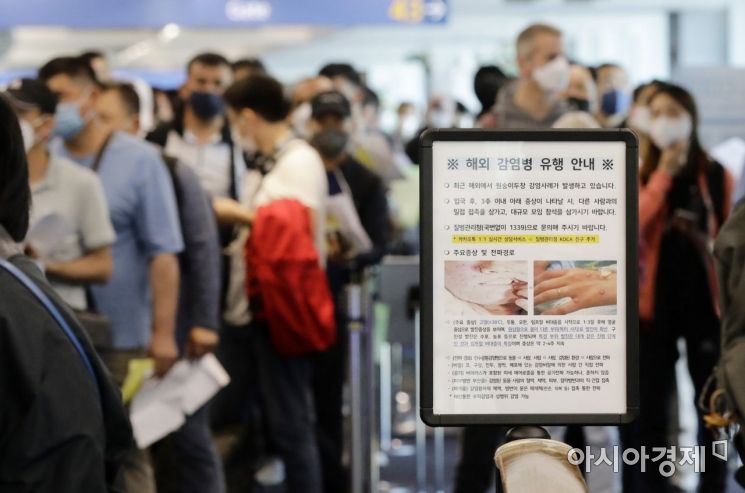 On the 27th of last month, passengers arriving on a flight from Europe at Incheon International Airport Terminal 1 are waiting to undergo quarantine for overseas infectious diseases such as monkeypox. Photo by Mun Ho-nam munonam@
[Asia Economy Reporter Jo In-kyung] As the quarantine authorities have decided to designate 'monkeypox' as a Class 2 notifiable infectious disease, it will henceforth be subject to the same management system as COVID-19, measles, and others.
The Korea Disease Control and Prevention Agency (KDCA) issued an infectious disease crisis alert at the 'interest' level last month on the 31st regarding monkeypox, which has been rapidly confirmed in countries worldwide. While assessing the impact of the monkeypox disease itself as low, considering the possibility of domestic inflow due to increased overseas arrivals, the risk level for high-risk groups was evaluated as 'medium' and for the general public as 'low.'
The infectious disease crisis alert is divided into four stages: interest → caution → warning → severe. 'Interest' is a measure issued during the 'occurrence and spread' of a new infectious disease overseas. The KDCA plans to raise the crisis alert level from 'interest' to 'caution' if confirmed cases of monkeypox occur domestically.
Along with this, the quarantine authorities will designate monkeypox as a Class 2 infectious disease but will announce it as a 'new infectious disease syndrome' until the official revision of the designation notice, taking proactive measures such as suspected patient reporting, epidemiological investigation, designation of treatment institutions, and isolation response. The new infectious disease syndrome can be designated and announced by the KDCA director in consultation with the Ministry of Health and Welfare without revising the notice.
The KDCA explained, "This is to enable rapid initial measures, including isolation, if monkeypox enters the country before being designated as a Class 2 infectious disease."
Once designated as a notifiable infectious disease, obligations such as reporting confirmed cases arise under the 'Infectious Disease Prevention and Control Act.' Considering the administrative procedures involved, the official revision to designate monkeypox as a Class 2 notifiable infectious disease is expected to be possible around late next week.
Class 2 infectious diseases require isolation considering the possibility of transmission. Currently, 22 types are designated, including COVID-19, tuberculosis, chickenpox, measles, cholera, typhoid fever, paratyphoid fever, bacillary dysentery, enterohemorrhagic Escherichia coli infection, hepatitis A, pertussis, mumps, polio, meningococcal infection, pneumococcal infection, Hansen's disease, scarlet fever, rubella, etc. Medical institutions must report confirmed cases of Class 2 infectious diseases to quarantine authorities within 24 hours. Previously, COVID-19 was managed as a Class 1 infectious disease but was downgraded to Class 2 from April 25.
Unlike Class 2 infectious diseases, Class 1 infectious diseases must be reported immediately upon occurrence or outbreak and require a high level of isolation such as negative pressure isolation. Ebola virus disease, smallpox, plague, anthrax, SARS, MERS, and novel influenza are Class 1 infectious diseases.
A KDCA official explained, "Considering the severity and impact, monkeypox is not an infectious disease to be designated as Class 1, but since isolation is necessary, we are promoting its designation as Class 2."
According to the World Health Organization (WHO), as of the 1st (local time), more than 550 cases of monkeypox infection have been confirmed in over 30 non-endemic countries.
© The Asia Business Daily(www.asiae.co.kr). All rights reserved.
![Clutching a Stolen Dior Bag, Saying "I Hate Being Poor but Real"... The Grotesque Con of a "Human Knockoff" [Slate]](https://cwcontent.asiae.co.kr/asiaresize/183/2026021902243444107_1771435474.jpg)
















