Quiet Island Boy's School Days: The '5·18 Uprising' as a Turning Point in Life
17th, 18th, and 19th National Assembly Member... 1 Year and 8 Months as the Longest-Serving Senior Secretary for Political Affairs at the Blue House
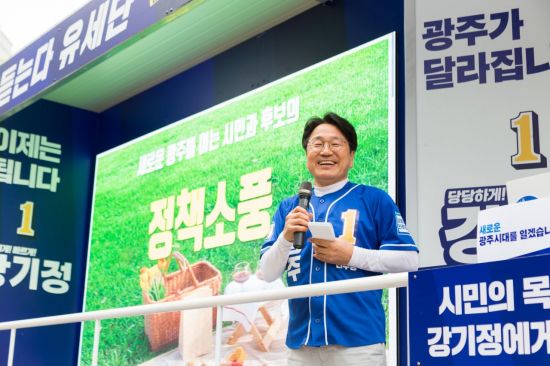
[Asia Economy Honam Reporting Headquarters Reporter Yoon Jamin] In the 8th nationwide simultaneous local elections for the mayor of Gwangju Metropolitan City, candidate Kang Ki-jung of the Democratic Party of Korea is shown to be leading by a large margin.
According to the exit poll announced at 7:30 p.m. on the voting day, the 1st, by the three terrestrial broadcasters (KBS, MBC, SBS), candidate Kang (77.4%) is predicted to be ahead of candidate Ju Ki-hwan of the People Power Party (15.4%) by 62 percentage points.
Candidate Kang was born in 1964 as the youngest of eight siblings in Geumsan, Goheung, Jeonnam, and graduated from Daedong High School and Chonnam National University.
The quiet and shy island boy in his childhood began to walk a slightly different path after encountering the May 18 Democratic Movement in 1980 when he was a high school sophomore.
In particular, after entering university, he changed his quiet personality by joining the Social Research Association, where he faced the news of the death of martyr Park Kwan-hyun, marking a major turning point in his life.
He lived through a period of resistance shouting for democratization, served as the chairman of the Sammin Movement Committee in 1985, fought against the Chun Doo-hwan regime, was sentenced to eight years in prison, and served three years and seven months behind bars.
Afterwards, he devoted himself to youth and dissident movements and then entered institutional politics to change citizens' lives.
He tasted defeat twice (in the 2000 16th National Assembly election and the 2002 by-election) but was elected at the young age of 39 in the 2004 17th National Assembly election.
He then served three terms as a member of the National Assembly for Buk-gu Gap, Gwangju, during the 18th and 19th sessions. He was also called a representative filial son of Korea for creating laws such as the Basic Old-age Pension Act and the Long-term Care Insurance Act for the Elderly.
In the 2016 general election, he faced a setback when he was excluded from the Democratic Party's nomination to ease the anti-Moon Jae-in sentiment at the time. After leaving the Democratic Party, he was urged several times to run but walked the path of principle and conviction by staying with the Democratic Party until the end.
He later studied the Fourth Industrial Revolution and other topics during his studies in Germany, marking a policy turning point.
During the early presidential election held amid the impeachment crisis in 2017, he served as the chief senior director of the Moon Jae-in candidate's election campaign headquarters, planning Honam pledges such as AI (artificial intelligence), Korea Electric Power Corporation University, and the Moonlight Inland Railroad. Afterwards, he launched the think tank ‘The Cube’ and began proposing policies specialized in Gwangju’s economy and industry sectors.
In 2019, he was appointed as the senior secretary for political affairs at the Blue House under President Moon Jae-in, serving as the longest-serving senior secretary for political affairs for 1 year and 8 months since the participatory government.
His greatest strengths are his fast execution ability based on his political experience as a three-term National Assembly member and his national governance experience gained while closely assisting President Moon Jae-in, as well as his extensive personal network crossing party lines.
Before this election, candidate Kang presented five major pledges.
He proposed ▲ five major full-day care guarantees by life cycle ▲ introduction of three public value allowances (housework, farmers, participation) ▲ sports health city ▲ a city where citizens’ daily lives become festivals and arts ▲ climate action and healthy city Gwangju.
The ‘five major full-day care guarantees by life cycle’ focus on establishing a five major care guarantee system by life cycle stages including infants, children and adolescents, the elderly, the disabled, and patients. It aims to strengthen a social safety net where both parents and children can be worry-free by creating a customized care environment involving schools and local communities.
The ‘introduction of three public value allowances (housework, farmers, participation)’ aims to create a social environment that respects the value of housework and revitalizes the local economy by guaranteeing the public value of agriculture and rural areas and creating a sustainable agricultural environment. It also promises to pay participation allowances to citizens engaged in various social value activities such as village care and climate environment activities.
The ‘sports health city’ pledge promises to build a sports health city that participates 365 days a year from recreational sports to elite sports and strengthen various health and sports infrastructure and programs to guarantee citizens’ health rights.
By building a ‘city where citizens’ daily lives become festivals and arts,’ it aims to expand citizens’ opportunities to enjoy culture and arts, strengthen support systems for cultural artists, and enhance the status of Gwangju as an Asian cultural hub through cooperation with the Asia Culture Center.
Lastly, ‘climate action and healthy city Gwangju’ involves promoting practical greenhouse gas reduction projects to achieve carbon neutrality by 2045, strengthening a just climate action system that leaves no one behind, and establishing a resilient city system safe from climate disasters.
In addition, he proposed five major vitality special zones as pledges: Yeongsan River Exciting Belt, Songjeong Station Vitality Belt, Gwangju Station Startup Belt, Hyochon Station Digital Content Belt, and Gwangju Stream Family Belt.
© The Asia Business Daily(www.asiae.co.kr). All rights reserved.
![Clutching a Stolen Dior Bag, Saying "I Hate Being Poor but Real"... The Grotesque Con of a "Human Knockoff" [Slate]](https://cwcontent.asiae.co.kr/asiaresize/183/2026021902243444107_1771435474.jpg)















