EU Agrees on Ban of Russian Maritime Oil Imports
Shanghai Lockdown Lifted with Economic Stimulus Announced
"Supply Contraction and Demand Expansion Overlap... February Price Surge Expected Again"
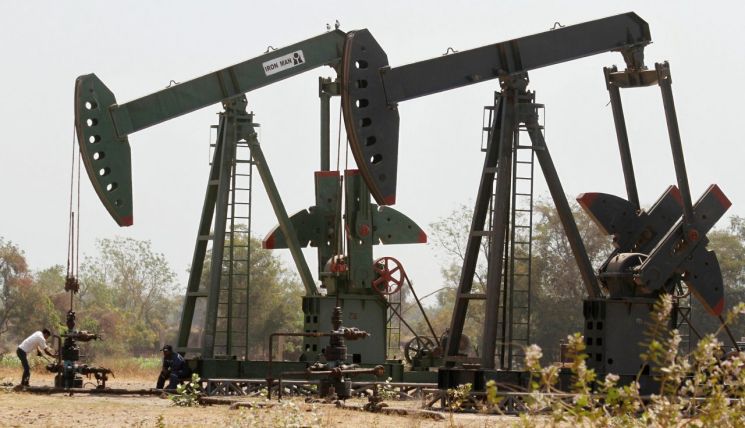
[Asia Economy Reporters Hyunwoo Lee and Hyunjung Kim] International oil prices have once again surpassed $120 per barrel since March, buoyed by the European Union's (EU) agreement on a partial embargo on Russian oil and China's announcement of easing lockdown measures. The combination of tightened European sanctions on Russia leading to supply constraints and increased demand from China, along with the seasonal rise in cooling demand as summer approaches, is intensifying upward pressure on global oil prices.
On the 30th (local time), Brent crude oil from the North Sea rose 1.88% from the previous day to $121.67 per barrel on the London ICE Futures Exchange. This is the first time Brent crude has exceeded the $120 mark since March 8. The West Texas Intermediate (WTI), a major international oil benchmark alongside Brent, was closed in observance of Memorial Day, a U.S. holiday.
The main driver of the price increase was the EU's agreement on a partial embargo on Russian oil. According to CNN, at the EU summit held in Brussels, Belgium, the EU agreed to ban maritime imports of Russian oil entering Europe.
Charles Michel, President of the European Council, tweeted immediately after the summit, "This agreement will allow us to ban two-thirds of Russian crude oil imports," adding, "It will restrict a huge source of funding for Russia's military expenses."
According to Eurostat, the EU's statistical office, about 65% of Russian oil imports to the EU are transported by sea. However, the remaining 35% of pipeline-imported oil, which was not included in the embargo agreement, will continue to be imported as before.
The failure to reach an agreement on pipeline sanctions is reportedly due to opposition from Eastern European countries led by Hungary. CNN reports that Hungary imports 86% of its oil through pipelines connected to Russia. The Czech Republic (97%) and Slovakia (100%) have even higher proportions.
At the summit, Hungarian Prime Minister Viktor Orb?n strongly opposed a complete embargo on Russian oil, citing his country's heavy dependence on Russian energy. The EU reportedly could not even set a grace period for pipeline sanctions in order to reach a partial embargo agreement.
However, the European Commission has indicated that it will increase the proportion of Russian oil subject to sanctions in the future, suggesting that sanctions will be gradually strengthened. Ursula von der Leyen, President of the European Commission, tweeted, "By the end of the year, we will reduce about 90% of oil imports from Russia to the EU," signaling an expansion of the embargo.
China's announcement of easing COVID-19 lockdowns and economic stimulus measures, as a major oil consumer, further fueled the rise in oil prices. The Shanghai municipal government announced the day before that from midnight on the 1st of next month, except for areas designated as high or medium risk or under control or management, full normalization will be pursued sequentially. This marks the lifting of lockdown measures after more than two months since March 28.
Along with lifting lockdowns, Shanghai also announced an economic stimulus package worth 300 billion yuan (approximately 56 trillion won), including 50 support measures. These measures are expected to expand oil consumption centered around Shanghai, China's economic capital.
Jeffrey Halley, senior analyst at energy investment firm Oanda, told The Guardian, "With supply set to tighten due to the EU's oil embargo, consumption will significantly increase as Shanghai eases lockdowns," and predicted, "International oil prices are expected to surge similarly to the early days of the Ukraine war in February."
Paul Horsnell, head of commodity research at Standard Chartered, diagnosed that China's oil demand decreased by about 1.2 million barrels per day in May due to COVID-19, and expects that most of this demand will recover as lockdowns ease, pushing daily consumption close to 16 million barrels. This accounts for a significant portion of the global daily consumption of approximately 100 million barrels.
© The Asia Business Daily(www.asiae.co.kr). All rights reserved.
![Clutching a Stolen Dior Bag, Saying "I Hate Being Poor but Real"... The Grotesque Con of a "Human Knockoff" [Slate]](https://cwcontent.asiae.co.kr/asiaresize/183/2026021902243444107_1771435474.jpg)















