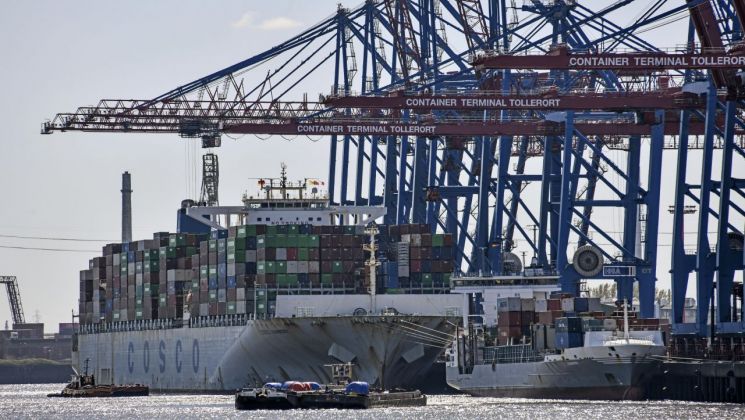
[Asia Economy Reporter Jeong Hyunjin] The logistics crisis that began with COVID-19 shows no signs of being resolved. Ahead of June, the typical peak season for logistics, difficulties are being encountered from securing containers to finding means to transport them at ports, causing ongoing supply chain disruptions, the Wall Street Journal (WSJ) reported on the 30th (local time).
Generally, the peak logistics season starts from late June, ahead of the second half of the year which includes school openings and year-end holidays. WSJ reported that logistics difficulties began early this year as companies that experienced supply shortages last year started placing orders from mid-May.
Gene Geroka, director of the Port of Los Angeles (LA), said, "Importers are not only bringing logistics on time but are also bringing goods in advance as a precaution, resulting in more boxes piling up at the port." He noted that with Shanghai, China lifting COVID-19 lockdown measures after about two months, more goods are expected to be handled.
Shipping operators and brokers counted that the number of available containers early this year was about 50.5 million, an increase of more than 8 million compared to before the pandemic.
As the COVID-19 situation gradually subsides, WSJ reported that demand for Asian product imports by U.S. retailers such as Walmart and Amazon has surged. Normally, it took about 45 days for products to be transported from China to the U.S., but now it reportedly takes over 100 days.
Rasmus Jensen, CEO of Danish consulting firm Vespucci Maritime, said, "At the export port Shanghai, ships are staying longer to load cargo, and at the import port LA, ships are anchored because there is nowhere to unload containers," adding, "Although many containers have been added, it could not solve the slow operation of the supply chain."
© The Asia Business Daily(www.asiae.co.kr). All rights reserved.
![Clutching a Stolen Dior Bag, Saying "I Hate Being Poor but Real"... The Grotesque Con of a "Human Knockoff" [Slate]](https://cwcontent.asiae.co.kr/asiaresize/183/2026021902243444107_1771435474.jpg)
















