[Asia Economy Reporter Jeong Hyunjin] As daily life, which was disrupted by COVID-19 in South Korea, is rapidly recovering, concerns are emerging that the fight against COVID-19 is not over yet, as the Omicron variant is resurging overseas, especially in the United States.
According to the Washington Post (WP) and others on the 29th (local time), the United States is currently experiencing more than 100,000 daily COVID-19 cases, about five times higher than the previous year, ahead of Memorial Day (May 30), a national holiday.
In the U.S., the Omicron subvariant ‘BA.2.12.1’ has become the dominant strain and is spreading rapidly. According to estimates from the U.S. Centers for Disease Control and Prevention (CDC), between May 15 and 21, 58% of the new daily cases were infected with BA.2.12.1. First identified in the U.S. in December last year, BA.2.12.1’s share of total cases expanded to 30% last month.
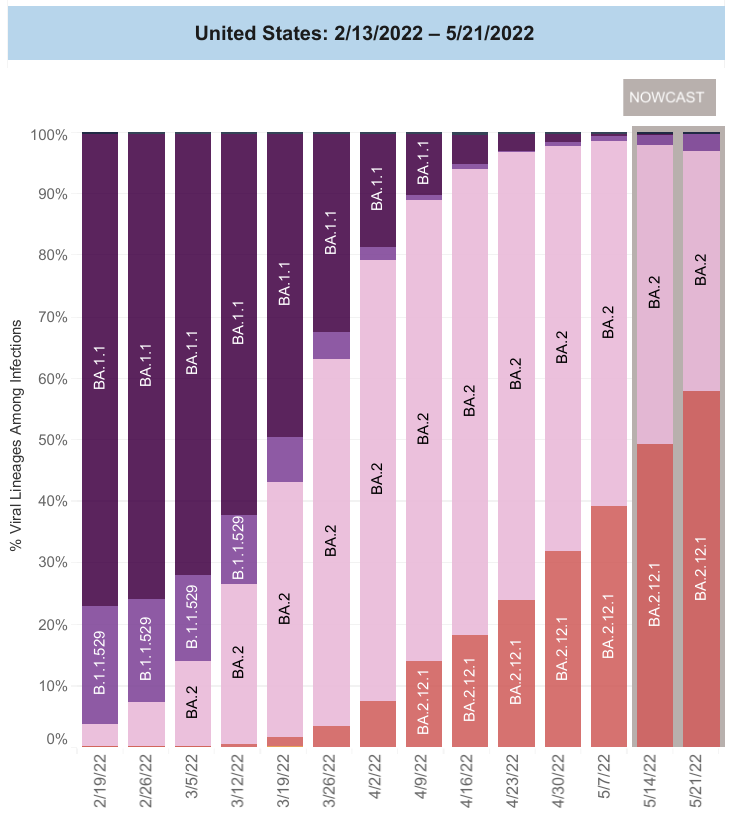 Trend of the Proportion of COVID-19 Variants Among Daily New Confirmed Cases in the United States (Source: U.S. Centers for Disease Control and Prevention (CDC))
WP reported, "The immunity created by the record-breaking spread of COVID-19 last winter offers little protection against recent variants, according to research," and added, "U.S. health authorities are preparing for a rapid spread of COVID-19 starting from Memorial Day, which could lead to a surge in cases during the summer."
As cases rise again in the U.S., the CDC has urged the reintroduction of preventive measures such as mask-wearing in public indoor spaces since mid-May. The U.S. government is also expected to extend the public health emergency, originally set to expire on July 15.
The Omicron variants ‘BA.4’ and ‘BA.5’, first detected and spreading in South Africa last month, are now spreading to India, the Philippines, and other countries following South Africa. In India, cases have been reported continuously since the first detection on the 23rd, but local health authorities stated, "There is no increase in deaths or hospitalizations to a concerning level."
In mid-May, health authorities in the United Kingdom and Europe reclassified these variants from variants of interest to variants of concern and are proactively reviewing the associated risks.
© The Asia Business Daily(www.asiae.co.kr). All rights reserved.


















