348 Disaster Victims Over 10 Years... 47% of Them Died
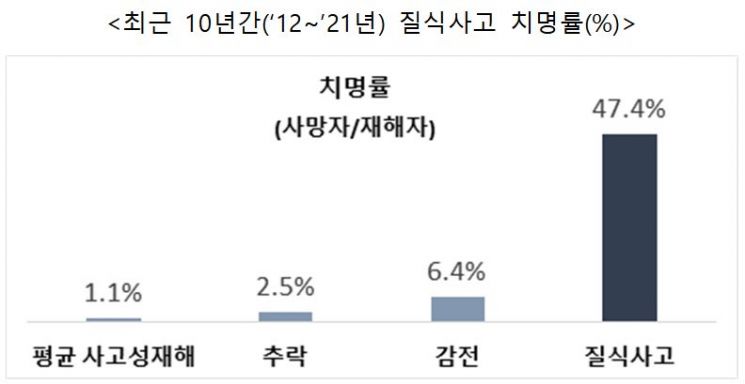
The Ministry of Employment and Labor announced on the 30th that over the past 10 years, there have been 348 casualties due to asphyxiation accidents, with nearly half of them, 165 people (47.4%), resulting in death. The fatality rate was found to be 44 times higher than that of general accidental injuries (1.1%), making it the most fatal type of industrial accident.
According to the Ministry, an investigation into asphyxiation accidents from 2012 to last year by type revealed that a total of 165 people died from asphyxiation accidents over the past decade. The fatality rate is 44 times that of average accidental injuries, 19 times that of fall accidents (2.5%), and 7 times that of electric shock accidents (6.4%).
Among asphyxiation accidents, wastewater treatment, septic tanks, and livestock manure processing were identified as the most hazardous tasks. There were 52 accident cases, 36 fatal accident cases, 91 casualties, and the number of deaths reached 49.
In addition, handling equipment for inert gases (nitrogen, argon, etc.) (oxygen deficiency), concrete curing work using lignite (carbon monoxide poisoning), and piping and tank welding work using argon gas (oxygen deficiency) were also identified as high-risk tasks.
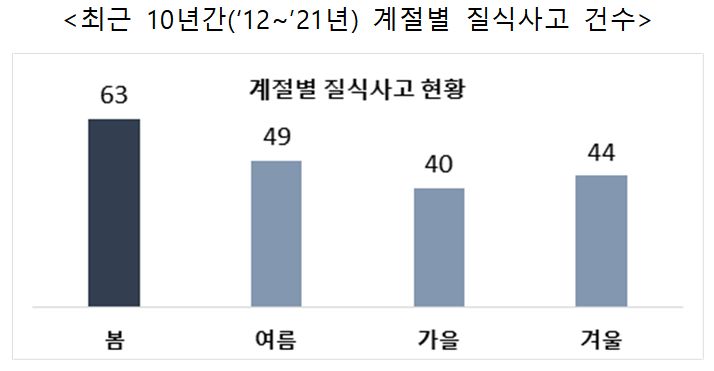
Asphyxiation accidents occurred particularly frequently in spring and summer. In spring, many accidents occurred during wastewater treatment, septic tank, livestock manure processing, and inert gas handling equipment operations, while in summer, accidents were frequent during work inside various manholes, sumps, tanks, and during pump operation in poorly ventilated areas.
The Ministry explained that such asphyxiation accidents are highly likely to fall under the Serious Accident Punishment Act.
Kim Cheol-hee, Director of Industrial Safety and Health Policy at the Ministry of Employment and Labor, said, "As the weather gets warmer, the risk of asphyxiation in manholes, wastewater treatment facilities, and similar places increases, so it is essential to measure oxygen levels and hazardous gas concentrations before work to ensure safety," adding, "from this year, even if death does not occur, if three or more asphyxiation casualties happen annually, it qualifies as a serious industrial accident under the Serious Accident Punishment Act, so thorough management and prevention of asphyxiation accidents are necessary."
© The Asia Business Daily(www.asiae.co.kr). All rights reserved.
![Clutching a Stolen Dior Bag, Saying "I Hate Being Poor but Real"... The Grotesque Con of a "Human Knockoff" [Slate]](https://cwcontent.asiae.co.kr/asiaresize/183/2026021902243444107_1771435474.jpg)
















