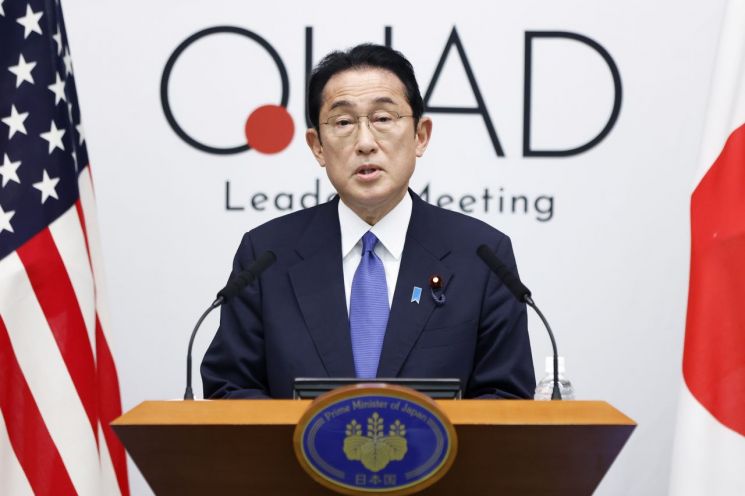
[Asia Economy Reporter Minji Lee] The flagship policy of Japanese Prime Minister Fumio Kishida, the "New Capitalism," appears to be shifting its focus from distribution to growth.
According to major Japanese media on the 29th, the Japanese government's "New Capitalism Implementation Plan," to be released next month, is expected to include △ nurturing talent in growth sectors △ fostering startups and developing science and technology △ investing in decarbonization and digital transformation.
Prime Minister Kishida proposed a "virtuous cycle of growth and distribution" through wage increases as the core of New Capitalism during the Liberal Democratic Party leadership election last September. However, the draft implementation plan by the Japanese government places emphasis on growth.
The Japanese government plans to support skill development and reemployment for about one million people, including non-regular workers. As a policy to promote workforce movement into growth sectors, it plans to invest 400 billion yen (approximately 4 trillion won) over three years. Training IT talent is a key goal of this policy.
A new system will also be established to facilitate easy loans for startup funding. This system allows borrowing without personal guarantees backed by the manager's assets if there is a guarantee from the Credit Guarantee Corporation. Since startups often lack tangible assets such as factories, the system will be revised to allow the entire business value, including intangible assets like know-how, to be used as collateral.
In the field of science and technology, research and development (R&D) in areas such as quantum, artificial intelligence (AI), and biotechnology will be supported through budgets and tax incentives, and a science and technology advisor will be appointed at the Prime Minister's Office. This is in response to the intensifying competition for supremacy in advanced technologies, including semiconductor development and production.
From the perspective of economic security, the draft also includes measures to strengthen supply chains for critical materials such as semiconductors, rare earths, batteries, and pharmaceuticals, and to expand capital in private companies holding important technologies under government leadership.
In the decarbonization sector, the Japanese government aims to invest more than 150 trillion yen (approximately 1,500 trillion won) over the next ten years. The policy also includes maximizing the use of nuclear power alongside renewable energy.
Nihon Keizai evaluated the draft implementation plan by stating, "The New Capitalism proposed by the Prime Minister originally emphasized distribution," and added, "This draft shows an attitude of pursuing a sustainable economy by using investments in social challenges such as climate change, low birthrate, and aging population as growth engines."
© The Asia Business Daily(www.asiae.co.kr). All rights reserved.
![Clutching a Stolen Dior Bag, Saying "I Hate Being Poor but Real"... The Grotesque Con of a "Human Knockoff" [Slate]](https://cwcontent.asiae.co.kr/asiaresize/183/2026021902243444107_1771435474.jpg)















