The Largest Scale Since the Introduction of the 2016 Extension Evaluation System
[Asia Economy Sejong=Reporter Kim Hyewon] The government plans to abolish, consolidate, or reduce 261 out of 500 national subsidy projects this year. This marks the largest expenditure restructuring since the introduction of the subsidy project extension evaluation system.
On the 29th, the Ministry of Economy and Finance announced that it held the first Subsidy Management Committee meeting of 2022 in writing, chaired by Second Vice Minister Choi Sang-dae, and approved the subsidy project extension evaluation plan containing these details.
The Ministry decided to restructure 52.2% (261 projects) of the total evaluated projects (500). This includes abolition (46 projects), consolidation (2 projects), and reduction (213 projects). Projects that change their operational methods account for 41.4% (207 projects) of the total.
This is the largest scale restructuring by number of projects since the extension evaluation system was introduced in 2016.
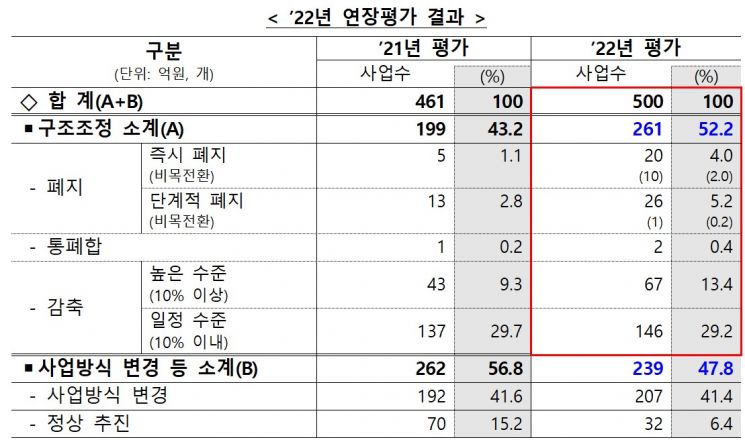
First, 46 projects evaluated as having low necessity for national funding, such as those with a narrow beneficiary scope or requiring budget item conversion, will be boldly abolished.
For example, the 'Regulatory Free Zone Demonstration Base Creation' project will be immediately abolished considering that no new free zones have been designated so far and no projects have been confirmed to be carried out from next year. The 'KONEX Market Activation Support' project will be phased out reflecting the decrease in the number of KONEX-listed companies.
If there are similar projects with the same purpose, they will be consolidated. The 'Metropolitan Bus Safety and Service Improvement Support' project subsidizes the purchase cost of metropolitan double-decker electric buses, and since its purpose is similar to the 'Metropolitan Bus Publicness Enhancement Support (sub-project)' which supports rental costs to increase chartered buses on metropolitan bus routes during commuting hours, the Ministry of Economy and Finance judged that it is desirable to integrate and operate them flexibly for increased bus operation.
Projects with insufficient effectiveness or poor execution, totaling 213, will have their scale reduced. This includes projects like 'Traditional Living Culture Promotion,' which had an actual execution rate of only 51.3% over the past three years. In particular, 67 projects evaluated as highly needing subsidy reductions will undergo restructuring at a level exceeding 10%.
The final results of the subsidy project extension evaluation will be submitted to the National Assembly in early September along with next year’s budget proposal. The scale of subsidy reductions will be finalized during the budget formulation process for next year.
Vice Minister Choi emphasized, "Considering the rapid increase in national debt due to recent expansionary fiscal operations and the aging trend in our country, it is important to balance the role of finance and fiscal soundness." He added, "We plan to continue strengthening evaluations of existing projects to reorganize subsidy projects and secure fiscal sustainability."
The government also announced in the '2023 Budget Formulation and Fund Operation Plan Preparation Guidelines' released last March that it would reduce discretionary spending by 10% through comprehensive restructuring of underperforming and subsidy-funded projects. This subsidy project extension evaluation is part of the follow-up measures.
© The Asia Business Daily(www.asiae.co.kr). All rights reserved.
![Clutching a Stolen Dior Bag, Saying "I Hate Being Poor but Real"... The Grotesque Con of a "Human Knockoff" [Slate]](https://cwcontent.asiae.co.kr/asiaresize/183/2026021902243444107_1771435474.jpg)















