Hanwha Investment & Securities Report
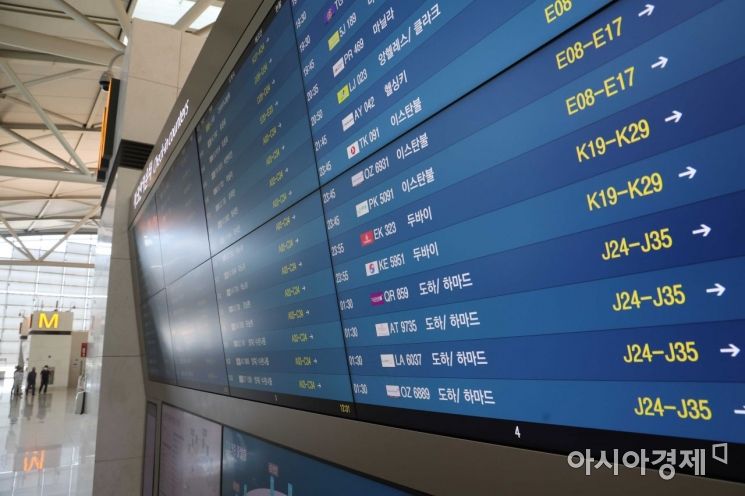 The departure hall of Terminal 1 at Incheon International Airport on the 26th. Photo by Mun Ho-nam munonam@
[Asia Economy Reporter Lee Myunghwan] Recently, Jeju Air decided to issue private perpetual bonds worth 79 billion KRW, and an analysis has emerged that the fundamentals of domestic low-cost carriers (LCCs) are solid. It is also forecasted that the recovery of air travel demand and the maintenance of air ticket prices will determine the stock price trends of LCCs.
On the 29th, Hanwha Investment & Securities analyzed Jeju Air and Jin Air, stating, "Fundamentals are not the factor that determines the direction of LCC stock prices."
On the 25th, Jeju Air announced plans to issue private perpetual bonds worth 75 billion KRW to secure financial soundness. This is half of the initially announced 150 billion KRW. The news of the reduced bond issuance size raised concerns about a slowdown in demand recovery and the possibility of additional capital increases, which weighed on the stock price.
However, Hanwha Securities' analysis suggests that even with the final raised amount, the burden of capital erosion has lessened, and regarding demand, an explosive recovery is expected rather than a slowdown. As of the first quarter of this year, Jeju Air holds 228.2 billion KRW in cash and cash equivalents. Net cash outflow from January to March was about 20 billion KRW per month, but thanks to the 150 billion KRW support from the Industrial Stabilization Fund in December last year, there is no immediate cash liquidity problem.
Hanwha Securities analyzed that Jeju Air's operating conditions have improved since the second quarter, indicating a greater possibility of improvement rather than deterioration in fundamentals. Previously, Jeju Air raised 350 billion KRW through paid-in capital increases over the past two years. As of the end of the first quarter, the total capital was 117.5 billion KRW, and capital stock was 49.8 billion KRW; considering the 79 billion KRW perpetual bonds, there is no immediate concern about capital erosion.
Hanwha Securities also analyzed that another LCC, Jin Air, has solid fundamentals. As of the first quarter of this year, Jin Air's cash and cash equivalents stood at approximately 29.6 billion KRW. Entering the second quarter, monthly cash flow has turned positive, indicating no concerns about cash liquidity. As of the end of the first quarter, Jin Air's total capital was 140.3 billion KRW, and capital stock was 52.2 billion KRW, showing low risk of capital erosion.
The lifting of overseas travel restrictions by neighboring countries is also expected to have a positive effect. On the 26th, Japanese Prime Minister Fumio Kishida announced, "The entry of foreign tourists will resume from June 10." However, to prevent the spread of COVID-19, only group tours through travel agencies will be allowed for the time being. The resumption of travel to Asian countries such as Japan is expected to act as a strong momentum for domestic LCC stock prices.
Park Sooyoung, a researcher at Hanwha Securities, said, "Ultimately, the investment point will be how quickly and strongly passenger demand recovers flexibly, and to what extent air ticket prices are maintained compared to pre-pandemic levels," adding, "If stable fundamentals are maintained, the sentiment and resulting stock prices, which are areas where stories can be created, will also show good trends."
© The Asia Business Daily(www.asiae.co.kr). All rights reserved.
![Clutching a Stolen Dior Bag, Saying "I Hate Being Poor but Real"... The Grotesque Con of a "Human Knockoff" [Slate]](https://cwcontent.asiae.co.kr/asiaresize/183/2026021902243444107_1771435474.jpg)















