Gu to Accept Proposals for '2023 Seocho-gu Resident Participatory Budget' Projects for 5 Weeks from June 30 to July 1... Distributing a Total Budget of 2 Billion KRW by District and Neighborhood, Actively Reflecting Local Issues and Long-Standing Projects
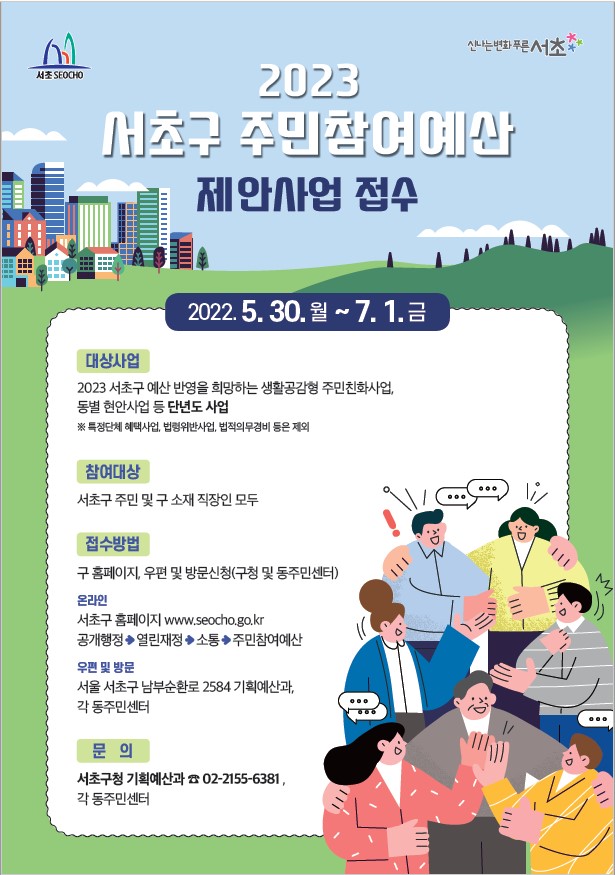
[Asia Economy Reporter Park Jong-il] Seocho-gu is accepting proposals for the "Resident Participatory Budget Project" for the 2023 budget formulation from the 30th until July 1st.
The Resident Participatory Budget is a democratic system that allows residents to participate in the budget formulation process to ensure transparency and accountability in financial management. Residents directly propose projects needed in Seocho-gu, and projects finally selected through resident voting are reflected in the next year's budget.
The scale of Seocho-gu's resident participatory budget for next year is a total of 2 billion KRW, with 900 million KRW for district-level projects and 1.1 billion KRW for neighborhood-level (by region) projects. The project cost is distributed evenly among local issues and long-standing projects, with up to 300 million KRW per district-level project, up to 100 million KRW per neighborhood-level project, and up to 30 million KRW for event-type projects.
Eligible projects include lifestyle-related projects with high resident preference, neighborhood-specific issues, and other Seocho-gu projects residents wish to see reflected in next year's budget. Any Seocho-gu resident or employee working in the district can propose projects.
Project proposals can be submitted online through the district office website, or offline by visiting the district office, neighborhood community centers, or by mail.
Submitted proposals undergo feasibility review by the responsible department, evaluation by the Resident Participatory Budget Committee and neighborhood meetings, and resident voting, with the final project list confirmed around August.
Resident voting will utilize online electronic voting through M-Voting and offline on-site polling stations to encourage more residents to participate and reflect diverse opinions. Selected projects will be reviewed by the district council's budget deliberation at the end of this year and incorporated into the 2023 budget.
Meanwhile, last year, through project proposal calls and resident voting, 25 projects totaling 1.846 billion KRW were reflected in this year's budget. Projects selected this year include ▲ CCTV installation in crime-prone and blind spots ▲ Anti-slip road paving on Seoripul-gil ▲ Installation of luminous bicycle lanes, among others.
In fact, the "Smart Play Zone for Cognitive Function Improvement" project, proposed by residents in 2020 and implemented last year, provided education on using smart devices such as kiosks for seniors. It offered various scenarios to practice real-life simulations, receiving great response from seniors struggling with the sudden shift to a non-contact culture.
Jo Byung-geon, Director of the Planning and Budget Division, stated, "We will strive to reflect projects directly proposed by residents into the budget through sufficient communication and empathy," and added, "We ask for active participation from residents with creative ideas."
© The Asia Business Daily(www.asiae.co.kr). All rights reserved.
![Clutching a Stolen Dior Bag, Saying "I Hate Being Poor but Real"... The Grotesque Con of a "Human Knockoff" [Slate]](https://cwcontent.asiae.co.kr/asiaresize/183/2026021902243444107_1771435474.jpg)















