"Male, in a state of mobility impairment due to tuberculosis"
[Asia Economy Reporter Na Ye-eun] The genome of a man who died in the volcanic eruption in ancient Roman Pompeii about 2,000 years ago has been decoded for the first time.
A joint research team from the University of Copenhagen in Denmark, the University of Salento in Italy, the Federal University of Minas Gerais in Brazil, and the University of California, Irvine (UC Irvine) in the United States extracted DNA from a man estimated to be 35-40 years old, discovered in the Pompeii area, and succeeded in sequencing his genome. The findings were published in the June 26 issue (local time) of the international academic journal Scientific Reports.
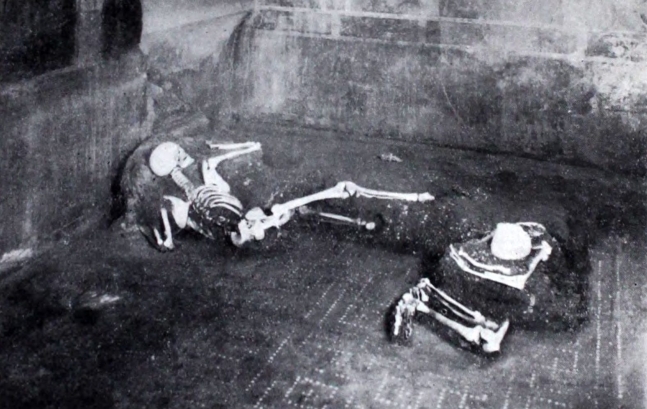
The researchers extracted genetic material from the inner ears of two individuals, a man and a woman, excavated in Pompeii in 1933 and decoded it.
On August 24, AD 79, Mount Vesuvius, located in Pompeii near Naples, Italy, erupted. The excavated man and woman died after being covered by volcanic ash while having lunch at a place now called the "House of the Blacksmith."
What was unusual was that unlike other Pompeii victims, they did not appear to be trying to escape the volcanic eruption. They died lying on a sofa facing it. The man was estimated to be 35-40 years old at the time of death, and the woman about 50 years old. Their physical ages were sufficient to attempt an escape.
Dr. Serena Viva of the University of Salento in Italy said, "The posture of the man and woman, which did not look like they were trying to flee, could be explained by their health condition." The woman's DNA was not decodable, so only the man's genome was sequenced.
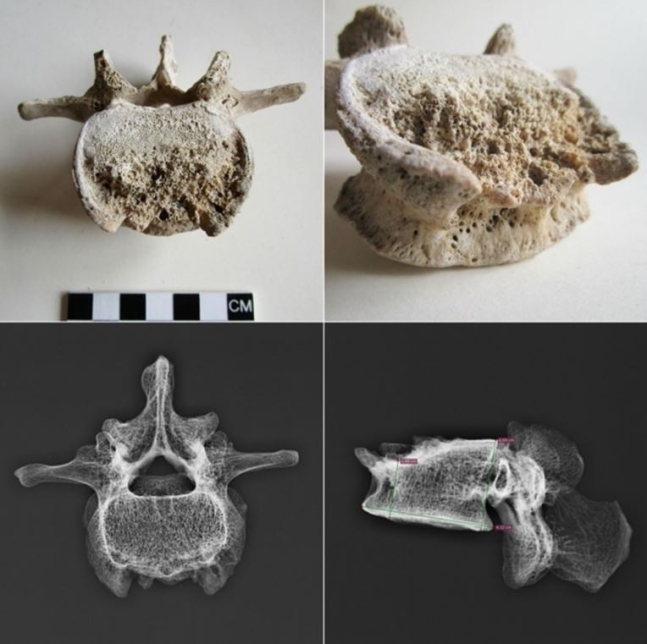
The researchers found the tuberculosis bacterium's genes in the man's lumbar vertebrae. He was already suffering from tuberculosis and had difficulty moving before the volcanic eruption.
The man's lineage was also unexpected. The research team compared his DNA sequence with those of 1,037 ancient individuals and 471 present-day Western Eurasians. The results showed that he was most similar to ancient Romans and people currently living in central Italy.
Analysis of the man's mitochondrial DNA and Y-chromosome DNA revealed commonalities with people living on the island of Sardinia in the western Mediterranean Sea off the west coast of Italy. This shared genetic region was not found in Italians from the ancient Roman period.
The research team explained that this suggests that people living on the Italian Peninsula in the past were genetically very diverse.
Meanwhile, in March last year, another Italian research team reported in Scientific Reports that the enormous amount of volcanic ash ejected by the Mount Vesuvius eruption likely exterminated the Pompeii inhabitants in less than 20 minutes.
© The Asia Business Daily(www.asiae.co.kr). All rights reserved.
![Clutching a Stolen Dior Bag, Saying "I Hate Being Poor but Real"... The Grotesque Con of a "Human Knockoff" [Slate]](https://cwcontent.asiae.co.kr/asiaresize/183/2026021902243444107_1771435474.jpg)
















