This Year's Grade 9 Civil Service Competition Rate is 22.5 to 1, the Lowest Since 2001 (19.7 to 1)
Many Drawbacks Including Pension System Reform and Low Salary
MZ Generation's 'Decent Job' Criteria: 'Working in the Capital Area', 'Work-Life Balance', 'Salary in the 30 Million KRW Range'
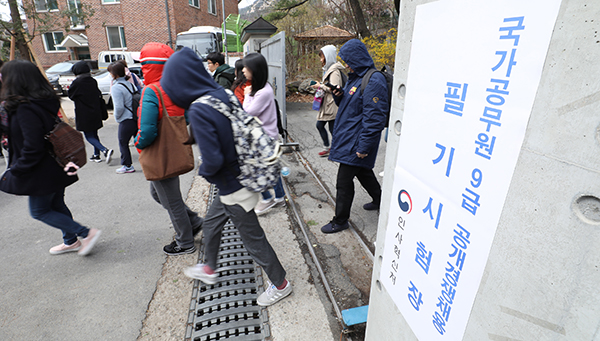 Examinees who have completed the Level 9 civil service written exam are coming out of Gyeongbok High School in Jongno-gu. [Image source=Yonhap News]
[Asia Economy Kim Gun-chan, Intern Reporter] The popularity of Grade 9 civil servants, once the most preferred job among job seekers, is declining. It is analyzed that due to the changing perceptions of the MZ generation (those born from the early 1980s to the 2000s), more job seekers hope to receive a high salary rather than the job security, which was considered an advantage of being a civil servant.
One of the most preferred jobs among young people preparing for employment was civil service. According to a Statistics Korea survey conducted in May last year, 32.4% of job seekers were preparing for the general civil service exam. Unlike the past when one out of three job seekers was preparing for the civil service exam, so-called 'Gongsi-jok,' the popularity of civil servants has recently been declining significantly.
This year, the competition rate for the Grade 9 national civil service exam recorded the lowest level in 21 years. According to the Ministry of Personnel Management, the competition rate for the 2022 Grade 9 national civil service open competitive recruitment written exam was 22.5 to 1. This is the lowest figure since 2001 (19.7 to 1). Despite the fact that the number of Grade 9 national civil servants to be selected this year is the highest in the past 10 years, the competition rate recorded the lowest level. A total of 12,7643 candidates took the exam this year to fill 5,672 positions.
Since 2011, the competition rate for Grade 9 national civil servants has been declining. After recording a competition rate of 68.7 to 1 in 2011, it dropped to 38.3 to 1 (2015) and 26.3 to 1 (2020). Although there was a slight rebound last year, it returned to a downward trend this year.
The main reason for the decline in the competition rate for Grade 9 civil servants is analyzed to be the change in perception of civil servants. Civil servants have long been popular among job seekers due to high job stability and benefits such as pension receipt after retirement.
However, due to pension system reforms, civil servants who joined after 2016 do not receive pensions equivalent to those of the older generation, which is considered a disadvantage. Additionally, there are sighs of dissatisfaction from job seekers regarding low salaries. While positive perceptions dominated in the past, negative perceptions have grown larger at present.
According to the Ministry of Personnel Management, the monthly salary of a Grade 9 general civil servant (entry-level) this year is 1,686,500 KRW. Including various allowances, the actual take-home pay is known to be around 2 million KRW. This is not much different from the monthly salary of approximately 1.91 million KRW calculated based on this year’s minimum wage of 9,160 KRW. It is also lower than the average monthly income of about half of people in their 20s. According to the ‘2021 Seoul Survey’ released by the Seoul Metropolitan Government in April, about half of people in their 20s have an average monthly income of 2 to 3 million KRW.
Kim (24), a job seeker living in Seoul, said, "Although Grade 9 civil servants have the advantage of stability, a monthly salary of less than 2 million KRW is a huge disadvantage," adding, "If I fail after studying, it’s a waste of time, so I don’t understand why I should spend time preparing for the civil service exam."
The decline in popularity of Grade 9 civil servants is also related to the attitude of the MZ generation toward jobs. The Korea Employers Federation released the results of a job perception survey targeting MZ generation job seekers. According to the survey, the conditions for a ‘good job’ as perceived by the MZ generation are working in the metropolitan area, maintaining work-life balance, and receiving an annual salary in the 30 million KRW range.
When asked about the criteria for a good job, only 14% chose ‘jobs with long-term employment such as job security like civil servants.’ This ranked fifth after work-life balance, fair compensation, welfare systems, and a horizontal organizational culture. Regarding the expected length of service in a good job, 35.1% answered ‘within 10 years,’ the highest proportion. This is interpreted as indicating a change in the traditional concept of working at one job to sustain a livelihood.
Regarding salary level, 50% responded ‘in the 30 million KRW range.’ Considering that 82.6% of respondents said they were willing to work for small and medium-sized enterprises if the job was good, the low salary of Grade 9 civil servants is seen as a major obstacle for job seekers choosing civil service.
Meanwhile, the resignation rate among young civil servants is also increasing within the civil service community. According to the Government Employees Pension Service, 4,375 civil servants aged 18 to 35 resigned in 2017. In 2020, the number increased by 1,586 to 5,961. Especially, among civil servants with less than five years of service, 9,968 resigned in 2020, accounting for 21% of the total 47,319.
A survey conducted by the Ministry of the Interior and Safety targeting civil servants born between 1980 and 2000 also showed that 58.6% had considered changing jobs, indicating that more than half are contemplating resignation.
© The Asia Business Daily(www.asiae.co.kr). All rights reserved.
![Clutching a Stolen Dior Bag, Saying "I Hate Being Poor but Real"... The Grotesque Con of a "Human Knockoff" [Slate]](https://cwcontent.asiae.co.kr/asiaresize/183/2026021902243444107_1771435474.jpg)















