[Asia Economy Reporter Byunghee Park] The White House stated on the 26th (local time) that it expects the impact of a Russian default on the U.S. and the global economy to be very limited.
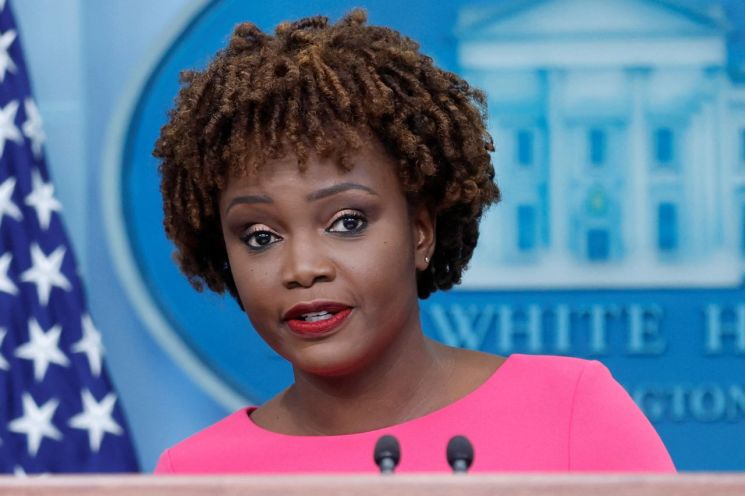
According to major foreign media on the day, White House spokesperson Karine Jean-Pierre said, "Since Russia is already isolated from the international financial market, the shock that a Russian default would have on the U.S. and the global economy is expected to be minimal." Jean-Pierre added, "Nevertheless, the U.S. Treasury will continue to monitor the situation and communicate with the international community."
Following Russia's invasion of Ukraine, the U.S. and the European Union (EU) imposed sanctions preventing Russia from using overseas assets. However, the use of overseas assets was allowed solely for the repayment of bond principal and interest. But the U.S. government ended the grace period allowing the use of foreign currency assets for bond principal and interest payments as of the 25th. As a result, Russia faces a default crisis as it can no longer repay the principal and interest on foreign currency-denominated bonds.
According to Bloomberg News, the amount of government bond interest Russia must pay in June alone reaches $394.2 million.
Russia has stated that if it cannot pay bond interest in dollars or euros, it will pay in its national currency, the ruble. On the 25th, the Russian Ministry of Finance declared that it has the funds and willingness to repay and intends to do so in rubles.
Despite the war, Russia has been able to earn significant revenue thanks to strong oil and gas prices. Additionally, the recent strength of the ruble means that repayment in rubles could actually be more advantageous.
However, repaying the principal and interest of foreign currency-denominated debt in rubles could be considered a breach of contract terms and thus regarded as a default.
U.S. Treasury Secretary Janet Yellen said at last week's Group of Seven (G7) finance ministers meeting, "If Russia cannot find a way to make payments, it will technically be in default, but I do not think this signifies a major change in Russia's situation," adding, "Russia is already cut off from the global capital markets, and this will continue."
© The Asia Business Daily(www.asiae.co.kr). All rights reserved.
![Clutching a Stolen Dior Bag, Saying "I Hate Being Poor but Real"... The Grotesque Con of a "Human Knockoff" [Slate]](https://cwcontent.asiae.co.kr/asiaresize/183/2026021902243444107_1771435474.jpg)















