Minimum Wage Increase Rate of 44.6% Over 5 Years... Four Times the G5 Average
One in Two Companies Considering Employment Reduction
[Asia Economy Reporter Jin-ho Kim] South Korea's minimum wage level and rate of increase rank among the highest within the Organisation for Economic Co-operation and Development (OECD) countries. Over the past five years during the Moon Jae-in administration, the minimum wage increased by a staggering 44.6%, which is four times the average of the Group of Five (G5) countries. Concerns have been raised that the previous government's aggressive push for wage hikes has increased the burden on businesses, potentially triggering a vicious cycle of 'employment reduction.'
On the 28th, the Federation of Korean Industries (FKI) analyzed OECD statistics and found that South Korea's minimum wage as a percentage of average wages stood at 49.6% in 2020, ranking 3rd among 30 OECD countries surveyed. The minimum wage as a percentage of median wages was also high at 62.5% in 2020, placing South Korea 7th among the 30 OECD countries.
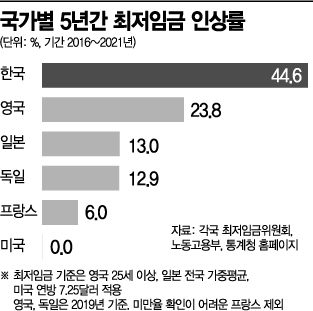
Notably, over the past five years (2016?2021), South Korea's minimum wage increase rate was 44.6%, four times the G5 average of 11.1%. The countries following were the United Kingdom (23.8%), Japan (13.0%), Germany (12.9%), France (6.0%), and the United States (0.0%).
Due to the rapid increase in the minimum wage, the proportion of workers earning below the minimum wage is also higher compared to major countries. South Korea's minimum wage underpayment rate was 15.6% in 2020, significantly higher than Japan (2.0%), the United Kingdom (1.4%), Germany (1.3%), and the United States (1.2%).
The FKI pointed out, "While hourly labor productivity increased by 11.5% over the past five years, the minimum wage rose by 44.6%, indicating that the pace of minimum wage hikes far exceeds productivity growth." This does not imply that raising the minimum wage itself is inappropriate, but rather that the excessively rapid increase is causing side effects.
As a consequence of the excessive minimum wage hikes, companies have begun considering employment reductions. Especially when factoring in the deteriorating business environment due to COVID-19 alongside the so-called 'three highs' risks?high inflation, high exchange rates, and high interest rates?corporate payment capacity is analyzed to be very fragile. Choo Kwang-ho, head of the FKI Economic Headquarters, expressed concern, saying, "With the minimum wage at a globally high level and various economic uncertainties persisting, the difficulties faced by small and micro enterprises with weak payment capacity are expected to intensify."
In fact, a recent survey conducted by the Korea Employers Federation and the Korea Federation of Small and Medium Business, targeting 600 small businesses, revealed that one in two companies would have to reduce employment if the minimum wage increases next year. The survey showed that companies are considering existing workforce reductions (9.8%) and cuts in new hiring (36.8%).
In response, the FKI recommended that, similar to major advanced countries such as the United States and Japan, minimum wages should be applied differentially based on factors such as industry, region, payment capacity, productivity, and work intensity. Earlier, President Yoon Suk-yeol also proposed 'differential application of minimum wages by industry' as part of his campaign pledges. The Minimum Wage Commission is expected to discuss the adoption of such a proposal at its third plenary meeting scheduled for the 9th of next month. However, since the commission has historically been at an impasse, the possibility of implementing 'differential application of minimum wages by industry' remains uncertain.
Meanwhile, the FKI also pointed out that the scope of minimum wage inclusion is narrower compared to major countries, that the adversarial labor-management relations lead to fierce annual disputes, and that the penalties for minimum wage violations are excessively severe?all of which are areas needing improvement.
Head Choo suggested, "The pace of minimum wage increases should be adjusted by comprehensively considering economic growth rates and overall wage levels of workers," adding, "Differential application by industry and region, designation of special minimum wage industries, abolition or inclusion of weekly holiday allowances within the minimum wage scope, and elimination of imprisonment penalties for violations are necessary."
© The Asia Business Daily(www.asiae.co.kr). All rights reserved.
![Clutching a Stolen Dior Bag, Saying "I Hate Being Poor but Real"... The Grotesque Con of a "Human Knockoff" [Slate]](https://cwcontent.asiae.co.kr/asiaresize/183/2026021902243444107_1771435474.jpg)
















