Murder of Severely Disabled Daughter Cared for 30 Years, Jumping with 6-Year-Old Son with Developmental Disability...
Series of Incidents Occur, "How Will the State Stop This?"
 A man in his 60s, Mr. A, who killed his severely disabled daughter whom he had cared for over 30 years and attempted an extreme act, is entering the Incheon District Court in Michuhol-gu, Incheon, on the afternoon of the 25th to undergo a pre-arrest suspect interrogation (warrant hearing). / Yonhap News
[Asia Economy Reporter Kang Juhee] "I am so sorry. I couldn't live with you."
A woman in her 60s, Ms. A, who killed her disabled daughter and attempted an extreme act, said this as she entered the Incheon District Court on the 25th for a pre-trial detention hearing (warrant review). Ms. A's daughter suffered from severe brain lesion disability level 1 and was recently diagnosed with terminal colon cancer.
After the crime, Ms. A also took sleeping pills to attempt an extreme act, but was discovered by her son who came to the house, and the attempt failed. Ms. A's son is married and lives separately, and her husband is known to work in other regions for a living. Ms. A cared for her daughter alone for over 30 years while living apart from her family.
On the 23rd, in an apartment in Seongdong-gu, Seoul, a woman in her 40s jumped to her death with her 6-year-old son who had developmental disabilities. Firefighters who responded to the security guard's report transported the woman and her son to a nearby hospital, but both eventually died.
In addition, in March, similar incidents occurred in Suwon and Siheung, Gyeonggi Province, where parents of disabled children, overwhelmed by their situation, killed their children and attempted extreme acts. They are pushed into such situations due to excessive caregiving burdens, economic difficulties, social prejudice against disabled people, and inadequate welfare policies.
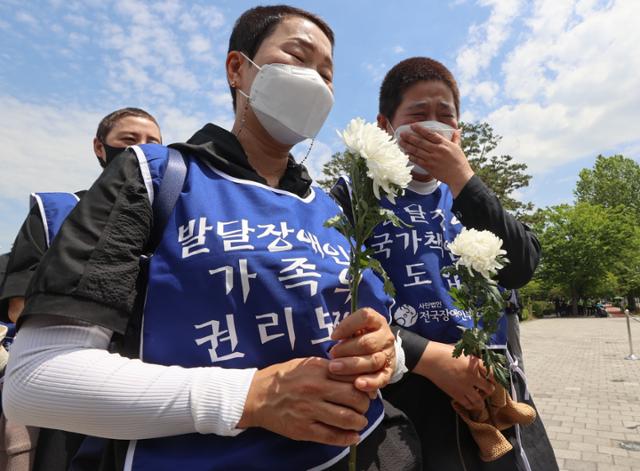 Members of the National Parents' Association for the Disabled shed tears while laying flowers at the "Memorial Ceremony for People with Developmental Disabilities and Their Families Forced to Die," held on the 26th in front of the War Memorial in Yongsan-gu, Seoul. Photo by Yonhap News.
According to the 'High-Risk Disabled Family Support Plan Study' conducted by the Seoul Metropolitan Government and the Seoul Welfare Foundation, more than 3 out of 10 families with disabled members have considered extreme acts due to caregiving difficulties. Among 374 caregivers of disabled people, 35.0% said they had thought about or attempted extreme acts. Additionally, 36.7% reported experiencing mental health issues such as depression and anxiety due to caregiving problems.
Parents of disabled children point out that the government does not take responsibility for caregiving burdens and instead shifts them solely onto parents. On the 26th, Kim Sujeong, head of the Seoul branch of the National Parents' Solidarity for Disabled People (Parents' Solidarity), appealed at a memorial service for families of people with developmental disabilities held in front of the Presidential Office in Yongsan-gu, Seoul, saying, "A mother killed her 6-year-old child. How will the government stop these repeated horrific incidents? We demand an answer."
Earlier, on the 19th of last month, 555 parents and individuals with developmental disabilities, including the Parents' Solidarity, held a head-shaving protest urging the establishment of a '24-hour support system.' They demanded that the Presidential Transition Committee select as national agenda items ▲restructuring and expansion of developmental disability activity services ▲income security for people with developmental disabilities ▲labor rights protection for people with developmental disabilities ▲housing rights protection for people with developmental disabilities ▲education rights protection for people with developmental disabilities.
In response, on the 3rd of this month, the Transition Committee announced ▲expansion of a 24-hour care model for the most severely disabled with developmental disabilities ▲elimination of institutional blind spots in activity support services ▲development of suitable job models and job support in the 4th industrial revolution and public sectors ▲support for housing and residential services for community independence of disabled people living in facilities. However, the Parents' Solidarity stated that these were "rehashed policies from the previous administration" and that no concrete and practical systems were reflected.
Professor Seo Dongmyeong of the Department of Social Welfare at Dongduk Women's University advised, "Currently, support for disabled people is focused on physical disabilities, and support for developmental disabilities is relatively insufficient. There are programs operating during the day, but outside those hours, caregiving is entirely the responsibility of guardians or family members. Also, support is mainly focused on the disabled individuals themselves, but there is a need to expand support for the families who bear the caregiving burden."
© The Asia Business Daily(www.asiae.co.kr). All rights reserved.
![Clutching a Stolen Dior Bag, Saying "I Hate Being Poor but Real"... The Grotesque Con of a "Human Knockoff" [Slate]](https://cwcontent.asiae.co.kr/asiaresize/183/2026021902243444107_1771435474.jpg)
















