Statistics Korea Releases Special Population Projections by Province (2020-2050)
Working-Age Population to Decrease by 35% in 30 Years
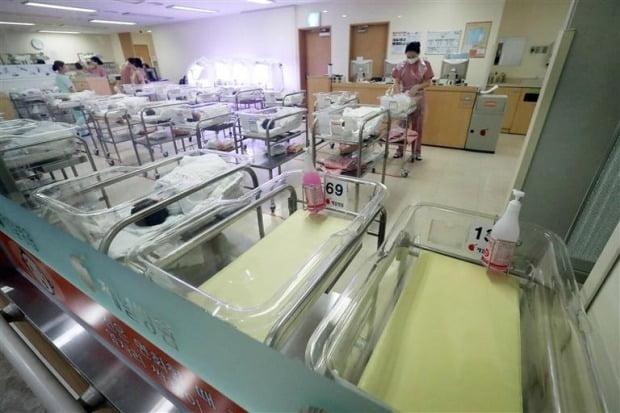 If the low birthrate phenomenon continues, it is projected that the population of Seoul will decrease by about one-quarter in 30 years. Photo by Yonhap News
[Asia Economy Reporter Na Ye-eun] If the low birthrate phenomenon continues, it is projected that Seoul's population will decrease by about one-quarter in 30 years.
On the 26th, Statistics Korea announced the '2020?2050 Future Population Projections by Province.' Based on the 2020 population census, Statistics Korea reflected recent trends in births, deaths, and population movement by province to forecast the future population until 2050.
According to a scenario assuming median values for birthrate and life expectancy, South Korea's total population is expected to decrease by 8.6%, from 51.84 million in 2020 to 47.36 million in 2050. Under a scenario assuming low values for birthrate and life expectancy, the population is projected to decline by 16.4% to 43.33 million in 2050.
By province, under the median scenario, the total population of 13 provinces including Seoul, Busan, Daegu, and Incheon is expected to decrease by 2050 compared to 2020. However, Gyeonggi, Sejong, Jeju, and Chungnam are expected to see population growth.
Ulsan (-25.9%), Daegu (-25.2%), and Busan (-25.1%) are projected to experience a population decrease of more than 25%, and Seoul's population is also expected to decline by 17.7%.
Under the low scenario, all provinces except Sejong are expected to see a population decrease. In particular, Seoul's population, which was 9.62 million in 2020, is estimated to decrease by 25.1% to 7.2 million in 2050.
By region, even under the median scenario, all regions' populations are expected to decline in 2050 compared to 2020. The decrease rates are in order: Yeongnam region (-21.0%), Honam region (-14.3%), Capital region (-3.6%), and Central region (-0.2%).

Meanwhile, aging is intensifying along with population decline. In 2020, no province had a median age over 50, but by 2050, all 17 provinces are expected to exceed 50 years. Sejong, which had the lowest median age in both 2020 and 2050, will see an increase from 37.8 years to 50.9 years.
The nationwide working-age population aged 15?64 is projected to decrease by 35.3%, from 37.38 million in 2020 to 24.19 million in 2050. The proportion of the working-age population within the total population will also shrink from 72.1% in 2020 to 51.1% in 2050.
By province, the proportion of the working-age population in 2050 will fall below 50% in 10 provinces including Jeonnam (43.4%) and Gyeongbuk (44%), while only 7 provinces including Sejong (58%), Seoul (54.7%), and Gyeonggi (53.8%) will maintain a proportion in the 50% range.
Conversely, the elderly population aged 65 and over is expected to increase from 8.15 million in 2020 to 19 million in 2050, and the proportion of elderly within the total population is projected to expand significantly from 15.7% to 40.1% during the same period. Among the 17 provinces in 2050, 10 including Jeonnam (49.5%) and Gyeongbuk (48.9%) will have elderly populations exceeding 40%, with Sejong being the only province below 30% at 28.8%.
Elon Musk, CEO of Tesla, shared on his Twitter on the 25th (local time) a ranking table of birthrates by country for 2020 provided by the World Bank, expressing concern that "South Korea and Hong Kong are experiencing the fastest population collapse."
According to the 2020 birthrate ranking by country, South Korea's birthrate was the lowest at 0.84. Hong Kong narrowly avoided last place with 0.87. Japan's birthrate was 1.34 (ranked 186th), and Italy's was 1.24 (ranked 191st).
Musk stated, "If South Korea's birthrate does not change, after three generations, the population will be only 6% of the current population, with most being aged 60 and above."
Expressing concern about the recent global population decline, Musk previously commented on Japan's population decreasing for 11 consecutive years, saying, "If Japan does not experience a change where the birthrate exceeds the death rate, it will eventually cease to exist," adding, "This would be a great loss to the world."
© The Asia Business Daily(www.asiae.co.kr). All rights reserved.
![Clutching a Stolen Dior Bag, Saying "I Hate Being Poor but Real"... The Grotesque Con of a "Human Knockoff" [Slate]](https://cwcontent.asiae.co.kr/asiaresize/183/2026021902243444107_1771435474.jpg)
















