Preparation of Regulatory Amendment for Expansion and Institutionalization of Parking Robots
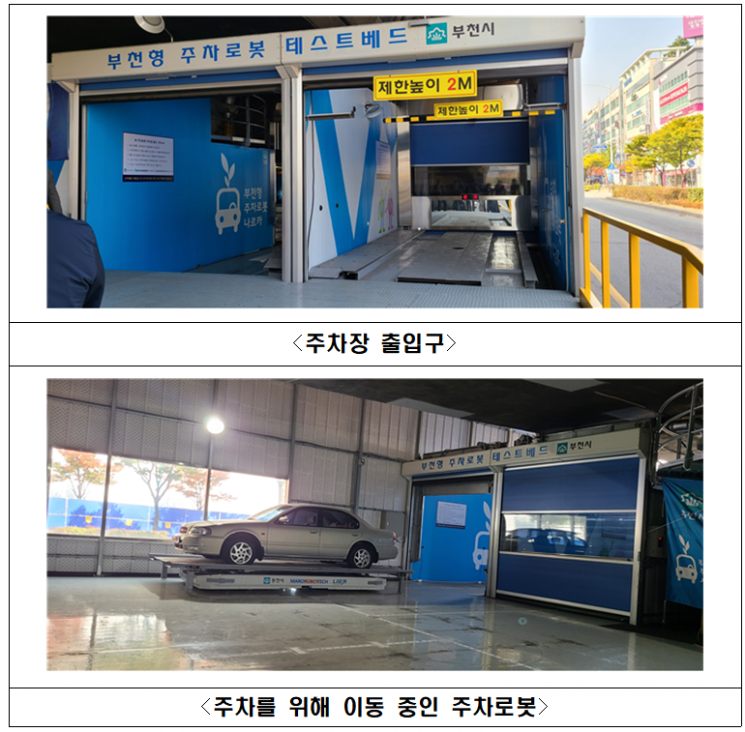
The common issues of 'door dings' (scratches caused when opening a car door into another vehicle) and inconvenience during getting in and out in parking lots with narrow spaces are expected to be significantly improved. A regulatory foundation has been established to expand a system where, after the driver stops and exits the car at the parking lot entrance, an 'autonomous parking robot' automatically parks the vehicle.
On the 26th, the Ministry of Land, Infrastructure and Transport announced, "The amendment to the 'Safety Standards and Inspection Standards for Mechanical Parking Devices,' which institutionalizes parking robots currently operating under a regulatory sandbox demonstration exception, will be publicly notified from May 27 to June 17 and is scheduled to be implemented from September 2022."
This amendment aims to define parking robots and establish the necessary safety and inspection standards for their operation, thereby creating an institutional framework to commercialize parking robots.
The autonomous parking robot service works by having the user leave the vehicle in the entry zone, after which the parking robot lifts both the carrier and the vehicle, recognizes QR codes on the parking lot floor, moves along the designated route to an empty parking space to park, and when the user inputs the vehicle number in the exit zone, the parking robot autonomously drives the vehicle to the exit zone.
Currently, the parking robot has been demonstrated since October 2020 in an off-street parking lot located in Bucheon City, verifying the operation system including location and route recognition and safety devices, while improving safety.
Until now, when a person parked directly in a general (self-parking) parking lot, time was spent wandering to find an empty parking space, and there was a high risk of contact accidents between people or vehicles, as well as door ding accidents.
With the introduction of parking robots, it is expected that parking time will be shortened and the risk of safety accidents in parking lots will be greatly reduced.
Additionally, when parking robots are introduced, there is no need to secure passage space for people to get in and out of vehicles, resulting in about a 30% increase in space efficiency compared to general (self-parking) parking lots.
Yoon Jin-hwan, Director General of Comprehensive Transportation Policy at the Ministry of Land, Infrastructure and Transport, stated, "Compared to existing mechanical parking lots, devices such as steel frames, rails, and chains are unnecessary, so initial installation costs are expected to be reduced by about 20%, enabling the installation of various types of parking lots."
The amendment can be viewed from May 27 in the official gazette and on the Ministry of Land, Infrastructure and Transport website under 'Policy Materials - Legal Information - Administrative Notice.' Those who have opinions on the amendment can submit them via mail, fax, or through the website.
© The Asia Business Daily(www.asiae.co.kr). All rights reserved.
![Clutching a Stolen Dior Bag, Saying "I Hate Being Poor but Real"... The Grotesque Con of a "Human Knockoff" [Slate]](https://cwcontent.asiae.co.kr/asiaresize/183/2026021902243444107_1771435474.jpg)















