If the Remaining Monetary Policy Meetings Raise Rates Consecutively, 2.75%
Governor Lee Chang-yong Declares Inflation-Centered Monetary Policy
Interest Burden Also Increases... Yeongkkeul Borrowers and Vulnerable Groups Suffer
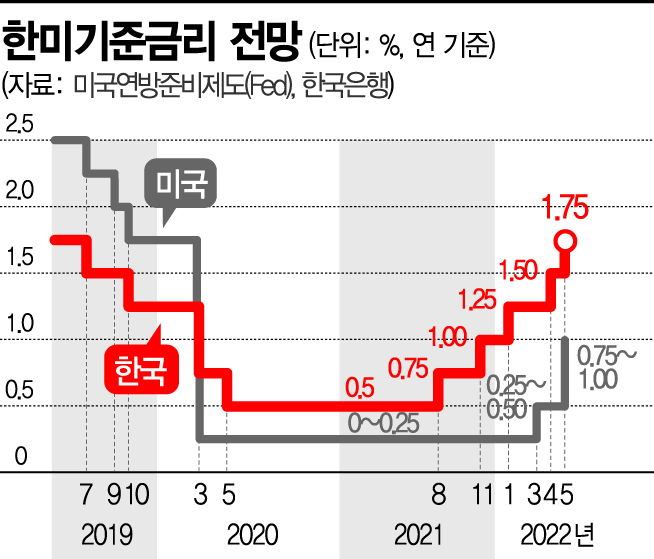
The Bank of Korea, which has declared an all-out war on inflation, is expected to raise the base interest rate by a 'baby step' (0.25 percentage point increase) in all four remaining Monetary Policy Committee meetings this year. If the base rate rises to a maximum of 2.75%, the annual household interest burden is analyzed to increase by an average of 820,000 KRW compared to the current level. If the Bank of Korea raises the base rate further at the pace of the Federal Reserve's (Fed) 'big step' (0.5 percentage point increase at once) to prevent a 'rate inversion' with the U.S., the interest burden could increase by an additional 2.41 million KRW until the first half of next year.
According to the financial sector on the 26th, the market expects the Bank of Korea's Monetary Policy Committee (MPC) to continue its rate hike trend after raising the base rate by 0.25 percentage points on this day and after the July MPC meeting. Since the Fed recently hinted at big steps in the June and July Federal Open Market Committee (FOMC) meetings, the Bank of Korea is likely to raise the base rate at least twice more this year, pushing it to at least 2.25%. If the Bank of Korea raises the rate by 0.25 percentage points in all four remaining MPC meetings this year, the year-end base rate could rise to a maximum of 2.75%.
The problem is that as the pace of rate hikes accelerates, the household interest burden is also increasing sharply. According to the Bank of Korea, if loan interest rates rise by 0.25 percentage points in line with the base rate hike, the annual household interest burden will increase by 3.3 trillion KRW. In this case, the average interest per borrower will increase by 164,000 KRW. Based on this, assuming the base rate rises from 1.50% to a maximum of 2.75%, the interest burden per person will increase by an average of 820,000 KRW (164,000 KRW × 5) compared to the current level. This result assumes that all borrowers hold variable-rate loans in the same proportion (74.2% of total household loans) based on household debt at the end of last year. Considering the household loan balance and the latest variable interest rate ratio in the first quarter of this year, the interest burden could increase further.
Those who took out mortgage loans with 'Yeongkkeul' (borrowing to the limit) during the rapid housing price surge over the past two to three years will inevitably face a greater interest burden in the future. Even if commercial banks adjust the spread to lower interest rates, the interest burden is likely to increase in the medium to long term in line with the base rate hikes.
If the Bank of Korea continues its rate hike trend until the first half of next year in response to the U.S. rate hike pace and the base rate rises above 2.75%, the interest burden will increase further. According to the Korea Economic Research Institute under the Federation of Korean Industries, to avoid damage such as capital outflows caused by narrowing the base rate gap with the U.S., the base rate must be raised to at least 2.86%. This calculation assumes the U.S. raises its base rate by 1.95 percentage points and South Korea maintains the appropriate Korea-U.S. base rate gap of 0.53 percentage points.
The Korea Economic Research Institute estimates that in this case, the annual household loan interest burden will increase by 28.1 trillion KRW compared to the current level. The interest burden per household will increase by 2.41 million KRW annually. This amount is calculated based on the household loan balance in the fourth quarter of last year and the household loan interest rates applied in the first quarter of this year. This is a steeper increase than the Bank of Korea's analysis. Lee Sang-ho, head of the economic research team at the Korea Economic Research Institute, said, "If the household interest burden increases, private consumption will shrink and corporate sales will decrease, negatively affecting the economy," adding, "Considering the increase in household debt, if the damage caused by rate hikes is not controlled, it could become a trigger for our economy."
© The Asia Business Daily(www.asiae.co.kr). All rights reserved.
![Clutching a Stolen Dior Bag, Saying "I Hate Being Poor but Real"... The Grotesque Con of a "Human Knockoff" [Slate]](https://cwcontent.asiae.co.kr/asiaresize/183/2026021902243444107_1771435474.jpg)















