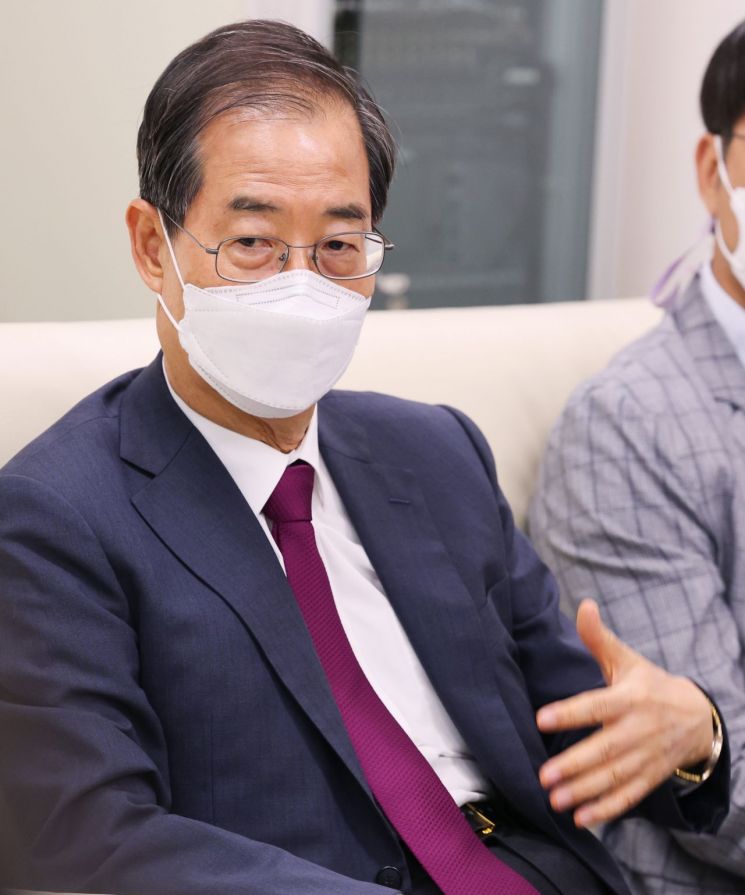
[Asia Economy Sejong=Reporter Kim Hyewon] Prime Minister Han Duck-soo revealed plans to create a separate organization focused on regulatory innovation by mobilizing retired public officials.
On the 25th, Prime Minister Han met with reporters at the Government Complex Sejong's Office for Government Policy Coordination press room and said, "I believe the number of personnel engaged in regulatory reform should increase significantly," expressing this idea.
This organization would be a task force-type unit distinct from the Office for Government Policy Coordination's Regulatory Reform Committee, which handles regulatory complaints, and would specifically work on identifying and easing various regulations that restrict corporate activities. According to Prime Minister Han, this separate organization for regulatory innovation will not be a 'control tower' or an 'advisory body,' but rather an organization that 'works together' with government ministries.
Prime Minister Han introduced, "The regulatory reforms already being carried out by each ministry in various aspects will continue as they are, and something like the Regulatory Innovation Promotion Council led by the President will be established. In addition, this temporary organization will review all alternatives and carry out related tasks."
He emphasized the intention to utilize the expertise of retired public officials who have actual experience in public service. He explained, "Among retired public officials, there are those who have even estimated budgets related to metropolitan area reforms and labor reforms. These individuals can be hired as contract workers even if they are not former full-time officials, and since they receive pensions, the organization can operate with slightly lower expenses."
Prime Minister Han also said that President Yoon Seok-yeol's background as a prosecutor rather than a politician will be helpful for regulatory innovation. He stated, "The highest authority must understand detailed options for regulatory innovation and be able to choose according to their own philosophy, but it was generally difficult to make presidents elected through political processes understand this." He added, "When President Yoon was conducting investigations, the trial process could not proceed without his understanding, so he seems to be meticulous. Furthermore, he does not seem afraid to directly call and persuade someone."
Regarding preventing corporate moral hazard in the long term, Prime Minister Han argued that granting freedom to companies and holding them fully accountable is more effective than government regulation. Using regulations on large conglomerates' preferential treatment as an example, he said, "If an assembly company entrusts parts production to a sibling company that poorly manages labor relations, the assembly company will eventually face difficulties as a penalty. If the state intervenes to rescue this penalty and banks extend loans, moral hazard will never disappear." He continued, "When our economy was small, if that assembly company failed, the economy would be shaken, but now we are aiming to be the world's 6th or 7th largest economy. Companies should freely conduct business with responsibility, and if a company fails, it should be accepted as natural."
On the Serious Accidents Punishment Act, he said, "There are similar laws, so we need to examine whether it is impossible to prevent accidents without a separate Serious Accidents Punishment Act," and added, "Aligning with international standards would be reasonable in terms of maintaining our overall national competitiveness," suggesting that legal amendments could be possible depending on the situation.
Regarding livelihood support policies linked to high inflation, he expressed his conviction, saying, "I think price control is the worst and most inferior method," and "In principle, we will not control (public utility) prices." He stated, "It is better to provide income support through vouchers rather than helping everyone from the richest to the poorest." On real estate policy, he explained, "The basic principle will focus more on helping those in difficulty."
On relocating public institutions to local areas and balanced regional development, he said, "I believe more sophisticated and efficient policies are needed," and "We need bold policies to place the best elementary, middle, and high schools in local areas, and we will continue efforts in that direction."
© The Asia Business Daily(www.asiae.co.kr). All rights reserved.
![Clutching a Stolen Dior Bag, Saying "I Hate Being Poor but Real"... The Grotesque Con of a "Human Knockoff" [Slate]](https://cwcontent.asiae.co.kr/asiaresize/183/2026021902243444107_1771435474.jpg)















