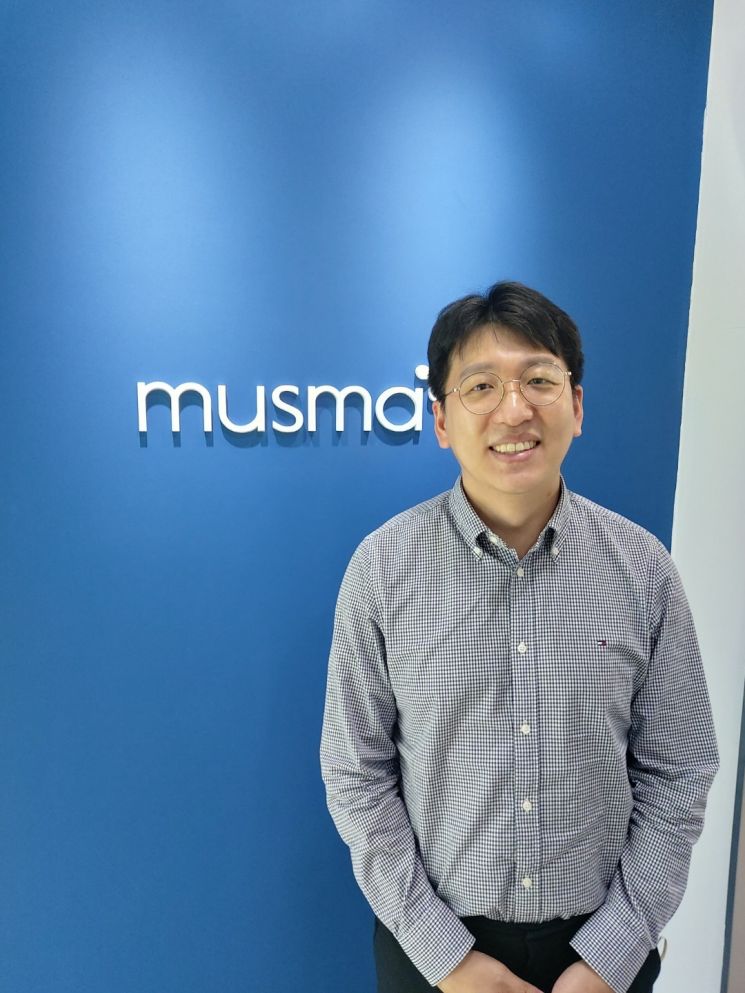
[Interview] Shin Sung-il, CEO of IT Solution Startup 'Moosma'
Developed Real-Time Risk Monitoring Sensor Safety System
Adopted at Over 200 Sites, Subscription Service Also Offered for SMEs
[Asia Economy Reporter Kim Jong-hwa] In November last year, at a shipyard in Geoje, Gyeongnam Province, a worker building a ship in a confined space urgently evacuated outside the vessel. This was because the ‘musma’ gas sensor detected that the harmful gas level exceeded the standard during work and immediately alerted the safety manager with an alarm. If a few more minutes had passed, there could have been a serious danger, but thanks to the gas detection system, the risk was avoided. This incident was selected as an excellent safety prevention case at the shipyard, and from this year, the shipyard has additionally installed the musma gas detection system at every shipbuilding stage.
At the end of March, at a construction site in the metropolitan area, a loud warning sound rang from a crane moving a pile of rebar, and the crane’s movement speed slowed down. This was because sensors and cameras attached to the crane detected a worker working nearby who was about to place down the rebar and warned of the dangerous situation. Since stopping the crane movement abruptly could cause the rebar to fall due to inertia, the speed was slowed down as much as possible, and warning sounds were simultaneously sounded in the crane operator’s cabin and the site control room to help the worker quickly leave the danger zone.
"If sensors detect danger and equipment stops operating, accidents will not happen"
Musma, a construction safety IT solution startup, supplied an industrial safety management solution called ‘MCAS’ that utilizes intelligent Internet of Things (AIoT) technology to this construction company.
Shin Sung-il, CEO of Musma, said, "When I saw workers at the shipyard suffer unexpected accidents, I thought that if there had only been sensors, or if the equipment had stopped operating after detecting danger, the accident would not have happened. This led me to develop a safety system for industrial sites using the Internet of Things (IoT)."
CEO Shin researched autonomous ships, robot automation, and welding automation design at Daewoo Shipbuilding & Marine Engineering’s Industrial Technology Research Institute. He founded Musma in 2017 with confidence in the necessity and business potential of smart safety systems. Starting from 430 million KRW in sales in the year after founding, the company achieved 2 billion KRW in sales last year. This year’s sales target is 5 billion KRW, more than double last year’s.
Musma has been greatly benefiting from the enforcement of the Serious Accidents Punishment Act in January. There has been an increase in inquiries from medium and small enterprises, and the government’s changed stance is also encouraging. According to the Construction Technology Promotion Act, companies undertaking construction projects worth 30 billion KRW or more must spend about 2-3% of the total construction cost on safety management expenses.
Just 2-3 years ago, smart safety equipment utilizing IoT and big data was not included in safety management items at construction sites, so construction companies often purchased and stockpiled excessive safety helmets to consume safety management costs. However, since the enforcement of the Serious Accidents Punishment Act, the government has been encouraging the introduction of smart safety equipment.
CEO Shin said, "Since the enforcement of the Serious Accidents Punishment Act, the government has been encouraging the introduction of smart safety equipment, and inquiries from medium and small enterprises have increased tremendously. I feel that awareness of safety has changed significantly compared to the past."
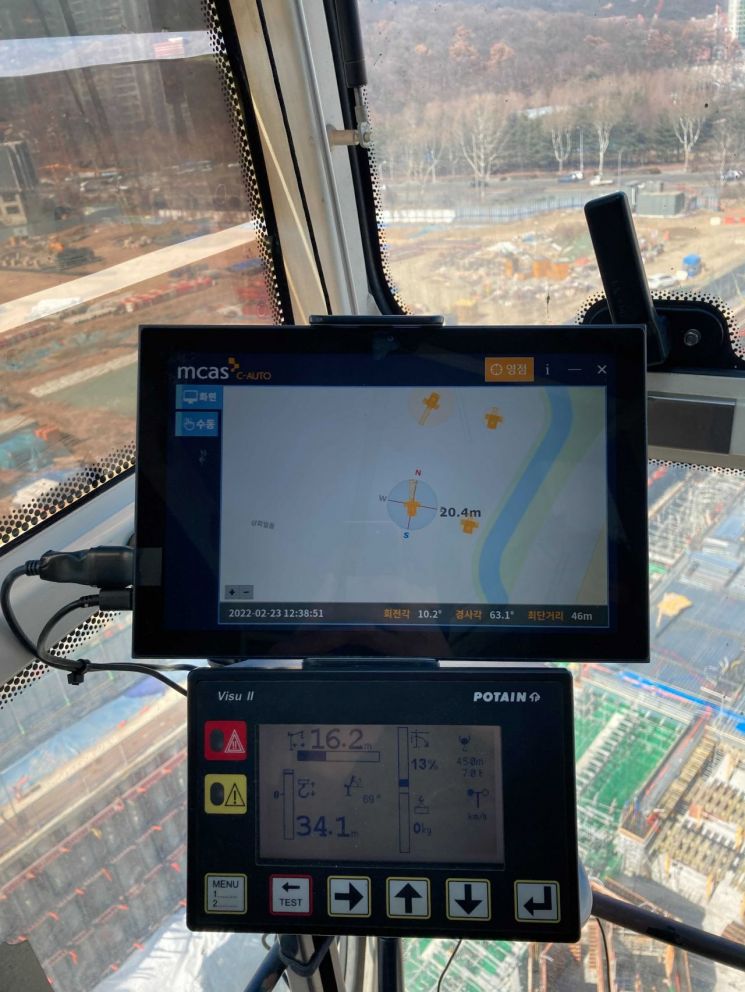 The smart safety management system 'M-CAS' is used to monitor the external situation of cranes in real time.
 [Photo by Moosma]
A safety partner for overseas construction sites with poor communication infrastructure
Musma is expanding its business not only domestically but also to overseas construction sites. It has entered markets such as Saudi Arabia, Qatar, Vietnam, and Mexico. Musma operates detection sensors and communication terminals (Lora), along with IoT wireless base stations and software that can transmit and receive collected site data in real time for real-time risk monitoring.
Musma’s industrial IoT wireless communication can maintain smooth communication throughout the entire construction site within 2 square kilometers with a single base station, and share data between headquarters and the site in real time. Due to these advantages, it can be used even in places with poor communication infrastructure such as deserts, making Musma the partner of choice for domestic construction companies expanding to the Middle East and Southeast Asia.
Currently, Musma protects safety at more than 200 sites including major domestic construction companies and shipbuilders such as Samsung Engineering, Hyundai Construction, Hyundai Steel Industry, and Daewoo Shipbuilding & Marine Engineering. In January, Musma secured follow-up investment worth 4.5 billion KRW through Korea Development Bank, BNK Venture Investment, and Capstone Partners, completing a Series A investment round totaling 6.5 billion KRW.
CEO Shin explained, "Recently, we introduced a system that allows small and medium-sized enterprises hesitant to adopt smart safety systems due to costs to subscribe to Musma’s software at a low cost." Depending on the size of the site and the application target, the cost of introducing Musma’s smart safety system varies from tens of thousands to hundreds of millions of KRW.
MCAS recognizes and analyzes distance, direction, slope, and worker movements together. It attaches only the appropriate number of sensors that simultaneously recognize the worker’s face and movements to determine danger. If the sensors analyze the location where rebar will be placed according to the crane’s rotation radius, the worker’s movements, and expected movement path, and determine that there is a risk of collision soon, a warning sound is issued.
© The Asia Business Daily(www.asiae.co.kr). All rights reserved.


















