[DTx Era③] Increase in Chronic Disease Patients... Rehabilitation Demand Up
Low Participation Due to Accessibility Issues Despite Awareness of Rehabilitation Need
Rehabilitation Possible Anytime, Anywhere Through DTx
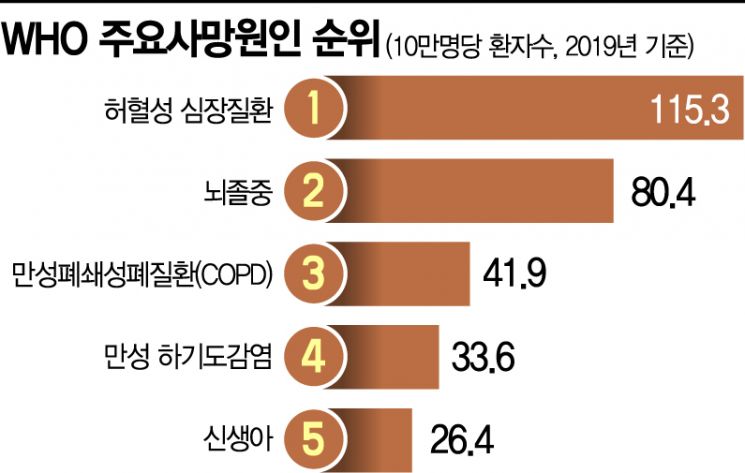
[Asia Economy Reporter Kim Young-won] As the aging process accelerates, the number of elderly people suffering from 'chronic diseases' is also increasing significantly. Along with stagnant declines in smoking rates and environmental issues, the population suffering from chronic diseases continues to grow. According to the Health Insurance Statistical Yearbook, the number of chronic disease patients in South Korea was 18.8 million in 2019, a 4.4% increase compared to the previous year, and rose by another 0.5% to 18.91 million in 2020. The top three leading causes of death according to the World Health Organization (WHO) are all chronic diseases. The first is ischemic heart diseases including acute myocardial infarction, the second is stroke, and the third is chronic obstructive pulmonary disease (COPD).
These chronic diseases require continuous rehabilitation. Acute coronary syndrome appears as an acute condition on the surface, but in reality, it is a chronic disease where the cardiovascular system becomes blocked over many years. Even after procedures, the blood vessels do not return to a completely clean state, so rehabilitation involving exercise and diet must continue after discharge. COPD is also an incurable disease, and it is important to alleviate symptoms such as breathing difficulties through ongoing rehabilitation.
Supporting Rehabilitation Participation with DTx
Digital therapeutics (DTx) are gaining attention in the rehabilitation field. Although the need for rehabilitation therapy is recognized, patient participation rates are low due to accessibility and other issues. DTx can be used independently by patients at home, addressing these problems. Globally, cardiac rehabilitation participation rates are low, averaging between 15% and 30%. The situation in South Korea is even more severe, with only 11% of cardiac patients participating in rehabilitation. In the case of respiratory rehabilitation, only about 2% of COPD patients are aware of their condition, resulting in poor linkage to treatment and management.
Professor Kim Cheol of the Department of Rehabilitation Medicine at Sangye Paik Hospital explained, "Unlike stroke, which leaves sequelae such as paralysis, even if medical staff emphasize the need for rehabilitation in cardiac disease, patients are reluctant to visit hospitals due to distance and time issues." He added, "The concept of rehabilitation DTx is that patients can perform rehabilitation anytime they want, and digital technology replaces the monitoring role."
Another strength of DTx is its ability to assist behavioral modification therapy. The core of behavioral modification therapy is 'lifestyle habit correction.' DTx can send alarms and messages to individual patients to help correct habits. According to clinical practice guidelines for cardiac rehabilitation, ICT (information and communication technology) is appropriate for increasing patients' knowledge and awareness of their disease and inducing behavioral changes for self-management. Instead of doctors recommending rehabilitation and teaching exercises directly, alarms motivate patients who dislike exercise to engage in it on their own.
Rehabilitation DTx Developed Domestically and Abroad
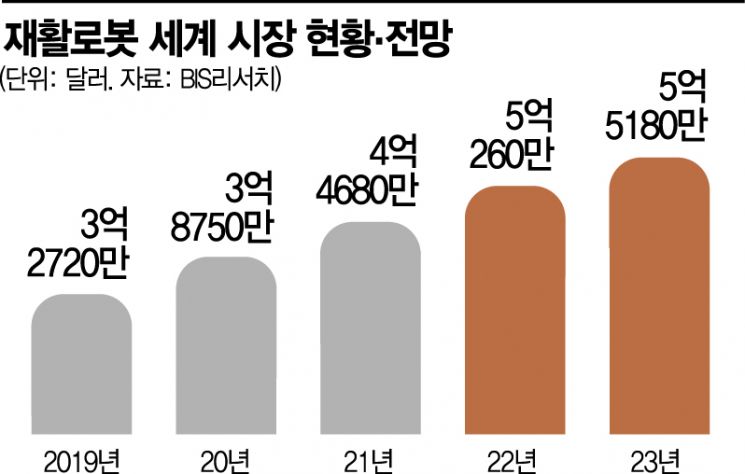
The medical device market supporting rehabilitation therapy is already expanding globally. According to BIS Research, an international market research firm, the global rehabilitation robot market is expected to grow from $224.7 million (approximately 284.2 billion KRW) in 2017 to $551.8 million (approximately 698 billion KRW) in 2023, with an average annual growth rate of 15.4%. According to statistics from the global consulting group KPMG, China, which has the largest rehabilitation medical market with 460 million rehabilitation therapy users as of 2020, is expected to grow at an average annual rate of 20.9% from 2020 to 2025, reaching 220.7 billion yuan (approximately 41.8 trillion KRW) by 2025.
In line with this trend, domestic and international companies have entered the development of rehabilitation DTx. The Korean company Life Semantics is developing 'Redpill Sumton,' a DTx that provides aerobic exercise programs based on biometric information to assist respiratory rehabilitation for COPD and lung cancer patients. It is currently undergoing confirmatory clinical trials after receiving clinical approval from the Ministry of Food and Drug Safety. Another Korean company, Techville, is conducting exploratory clinical trials for 'Rehab Wear,' a VR-based rehabilitation DTx aimed at restoring upper limb motor function in stroke patients. Abroad, Swiss company MindMaze has developed 'MindMotion Pro,' a rehabilitation DTx for motor function decline due to stroke and trauma, and 'MindMotion Go,' a VR game neurorehabilitation DTx. Both products have been approved as Class II medical devices by the U.S. Food and Drug Administration (FDA).
Given the nature of rehabilitation, where increasing participation rates is urgent, DTx products are expected to be widely utilized once released. Professor Kim Min-young of the Department of Rehabilitation Medicine at Bundang CHA Hospital emphasized, "There are many areas where DTx can be applied, but rehabilitation is the strongest field. Especially in rehabilitation, motivating patients is important, and using virtual reality and augmented reality through DTx can create much more enjoyable and powerful motivation."
© The Asia Business Daily(www.asiae.co.kr). All rights reserved.
![Clutching a Stolen Dior Bag, Saying "I Hate Being Poor but Real"... The Grotesque Con of a "Human Knockoff" [Slate]](https://cwcontent.asiae.co.kr/asiaresize/183/2026021902243444107_1771435474.jpg)

















