Samsung SDI Breaks Ground on Indiana Plant with Stellantis
LG Energy Solution Forms Joint Venture with GM, Establishes Production Facility in Michigan
SK On Partners with Ford for Investments in Tennessee and Kentucky
[Asia Economy Reporter Oh Hyung-gil] The three major battery companies have finalized their North American market entry plans. They are accelerating their independent ventures while forming alliances with automakers. It is expected that by securing the North American region, the world's largest automobile market, they will gain an advantage in competition against Chinese and Japanese companies.
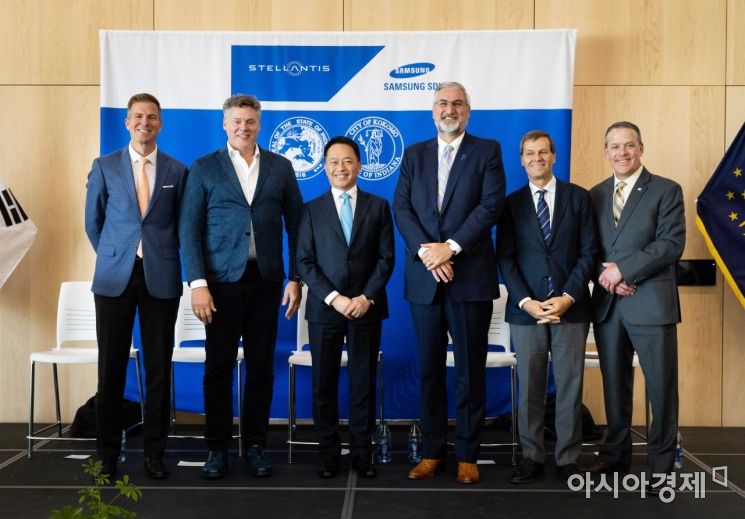
On the 24th (local time), Samsung SDI signed a joint venture agreement to establish an electric vehicle battery cell and module joint corporation with Stellantis, the world's fourth-largest automaker, and the Indiana state government in Kokomo, Indiana, USA.
The signing ceremony was attended by government officials including Eric Holcomb, Governor of Indiana; Bradley Chambers, Indiana Secretary of Commerce; Tyler Moore, Mayor of Kokomo; as well as Samsung SDI CEO Choi Yoon-ho and Mark Stewart, Stellantis North America COO (Chief Operating Officer).
The two companies plan to begin construction of the factory in Kokomo by the end of this year and start mass production of batteries from the first quarter of 2025. The annual production capacity is initially set at 23GWh, with plans to expand to 33GWh in the future. The investment amount, which started at $2.5 billion (3.1 trillion KRW), is expected to increase to $3.1 billion (3.9 trillion KRW).
Kokomo, where the factory will be located, already hosts Stellantis' parts manufacturing plant, and with the addition of the battery joint factory, it will emerge as Stellantis' electric vehicle production hub. Samsung SDI plans to transfer its proprietary battery brand 'PRiMX' development technology to the joint venture to supply high-efficiency batteries.
Choi Yoon-ho, President of Samsung SDI, said, "We thank the Indiana state and Stellantis officials who helped select the joint venture site. Through this partnership with Stellantis, we have established a solid foothold in the rapidly growing North American electric vehicle market and will contribute to achieving climate change goals."
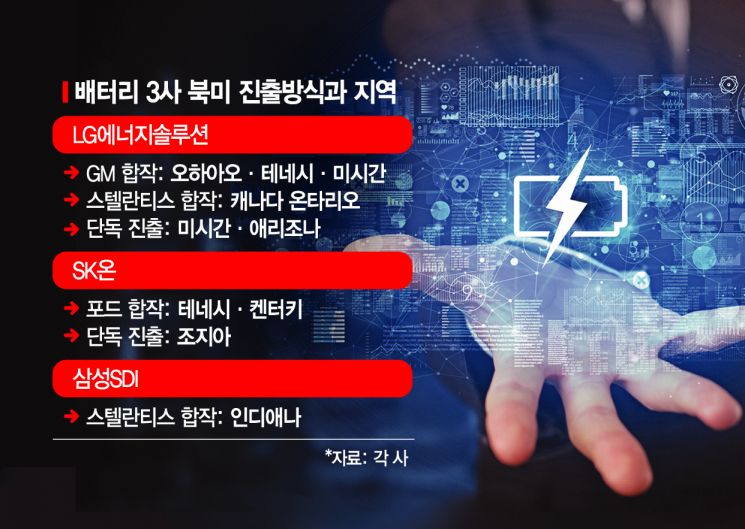
With this establishment plan, all three major domestic battery companies have secured production bases in North America.
LG Energy Solution formed Ultium Cells in partnership with GM and set up production facilities in Ohio, Tennessee, and Michigan. It is also building a joint factory with Stellantis in Ontario, Canada. Additionally, it has standalone factories in Michigan and Arizona.
SK On is constructing battery plants in Tennessee and Kentucky through its joint venture BlueOvalSK with Ford. It also operates the largest battery production plant in the U.S. located in Georgia. As Hyundai Motor Group has designated Georgia as its exclusive electric vehicle production base, cooperation between the two companies is expected to become more concrete in the future.
Moreover, SK Innovation is establishing an investment corporation called 'Energy Solution Holdings' through its subsidiary SK Energy to invest in energy solution businesses within the U.S.
The industry estimates that the total investment by the three battery companies in North America will reach 17.5 trillion KRW by 2025.
The rush of battery companies into the North American market is driven by the U.S. government's eco-friendly vehicle transition and the 'Buy American' policy. President Joe Biden has announced a plan to make 50% of new vehicle sales eco-friendly by 2030. Additionally, under the 'United States-Mexico-Canada Agreement (USMCA)' effective from July 2025, at least 75% of parts used in production must be made in the U.S. to qualify for tariff-free export benefits.
As automakers increase electric vehicle production, battery companies are expected to accelerate their market entry. The market anticipates a shortage of U.S.-made batteries until 2024.
Market research firm SNE Research projected, "In 2024, the supply of lithium-ion secondary batteries for electric vehicles in the U.S. will be 211GWh, which is 56GWh less than the demand of 267GWh," forecasting that demand will exceed supply. The demand for secondary batteries for electric vehicles in the U.S. is expected to grow to 453GWh by 2025 and reach 1,200GWh by 2030.
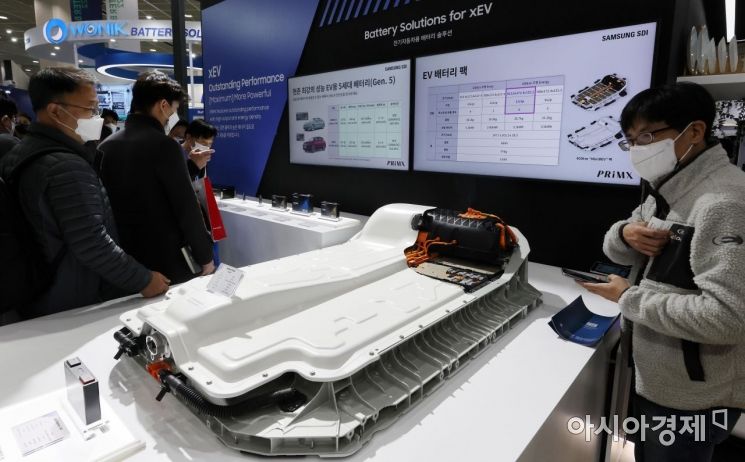 On the 17th, visitors are examining Samsung SDI's EV battery pack at 'InterBattery 2022' held at COEX, Samseong-dong, Gangnam-gu, Seoul. Photo by Hyunmin Kim kimhyun81@
© The Asia Business Daily(www.asiae.co.kr). All rights reserved.
![Clutching a Stolen Dior Bag, Saying "I Hate Being Poor but Real"... The Grotesque Con of a "Human Knockoff" [Slate]](https://cwcontent.asiae.co.kr/asiaresize/183/2026021902243444107_1771435474.jpg)


















