Zara, Chicor Renew Existing Stores into Experiential Spaces
Expert: "It's Not Just Trying on Clothes, but Experiencing Various Activities"
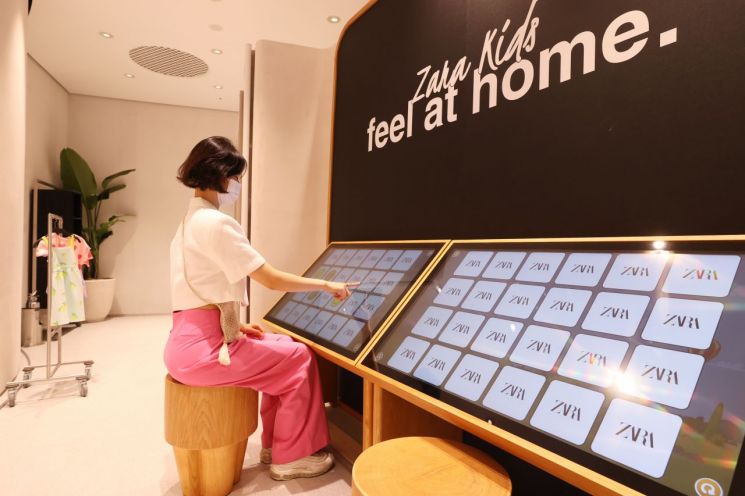 On the 20th, the Zara Jamsil Lotte World Mall store, which reopened as an experiential store, is operating a 'Digital Playground' where children can enjoy games in the fitting room of the children's clothing corner.
 [Image source=Yonhap News]
[Asia Economy Intern Reporter Kim Gunchan] More companies are expanding experiential stores where consumers can directly try and experience products. It is analyzed that there is a growing consumer base that values experience and enjoyment in consumption beyond just purchasing products.
Recently, experiential stores have opened in sectors such as home appliances and toys, including LG Electronics, Ceragem, and Monami. Brands like Nike and Amorepacific have been operating experiential stores for some time. A notable trend is the increase in officially operated standalone stores rather than temporary pop-up stores.
The Spanish fashion brand Zara renewed its Jamsil Lotte World Mall store into an experiential store on the 20th. The previous strategy was to display as many products as possible. In contrast, the renewed store features a segmented display by product line, enabling more efficient shopping.
The biggest change is the expansion of experiential spaces within the store. On the first floor, a 'Beauty Zone' was created where customers can try various makeup styles using tablets equipped with augmented reality (AR) filters. Additionally, a 'Special Fitting Room' that changes themes every six weeks was introduced for customers to take unique certification photos. On the second floor, the children's clothing section now includes a 'Digital Playground' where kids can enjoy experiential games.
Experts analyze that consumers are moving beyond simple consumption to a form of experience, and companies provide experiences during this process. This reflects the industry's response to changing consumption patterns. Professor Eunhee Lee of Inha University's Department of Consumer Studies explained experiential content as "not just trying on clothes, but joyfully experiencing various activities related to the industry inside the store."
This experiential store renewal is Zara's first store concept introduced this year. Zara selected Seoul, Korea as its fourth global store following Madrid, Spain; Ginza, Japan; and Dubai, United Arab Emirates. A Zara representative said, "We are pleased to introduce Zara's new concept store in Korea," adding, "We will provide a more innovative and efficient shopping experience and an enhanced brand experience."
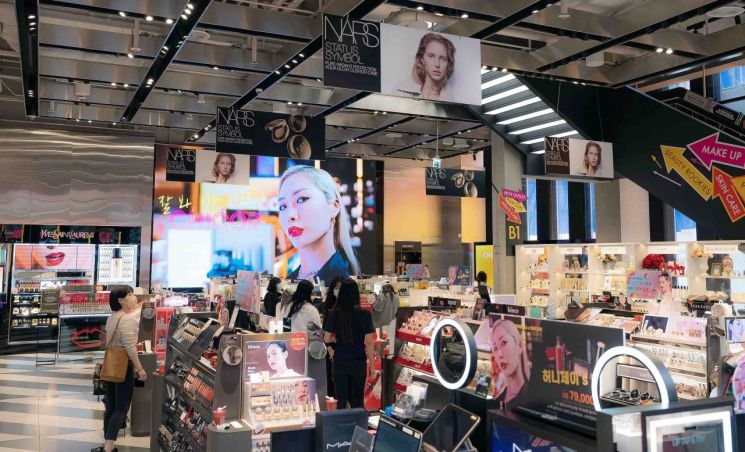 First floor view of Chicor Gangnam Station branch. Consumers can receive consultations on makeup and hair color on-site.
Not only in fashion but also in the beauty industry, there is a strong trend toward expanding experiential stores. CHICOR, a beauty select shop operated by Shinsegae, renewed its Gangnam Station store into an experiential store on the 17th after five years.
CHICOR operates the 'CHICOR Color Studio,' which diagnoses personal color and offers consultations on makeup and hair color suited to the individual. A 'Makeup Curation Zone' where customers can try makeup products matching their personal color was also created on the second floor. Additionally, a space for hair care was established where experts directly diagnose scalp and hair conditions.
Kim Myosoon, Executive Director in charge of cosmetics and miscellaneous goods at Shinsegae Department Store, said, "Through the renewal after five years, CHICOR Gangnam Station has transformed into a space where various experiences are possible," adding, "We aim to establish ourselves as a true beauty platform with differentiated beauty services and content unique to CHICOR rather than competing through traditional price discounts."
The reason companies are eager to expand experiential stores is related to the characteristics of the MZ generation (born from the early 1980s to the 2000s), who do not hesitate to spend on consumption necessary for experience and trial.
Unlike traditional stores visited solely for purchasing, experiential stores emphasize both product purchase and experience as important purposes. In fact, CHICOR renewed its store into an experiential one to provide various experiential contents tailored to the tastes of the MZ generation. About 60% of CHICOR's consumers are in their 20s and 30s, and at the Gangnam Station store, this age group accounts for 80%.
Cultural critic Jung Deokhyun explained, "The MZ generation, which values experience, does not stop at the experience itself but shares videos of their experiences on social media," adding, "Because such sharing has a large ripple effect, the marketing impact is significant."
Another reason for the expansion of experiential stores is the strengthened connection between online and offline channels. When a product gains popularity online, consumers visit offline stores to see the product in person.
Professor Eunhee Lee said, "Stores that started online are also opening experiential spaces," explaining, "The emotions experienced in offline stores connect to online shopping." She emphasized, "Consumers who mainly shopped online during COVID-19 are now fulfilling unmet desires by trying things directly." Cultural critic Jung also analyzed, "As people access a lot of information online, their desire to have their own experiences grows," adding, "Marketing that draws out such desires is increasing."
© The Asia Business Daily(www.asiae.co.kr). All rights reserved.
![Clutching a Stolen Dior Bag, Saying "I Hate Being Poor but Real"... The Grotesque Con of a "Human Knockoff" [Slate]](https://cwcontent.asiae.co.kr/asiaresize/183/2026021902243444107_1771435474.jpg)
















