National Average Diesel Price Surpasses 2,000 Won
Gasoline Price Also Approaching 2,000 Won Range
Concurrent Rise Expected to Continue for a While
Livelihood Drivers' Worries Deepen
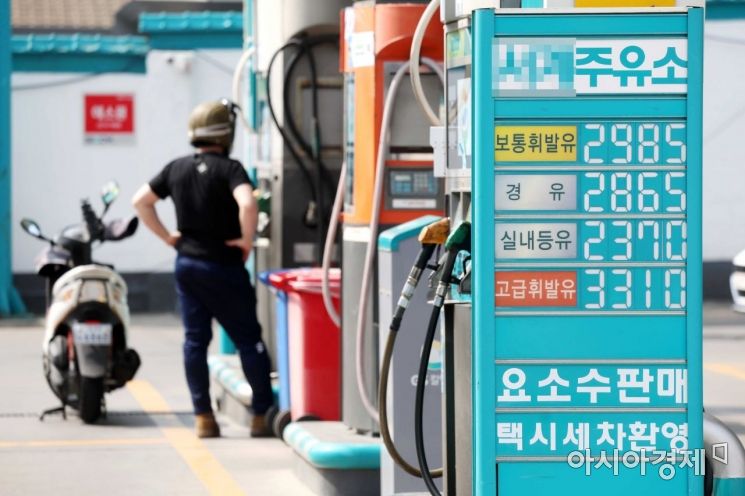 On the 25th, amid the sharp rise in international oil prices, fuel prices such as gasoline and diesel continue to soar domestically, with fuel price information displayed at a gas station in Seoul. According to the Korea National Oil Corporation's oil price information system, Opinet, the average price of diesel sold at gas stations nationwide the previous day was 2,000.93 KRW per liter. This is the first time since April 2008, when nationwide sales price statistics began to be compiled, that diesel prices have exceeded 2,000 KRW. Photo by Moon Honam munonam@
[Asia Economy Reporters Donghoon Jeong and Chaeseok Moon] For the first time in history, the prices of both diesel and gasoline are on the verge of surpassing 2,000 KRW per liter. Notably, this is the first time diesel prices have exceeded 2,000 KRW, overtaking gasoline prices. As fuel prices rise sharply regardless of fuel type, concerns are growing that the logistics crisis caused by the total strike of the Cargo Solidarity Union and the burden on everyday consumers will intensify.
According to the Korea National Oil Corporation’s oil price information service, Opinet, as of noon on the 25th, the nationwide average diesel price stands at 2,002.46 KRW. The nationwide average diesel price exceeded 2,000 KRW for the first time the previous day. This marks a 49% increase (658.89 KRW) compared to 1,343.57 KRW at the same time last year. Diesel prices briefly paused after the fuel tax reduction rate was expanded from 20% to 30% this month but have continued to rise daily since the 3rd due to the surge in international oil prices.
The phenomenon of diesel prices surpassing gasoline prices has also continued for fifteen days. As of noon on this day, the gasoline price is 1,998.1 KRW. Gasoline prices, which broke the 2,000 KRW mark for the first time in 9 years and 5 months (since October 2012) in early March, dropped to 1,932 KRW on the 6th before sharply turning upward.
The sharp rise in diesel and gasoline prices is due to the surge in energy prices following Russia’s invasion of Ukraine. In particular, for diesel, Western sanctions banning imports of Russian oil?which accounts for 60% of Europe’s total imports?have caused a significant supply shortage relative to demand.
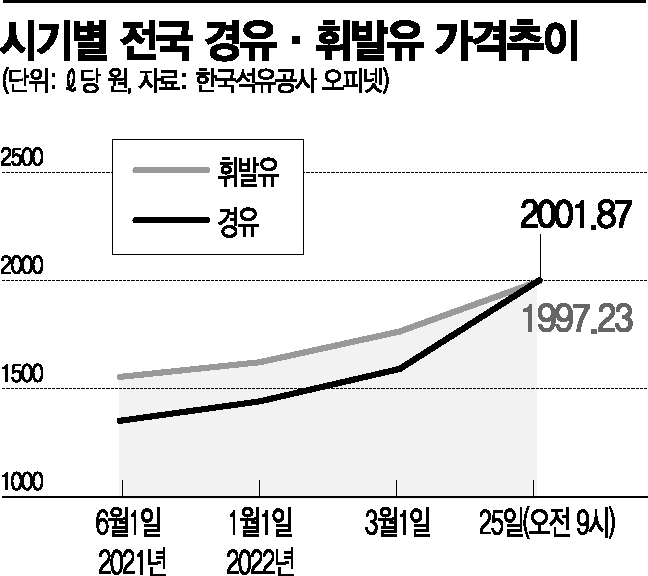
The problem is that the simultaneous rise in diesel and gasoline prices is likely to continue for some time. Russia’s war in Ukraine is cited as the main cause of reduced crude oil and petroleum product supplies. Many analyses suggest that the sharp increase in diesel prices is largely due to inventory shortages centered in Europe, where diesel vehicle demand is high, following the war. The global sanctions on Russian petroleum products also have a significant impact. Domestic diesel wholesale prices are linked to international diesel prices, so the influence of international oil price trends is inevitably large. International oil prices rarely fall below 100 dollars per barrel. On the previous day (local time), the July West Texas Intermediate (WTI) crude oil price on the New York Mercantile Exchange fell by 52 cents (0.47%) from the previous trading day to 109.77 dollars per barrel.
The soaring oil prices are deepening the worries of the industrial sector. In particular, livelihood drivers such as truck drivers, who spend hundreds of thousands of KRW per month on fuel due to long-distance driving, have been hit hard by the soaring diesel prices. Although the government plans to expand fuel price-linked subsidies starting next month, critics say this will not be enough to resolve the issue.
Consumers’ burden of rising prices is also increasing. Ultimately, the price pressure is bound to grow as the chain of "energy price increase → logistics cost increase → price increase" continues. In fact, the price rise that began in the second half of last year peaked last month. The consumer price index in April rose 4.8% compared to the same period last year, marking the highest record in 13 years and 6 months since October 2008 (4.8%).
A representative from the refining industry stated, "As major European countries have restricted or banned diesel imports from Russia, one of the world’s largest oil producers, the supply-demand imbalance has worsened," adding, "Since Europe, which imported most of its diesel from Russia, has turned its back on Russia, the rise in diesel prices will not end as a short-term trend."
© The Asia Business Daily(www.asiae.co.kr). All rights reserved.
![Clutching a Stolen Dior Bag, Saying "I Hate Being Poor but Real"... The Grotesque Con of a "Human Knockoff" [Slate]](https://cwcontent.asiae.co.kr/asiaresize/183/2026021902243444107_1771435474.jpg)
















