Past Agricultural Data and Wisdom Utilized in Modern Content 'Series Publication Work' Progressing Smoothly
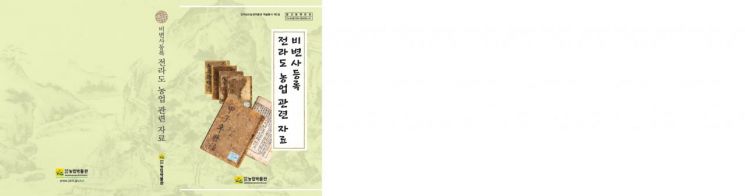
[Muan=Asia Economy Honam Reporting Headquarters, Reporter Yoon Jamin] The Jeonnam Provincial Agricultural Museum (Director Lim Young-ho) is smoothly progressing with the publication of a series aimed at utilizing ancestral agricultural data and wisdom from old documents as modern content.
Through historical document research, the Agricultural Museum accurately identified the realities of agriculture during the Joseon Dynasty to connect the past and present of agriculture. Following last year's publication of the Annals of the Joseon Dynasty materials, it has now achieved the publication of "Bibyeonsa Deungnok (備邊司謄錄) Jeollado Agricultural Related Materials."
Bibyeonsa Deungnok is the minutes of meetings recorded by Bibyeonsa, the highest deliberative body during the Joseon Dynasty, documenting discussions and decisions made.
The content is extensive, making it valuable for research in social and economic history. It is so comprehensive that it was used as a fundamental source when compiling the Annals of the Joseon Dynasty.
Records prior to the Imjin War were lost, and currently, 273 volumes covering 276 years from 1617 (the 9th year of King Gwanghaegun) to 1892 (the 29th year of King Gojong) remain.
The newly published book extracts 908 agricultural-related records from 34 categories such as land reclamation (開墾), irrigation (灌漑), agricultural encouragement (勸農), and rice transplanting (移秧) in the Jeollado region from the Bibyeonsa Deungnok.
Among the 908 records, 102 pertain to "Hwangok (還穀)," a relief system where grain was lent during famine or spring scarcity and repaid during bountiful harvests, marking the largest category.
This vividly illustrates how difficult the lives of farmers and common people were at the time.
The next largest categories were 87 records on water facilities called "Jeon (堤堰)," 57 records on relief measures during famine called "Jinhyul (賑恤)," and 56 records on land surveying systems called "Yangjeon (量田)" used to assess actual cultivation.
The Bibyeonsa Deungnok Jeollado agricultural materials are expected to be widely used as diverse research resources covering agricultural policies, systems, and farming culture of the Joseon Dynasty.
Director Lim Young-ho stated, "The Agricultural Museum will continue to discover and compile agricultural-related old documents and uncover hidden stories within them to utilize as exhibition and educational materials."
© The Asia Business Daily(www.asiae.co.kr). All rights reserved.
![Clutching a Stolen Dior Bag, Saying "I Hate Being Poor but Real"... The Grotesque Con of a "Human Knockoff" [Slate]](https://cwcontent.asiae.co.kr/asiaresize/183/2026021902243444107_1771435474.jpg)















