Examining the Large-Scale Investment Plan...
The Tycoons' Strategic Moves to Survive Future Battlefields Revealed
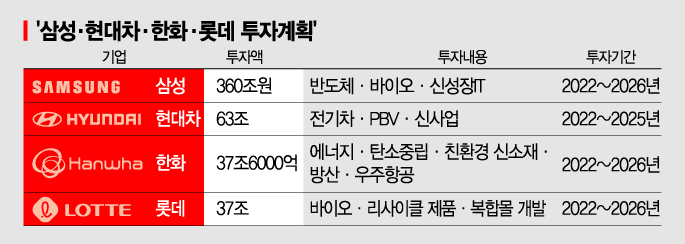
[Asia Economy Reporters Sunmi Park, Daeyeol Choi, Yuri Kim] The 600 trillion won investment announced by major conglomerates, including Samsung Electronics, for the next 3 to 5 years reflects not only their commitment to core industries but also their determination to lead new industrial sectors by discovering future growth engines. It also incorporates the necessity of proactive investment for survival amid severe economic conditions such as the semiconductor hegemony war and global supply chain crises. Analysts say that the investment plans fully embody the decisive moves of each company’s top executives to survive in the future battleground.
◆Future growth engines packed inside the 600 trillion won investment bundle= Samsung Electronics, which announced a 450 trillion won investment plan over five years, is seen as having officially launched Vice Chairman Lee Jae-yong’s ‘New Samsung’ strategy. This represents a 120 trillion won (over 30%) increase compared to the amount invested in the past five years, demonstrating a bold commitment to future investments.
The investment funds will be concentrated in the future growth sectors identified by Samsung: semiconductors, bio, and new growth IT. Samsung has identified three sectors?fabless system semiconductors, foundry, and bio?as future growth industries expected to rapidly expand in market size in the post-COVID-19 era. Samsung plans to hire 80,000 new employees over the next five years, focusing on these three future growth sectors.
Hyundai Motor Group, centered on Hyundai Motor, Kia, and Hyundai Mobis, plans to invest 63 trillion won domestically by 2025. The target is the future mobility sector. About 40% of the investment will be allocated to electrification, eco-friendly initiatives, new technologies, and new business areas. Regarding electrification and eco-friendly businesses, they plan to build a new dedicated electric vehicle plant for purpose-built vehicles (PBV) and modify existing plants to produce electric vehicles simultaneously. In new technologies and new businesses, such as robotics, they will develop wearable robots, service robots, and mobile robot technologies mainly used in production and manufacturing sites. The remaining 60%, approximately 38 trillion won, will be used to enhance the competitiveness of existing internal combustion engine vehicle products.
Lotte will invest a total of 37 trillion won over the next five years in core industries such as chemicals and distribution, including future businesses like ‘Health and Wellness.’ Preparing to enter the bio-pharmaceutical contract development and manufacturing organization (CDMO) business in the Health and Wellness sector, Lotte plans to acquire overseas factories and build a new domestic factory worth about 1 trillion won. Lotte Chemical will invest more than 1.6 trillion won over five years in hydrogen and battery materials businesses, with the chemical sector receiving 7.8 trillion won and the distribution sector 8.1 trillion won in investments.
Hanwha will invest a total of 37.6 trillion won, including 20 trillion won domestically, over the next five years in future industries such as energy, carbon neutrality, defense, and aerospace. Through this, they plan to create more than 20,000 new jobs domestically over five years. Approximately 4.2 trillion won will be invested in energy sectors like solar and wind power, and 900 billion won will be allocated to carbon neutrality projects such as commercialization of hydrogen co-firing technology and investment in water electrolysis mass production facilities. They will also invest 2.1 trillion won in developing eco-friendly new material products to align with carbon neutrality efforts. The defense and aerospace sectors will receive 2.6 trillion won in investments.
◆Investment and employment blueprint unveiled two weeks after new government inauguration= The large-scale investment and employment blueprint announced by companies just two weeks after the inauguration of the Yoon Suk-yeol administration reflects their determination not to rest on current successful businesses but to focus investments on future growth engines and create employment effects.
Since President Yoon has emphasized securing super-gap technologies in future industries and private-led economic growth, there is a clear intention to support these goals by presenting related investment blueprints early on. Although the post-COVID-19 era calls for economic recovery, uncertain external economic conditions and inflation are expected to slow the recovery pace, creating a mood among large conglomerates, which have accumulated significant cash reserves, to lay the groundwork for growth through investments.
The nearly 600 trillion won future growth investment announced by the four groups requires industrial policy support to maximize its effectiveness, and companies are calculating that presenting investment blueprints early in the new government’s term will help them receive policy assistance.
Samsung aims to achieve the goal of becoming a ‘semiconductor superpower’ and realize a ‘second semiconductor miracle’ through aggressive investments in bio and next-generation communications. However, to concretize the 450 trillion won investment in future growth sectors, numerous trials and decisions are needed. A variable is that Vice Chairman Lee is currently under parole due to involvement in the state affairs manipulation case, limiting his participation in management.
Hyundai Motor Group recognizes that the automotive industry’s focus has shifted from internal combustion engines to electrification technologies such as motors and batteries, and that software competitiveness in autonomous driving, artificial intelligence (AI), and connected cars has become increasingly important. To expand electric vehicle production, develop next-generation mobility powered by hydrogen, and expand research facilities and infrastructure, active government incentives are essential.
Additionally, Hyundai Motor Group plans to accelerate the development of Level 4 autonomous driving core technologies and soon launch urban demonstration projects for robotaxi and shuttle services. These efforts also require infrastructure support to enhance efficiency.
The sectors Hanwha will focus on over the next five years?energy, carbon neutrality, defense, and aerospace?and Lotte’s new growth themes such as Health and Wellness, urban air mobility (UAM), and electric vehicle charging infrastructure also require government deregulation and the creation of an innovative environment.
An industry insider said, "The fact that companies announced large-scale investment plans early in the new administration reflects their willingness to grow their businesses centered on future growth engines in response to the pro-business atmosphere of the government. If active private sector investment combines with government deregulation and policy support, a virtuous cycle of investment that extends its influence to small and medium-sized enterprises can emerge."
© The Asia Business Daily(www.asiae.co.kr). All rights reserved.
![Clutching a Stolen Dior Bag, Saying "I Hate Being Poor but Real"... The Grotesque Con of a "Human Knockoff" [Slate]](https://cwcontent.asiae.co.kr/asiaresize/183/2026021902243444107_1771435474.jpg)
















