[Asia Economy reporters Jung-yoon Lee and Hyun-ji Kwon] The Financial Supervisory Service (FSS) has begun on-site inspections of some companies providing financial services linked to Luna and TerraUSD (UST), which experienced a crash.
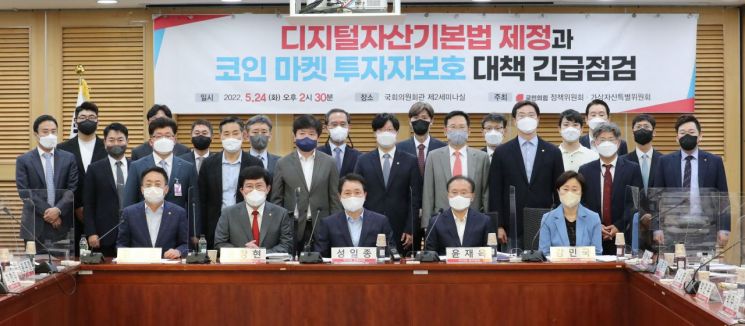
At the 'Emergency Inspection on the Enactment of the Digital Asset Basic Act and Coin Market Investor Protection Measures' meeting held at the National Assembly on the 24th, an FSS official stated, "The possibility that this incident will still affect the financial market is low," but added, "However, to prevent risk transmission to the financial market, on-site inspections will be conducted on some companies providing financial services linked to the issuers or related virtual assets."
Through the on-site inspections, the FSS plans to verify the maintenance of payment services linked to UST and others, the status of outflow funds, and the effectiveness of user protection measures.
The FSS will also conduct a research project analyzing the risk levels of virtual currencies circulated on domestic cryptocurrency exchanges, classifying them by risk characteristics, and will disclose the results to be utilized for future listing evaluations, investor value assessments, and follow-up research and analysis.
Furthermore, the FSS will monitor the overall domestic and international virtual asset markets and share information with related agencies as needed, while establishing a cooperative system with international supervisory bodies and major countries' regulatory authorities. To anticipate potential risk factors, the existing FSS Blockchain Forum, which includes industry, academia, and supervisory authorities, will be expanded into a Virtual Asset Risk Forum.
An FSS official said, "Currently, due to the absence of relevant laws, it is difficult to manage risks in the virtual asset market and among operators."
Earlier, when the price of UST, a stablecoin designed to be pegged to 1 dollar, plummeted, the price of its sister coin Luna also dropped, causing a major crash. Unlike other stablecoins backed by safe assets such as cash or government bonds, UST maintained its value through an algorithm linked to Luna. However, due to concerns about economic recession, the prices of Luna and UST fell, ultimately leading to the crash.
On the same day, the Financial Services Commission (FSC) also announced plans to establish a regulatory framework for cryptocurrencies.
The FSC intends to establish regulatory systems based on the economic substance of cryptocurrencies, categorizing them into securities-type and non-securities-type.
Securities-type cryptocurrencies will be issued under the Capital Markets Act, which includes investor protection measures, with market conditions fostered and regulatory systems established. The FSC also stated it will prioritize the use of the financial regulatory sandbox if necessary.
For non-securities-type cryptocurrencies, regulatory frameworks regarding issuance, listing, and prevention of unfair trading will be established through discussions on bills currently pending in the National Assembly. In this regard, a total of 13 bills, including 7 new bills and 6 amendments to existing laws such as the Electronic Financial Transactions Act, are pending in the National Assembly.
The FSC said, "To ensure the effectiveness of the system, we must secure global regulatory consistency by fully considering trends in regulatory discussions of international financial organizations such as the Bank for International Settlements (BIS), the Financial Stability Board (FSB), and executive orders from the United States," adding, "We will actively review regulatory measures for new digital assets such as stablecoins and DeFi that affect consumers and the stability of the global financial market."
Kim So-young, Vice Chairman of the FSC, said, "Along with efforts to protect investors, we will participate in discussions on the enactment of the Digital Asset Basic Act centered on the National Assembly," and added, "We will do our best to ensure that policy proposals are reflected in institutionalization."
Representatives of exchanges also attended the meeting. Representatives from the five major exchanges?Upbit, Bithumb, Coinone, Korbit, and GOPAX?as well as representatives from CoreDAX, Probit, and Gidax were present.
Lee Seok-woo, CEO of Dunamu, which operates Upbit, said, "To protect investors, we continuously monitor and evaluate virtual currency projects currently supported for trading," adding, "For projects that do not meet Upbit's trading support conditions, we designate them as cautionary items and terminate trading, recognizing the impact on investors and making decisions through fair and strict reviews."
He also said, "We plan to strengthen the foundation for joint responses in emergencies through discussions with major domestic exchanges."
During the meeting, questions were raised suggesting that Coinone and Korbit, which support trading of Luna and UST, were slow to respond. In response, Oh Se-jin, CEO of Korbit, and Kang Myung-gu, Vice President of Coinone, acknowledged this and promised prompt action. Oh said, "We were the first in Korea to designate trading caution for Terra and Luna price fluctuations and announced investment caution reflecting opinions from internal and external committees," adding, "Further discussions are underway, and measures will be announced soon."
Vice President Kang said, "Decisions are made through a two-week review period after designating cautionary items," and added, "We considered that delisting could pose risks to investor protection, so we examined whether there were improvements during the cautionary period, and the decision on delisting will be made around the 25th to 26th."
On the same day, the possibility of measures under the Enforcement Decree of the Act on Reporting and Using Specified Financial Transaction Information was also raised. Yoon Chang-hyun, Chairman of the People Power Party's Special Committee on Virtual Assets, told reporters after the meeting, "The government largely recognizes that the provisions of the Act on Reporting and Using Specified Financial Transaction Information relate to anti-money laundering and have limitations in regulating or controlling exchanges," adding, "Since the Enforcement Decree is a short-term legislative function, the government will consider short-term legislative responses and mid-term plans to enact a basic law."
© The Asia Business Daily(www.asiae.co.kr). All rights reserved.
![Clutching a Stolen Dior Bag, Saying "I Hate Being Poor but Real"... The Grotesque Con of a "Human Knockoff" [Slate]](https://cwcontent.asiae.co.kr/asiaresize/183/2026021902243444107_1771435474.jpg)















