Korea Capital Market Institute Seminar
"Legislation Needed to Codify Issuers, Disclosures, and Listing Standards in Exchange Regulations"
"Luna Incident Does Not Represent the Entire Digital Asset Market"
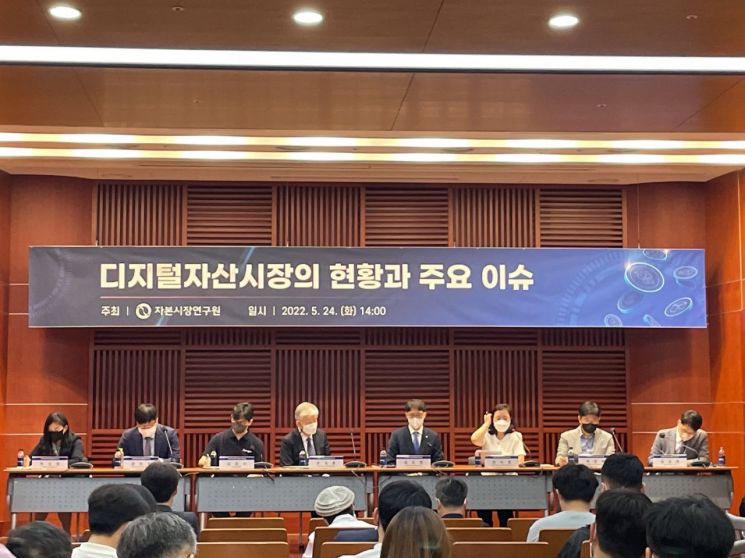
[Asia Economy Reporter Lee Myunghwan] Amid growing concerns over cryptocurrency investment following the recent Luna crash, there have been calls for legislation to fill regulatory gaps regarding issuers' disclosure obligations and listing standards.
Kim Gaprae, a research fellow at the Korea Capital Market Institute, attending the 'Current Status and Key Issues of the Digital Asset Market' policy seminar held on the afternoon of the 24th at the Financial Investment Center in Yeouido, Seoul, argued that legislation related to the digital asset market is necessary for the development of the domestic Initial Coin Offering (ICO) market.
Currently, ICOs are prohibited in South Korea at the administrative guidance level. However, on the 3rd, when President-elect Yoon Suk-yeol announced the 110 national policy tasks, he presented the enactment of a Digital Asset Basic Act along with the allowance of ICOs as major policy agendas.
Research fellow Kim stated that through related legislation, it is essential to introduce systems such as ▲defining the issuer as the disclosure subject ▲nationalizing whitepapers (disclosures) ▲regulating listing standards and procedures through exchange rules ▲categorizing types of unfair trading ▲minimizing conflicts of interest structures among virtual asset traders.
Regarding the Security Token Offering (STO) market, which has been limitedly permitted through regulatory sandboxes, he argued that its development direction should be sought through the refinement of the existing Capital Market Act framework. He explained that institutional improvements based on the operational experience of the financial regulatory sandbox and regulatory measures against speculative activities involving tokenized low-priced securities are necessary.
For Initial Exchange Offerings (IEO), where cryptocurrency exchanges conduct primary verification and then consign the sale of cryptocurrencies, he claimed that to address shortcomings, resolving conflicts of interest and strengthening supervisory authority through listing regulations and operational rules by the competent department are required.
Before Research fellow Kim’s remarks, Professor Park Sun-young of Dongguk University’s Department of Economics emphasized that the Luna-Terra incident does not represent the overall development pattern of digital assets. She also assessed that the prices in the global digital asset market have synchronized with movements in traditional financial markets. In particular, she noted that the increase in institutional investors and the growth of the DeFi market using stablecoins have increased the connectivity among Decentralized Finance (DeFi), Centralized Finance (CeFi), and Traditional Finance (TraFi).
Regarding the domestic digital asset market, she evaluated it as a market unique globally for being CeFi-centered and involving only individual investors, with high potential in terms of market size and national interest.
Professor Park advised that it is time to simultaneously consider investor protection and value creation in the virtual asset market. She suggested, "The degree of regulation concerning investor protection requires social consensus aligned with international consistency," and "At this stage, exchanges need to strengthen self-regulation on transaction support rather than compete for market share."
© The Asia Business Daily(www.asiae.co.kr). All rights reserved.

















