Korea Federation of SMEs to Hold Minimum Wage Special Committee Meeting on the 24th
Employment Difficulty Survey for 600 Small and Medium Enterprises Conducted
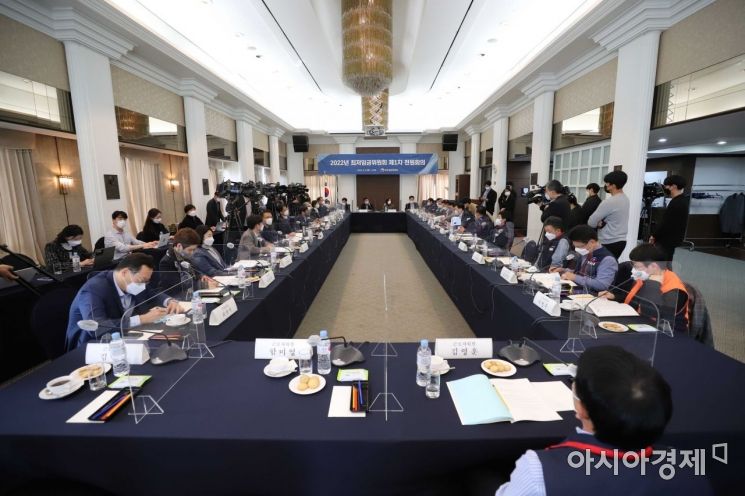 Park Junsik, Chairman of the Minimum Wage Commission, is delivering an opening remark at the Minimum Wage Commission meeting held on the 5th at the Press Center in Jung-gu, Seoul. Photo by Kang Jinhyung aymsdream@
[Asia Economy Reporter Kim Bo-kyung] It has been revealed that 6 out of 10 small and medium-sized enterprises (SMEs) believe that next year's minimum wage should be frozen or lowered.
The Korea Federation of SMEs held a special minimum wage committee meeting on the 24th at the Federation's headquarters in Yeouido, Seoul, and announced the results of the 'Survey on Employment Difficulties and Minimum Wage Opinions of SMEs.'
The special minimum wage committee was formed to represent the voices of SMEs in the minimum wage decision-making process. This survey was jointly conducted by the Federation of SMEs and the Korea Employers Federation from the 4th to the 16th, targeting 600 SMEs employing workers at the minimum wage level.
The survey results showed that 6 out of 10 SMEs (59.5%) responded that next year's minimum wage should be frozen (53.2%) or lowered (6.3%).
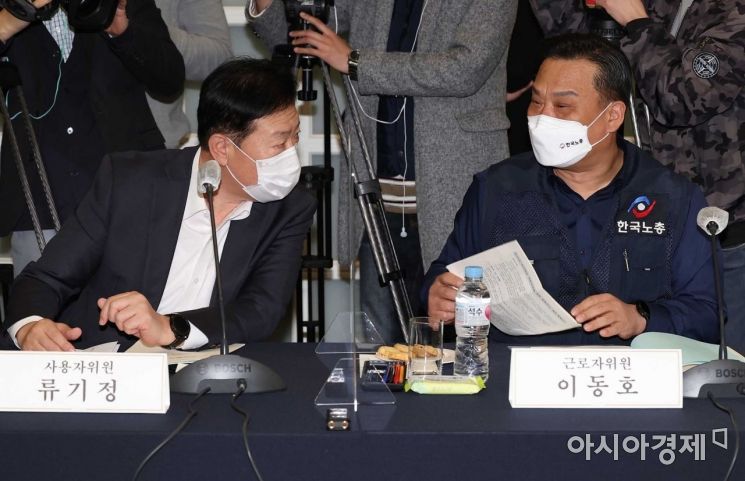 Lee Dong-ho, Secretary General of the Korean Federation of Trade Unions and a worker member of the Minimum Wage Commission (right), and Ryu Ki-jung, Executive Director of the Korea Employers Federation and an employer member, are attending the first plenary meeting of the Minimum Wage Commission this year at the Korea Press Center in Jung-gu, Seoul, on the afternoon of the 5th, engaging in conversation. Photo by Kang Jin-hyung aymsdream@
Regarding responses to a minimum wage increase, 47.0% said they had no countermeasures (unknown), and 46.6% said they would reduce employment (9.8% reducing existing staff + 36.8% reducing new hires). In the service industry, employment reduction was 56.0% (10.3% reducing existing staff + 45.7% reducing new hires), indicating that a minimum wage increase could lead to employment contraction.
This appears to be due to the fact that 29.0% of SMEs find it difficult to pay wages normally, and 33.2% responded that they are unable to cope with increased labor costs, showing that SMEs are vulnerable to responding to minimum wage increases.
Regarding differentiated application of the minimum wage, 53.7% responded that it is necessary. The reasonable differentiation criteria were industry (66.5%), job type (47.2%), size (28.9%), age (11.8%), and region (7.5%), in that order.
Kim Moon-sik, chairman of the special minimum wage committee, said, "On-site, businesses had hoped to catch a break with the lifting of social distancing measures after a long period of hardship, but they are now complaining of difficulties again due to the sharp rise in raw material prices," adding, "I hope that the voices of SMEs will not be ignored and will be definitely reflected in the minimum wage decision."
© The Asia Business Daily(www.asiae.co.kr). All rights reserved.
![Clutching a Stolen Dior Bag, Saying "I Hate Being Poor but Real"... The Grotesque Con of a "Human Knockoff" [Slate]](https://cwcontent.asiae.co.kr/asiaresize/183/2026021902243444107_1771435474.jpg)
















