Existing Bus-Subway Transfers Reduced Significantly from 50-Minute Range
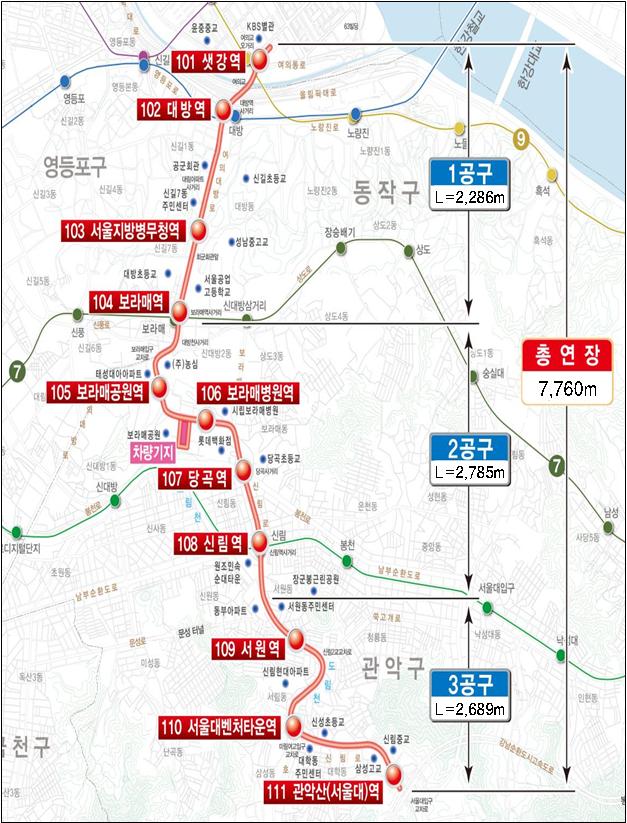
Commuting between the southwestern area of Seoul and Yeouido will become much easier.
On the 24th, the Ministry of Land, Infrastructure and Transport's Metropolitan Area Wide-area Transportation Committee announced that the Sillim Line, an urban railway connecting Saetgang Station (Yeouido) in Yeongdeungpo-gu and Gwanaksan Station (Seoul National University) in Gwanak-gu, will open on May 28.
The Sillim Line is a route consisting of 11 stations over a total length of 7.76 km, connecting Saetgang Station on Subway Line 9, Daebang Station on Line 1, Boramae Station on Line 7, Sillim Station on Line 2, and Gwanaksan (Seoul National University) Station. Construction began in March 2017 and it will open after 5 years and 3 months.
During peak commuting hours, trains will run every 3.5 minutes, and during off-peak hours every 4 to 10 minutes, operating from 5:30 AM (first train) to midnight (last train). After the opening ceremony on May 27, service will begin at 5:30 AM on May 28.
With the opening of the Sillim Line, Seoul Subway Lines 1, 2, 7, and 9, which run east-west across the area, will be connected north-south. This is expected to alleviate traffic congestion in the southwestern part of Seoul and significantly reduce commuting times for citizens.
Previously, it took about 50 minutes to travel from Gwanak-gu (Gwanaksan Station) to Yeongdeungpo-gu (Saetgang Station) via subway and bus transfers, but using the Sillim Line will reduce this to approximately 16 minutes.
Additionally, since transfers will be possible among four Seoul subway lines (Lines 1, 2, 7, and 9), residents in the area are expected to be able to travel conveniently anywhere in Seoul.
The Sillim Line is also significant technologically, as it incorporates many domestically developed technologies through research and development (R&D) in land, infrastructure, and science and technology.
The Korean standard rubber-tired light metro (K-AGT) and the Korean train control system (KTCS-M, for urban rail) have been applied. In particular, the Korean train control system, which is being applied for the first time domestically on the Sillim Line, enables fully driverless operation throughout the entire route.
The Metropolitan Area Wide-area Transportation Committee plans to steadily proceed with various wide-area transportation projects such as railways, BRT, transfer facilities, semi-public operation of wide-area buses, and the Altteul Transportation Card to realize 'commuting within 30 minutes in the metropolitan area' and to build a 'dense public transportation network.'
Baek Seung-geun, chairman of the Metropolitan Area Wide-area Transportation Committee, said, "We will continue to work closely with Seoul and other local governments to expand the wide-area transportation network without delay, doing our best to give the people 'a relaxed morning and a generous evening.'"
© The Asia Business Daily(www.asiae.co.kr). All rights reserved.
![Clutching a Stolen Dior Bag, Saying "I Hate Being Poor but Real"... The Grotesque Con of a "Human Knockoff" [Slate]](https://cwcontent.asiae.co.kr/asiaresize/183/2026021902243444107_1771435474.jpg)















