700 Billion KRW Supplementary Budget for Kamco Debt Adjustment Project
Political Circles Demand Inclusion of Dormant and Closed Businesses
Experts Warn of Moral Hazard Concerns
Financial Services Commission Reluctant to Significantly Increase Budget
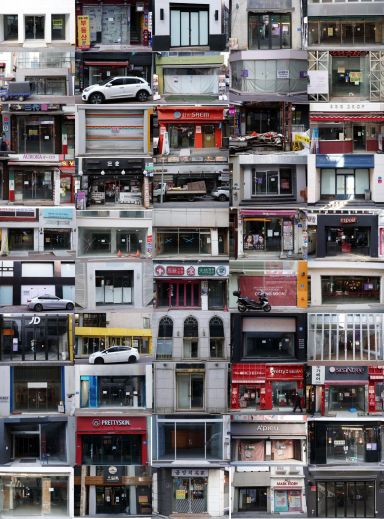
[Asia Economy Reporter Song Seung-seop] The government plans to include temporarily closed and permanently closed small business owners and self-employed individuals in the debt adjustment support program. This policy is completely opposite to the Financial Services Commission’s usual stance of excluding closed businesses from financial support. While considering the difficulties faced by small business owners, there are concerns that this could lead to moral hazard.
According to sources from the political and financial sectors on the 24th, the National Assembly’s Political Affairs Committee added a supplementary opinion to the 2022 supplementary budget revenue plan under the jurisdiction of the Financial Services Commission and the fund operation plan amendment review materials, stating that "the Financial Services Commission will consider including small business owners and self-employed individuals who have already closed due to COVID-19 damage as eligible for support." It is reported that the government has expressed its acceptance of this request from the National Assembly.
The policy with the supplementary opinion is the ‘Debt Adjustment Program’ funded by the Korea Asset Management Corporation (KAMCO). The Financial Services Commission plans to support the business recovery and rehabilitation of small business owners by purchasing non-performing loans through KAMCO. It is also known that the Yoon Seok-yeol Presidential Transition Committee discussed this system. To this end, 700 billion KRW will be reflected in the supplementary budget. The National Assembly has ordered that temporarily closed and permanently closed small-scale business operators be included in this program.
Until now, the Financial Services Commission has often excluded temporarily closed and permanently closed businesses from COVID-19 financial support policies. Even during the fourth supplementary budget phase in 2020, when 1.5 trillion KRW of special guarantees from the Credit Guarantee Fund were supplied, some companies including luxury and entertainment businesses as well as temporarily and permanently closed companies were excluded. Even if support was received, once a business closed, loan repayments had to begin. Although repayment extensions for guarantees and principal and interest were granted as COVID-19 prolonged, there were no cases of debt forgiveness or reduction.
Since the National Assembly has requested and the government has expressed willingness to accept, it is highly likely that the Financial Services Commission will proceed with debt adjustment including temporarily and permanently closed businesses, contrary to its previous stance. Financial Services Commission officials attending the National Assembly’s Political Affairs Committee Budget and Accounts Review Subcommittee on the 17th did not voice opposition or concerns.
"If debts are forgiven even after closure, what about those who repaid diligently?"
Criticism has been raised that this could cause moral hazard from a long-term perspective. Professor Kim Sang-bong of Hansung University’s Department of Economics said, "There is sufficient possibility of moral hazard," and pointed out, "If the principal is also reduced, it raises questions about what happens to those who struggled and repaid well." Professor Oh Jung-geun of Konkuk University’s Department of Economics said, "The emergency situation of COVID-19 must be considered," but added, "Since the policy itself could induce moral hazard, it should be implemented within a range that does not undermine financial market stability."
On the same day, the Political Affairs Committee also demanded that the business budget be increased by 3.9 trillion KRW instead of 700 billion KRW and that the expected bond purchase rate, set at 60%, be lowered to support more people. The expected bond purchase rate is the ratio applied when purchasing non-performing loans of small business owners and self-employed individuals. The lower the rate, the less money KAMCO has to spend, enabling support for more people.
The Financial Services Commission expressed reluctance. An ironic scene unfolded where the Financial Services Commission, the supervised agency, appealed that "the budget is too large, so please reduce it." Deputy Chairman Do Gyu-sang of the Financial Services Commission said at the Political Affairs Committee, "If you revise it to say ‘we will try to increase the budget,’ we can accept it," indirectly rejecting the demand. When a compromise was proposed, he expressed concern, saying, "The National Assembly criticizes us for why we draw money early if we do not use it," and "If we do not use the money, we get severely scolded."
Deputy Chairman Do also requested regarding the expected bond purchase rate, "We are expecting about 61%," and asked, "Rather than saying ‘lower it,’ please say ‘we will calculate an appropriate rate and try to increase the support target.’"
© The Asia Business Daily(www.asiae.co.kr). All rights reserved.
![Clutching a Stolen Dior Bag, Saying "I Hate Being Poor but Real"... The Grotesque Con of a "Human Knockoff" [Slate]](https://cwcontent.asiae.co.kr/asiaresize/183/2026021902243444107_1771435474.jpg)















