Paradigm Shift After COVID-19
Regulations Lag Behind Changes
Relaxation Trends in US and Europe
"It's Time for Revisions Now"
The paradigm shift in the distribution industry has accelerated due to the COVID-19 pandemic. However, there are growing voices that regulations surrounding the industry have remained stuck in the past, failing to keep up with the changing times. Experts evaluate the distribution regulations as "anachronistic" and analyze that it is urgent to establish new standards reflecting the current reality.
◇Alcohol, Dining, Marts, Home Shopping, Convenience Stores "Need to Reflect Reality"
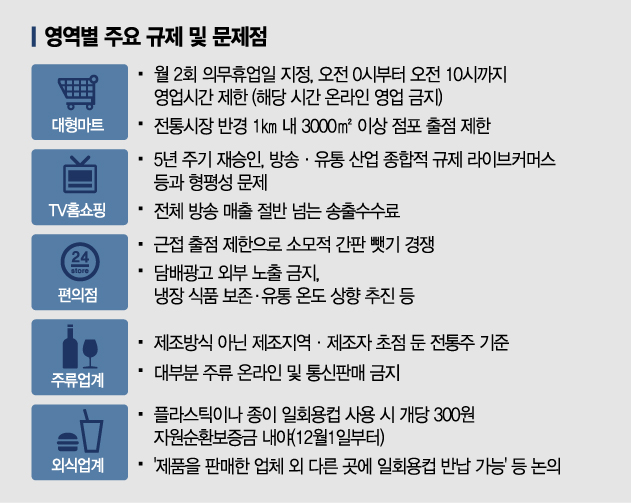
According to the industry on the 24th, the alcohol industry has recently been heated by controversy over the standards for traditional liquor. Under the Liquor Tax Act, if classified as traditional liquor, benefits such as tax reductions and permission for online sales are granted, but the criteria are based on the manufacturing region and manufacturer rather than the type of liquor, leading to frequent fairness issues. Due to this classification, domestically produced "wine," "gin," and "apple cider," which are ambiguous as traditional liquors, are recognized as traditional liquor, while drinks like Makgeolli, traditionally recognized as traditional liquor, are legally classified as general liquor, resulting in cases where traditional liquors do not receive traditional liquor benefits.
The dining industry is united in calling for a slowdown in environmental regulations. Starting in December, food and beverage and dining franchises with more than 100 stores, such as cafes, coffee shops, fast food, and ice cream/bingsu shops, must pay a resource circulation deposit of 300 KRW per disposable plastic or paper cup used. When consumers return cups to the store, the store must refund the deposit, but issues have arisen such as "disposable cups can be returned to places other than the product seller." Concerns about business disruptions and additional costs have been raised.
Large marts are hampered by the Distribution Industry Development Act introduced in 2010. It restricts operating hours from midnight to 10 a.m., designates two mandatory closing days per month, and limits the opening of stores larger than 3,000㎡ within a 1 km radius of traditional markets. Although intended to revitalize traditional markets and protect small and medium-sized merchants, the effectiveness of these measures has been increasingly questioned recently.
TV home shopping must be reapproved every five years under the Broadcasting Act and other laws. The industry's sense of crisis is significant as the transmission fees paid to pay-TV operators have risen to exceed half of home shopping's combined sales. Convenience stores are voicing concerns about intensified wasteful competition for signage due to restrictions on nearby store openings. Other controversies include bans on external exposure of tobacco advertisements and proposals to raise the preservation and distribution temperatures for refrigerated foods. In the food and beverage industry, there are calls to revitalize the functional labeling system for general foods, now in its second year, through institutional improvements. The raw milk price linkage system, which is a cause of dairy price increases, is also cited as a representative issue needing revision.
◇Overseas Also Leaning Toward Deregulation... "Time to Revise Now"
Major countries overseas are pursuing policies to secure global competitiveness by easing regulations on distribution companies. In the United States, although details vary by state, there are no laws regulating the opening or operating hours of large retailers except for local land use ordinances. There are no direct distribution regulations on retail stores, allowing free entry of large companies. France has been easing the scope of store opening regulations and Sunday operation restrictions since the 2008 financial crisis. With the full implementation of the "Macron Law" in January 2017, restrictions on Sunday operations for all retail stores were relaxed. The UK has no restrictions on store openings in city centers. Rather, to prevent urban hollowing, if a store larger than 2,500㎡ is established outside the city center, it must prove that there is no space available in the city center area.
Experts unanimously agree that the mandatory closing days and operating hour restrictions under the current Distribution Industry Development Act should be abolished. Regarding the ban on disposable items in cafes and restaurants, they emphasize that "consumer awareness improvement" is most important. The traditional liquor controversy should be addressed by revising the law to separately manage regional specialty liquors and traditional liquors. Professor Seoyonggu of the Department of Business Administration at Sookmyung Women's University pointed out, "There are hardly any countries worldwide regulating the distribution industry since 2010," adding, "The law does not consider the growth of e-commerce at all." Professor Jeong Yeonseung of Dankook University's Department of Business Administration criticized, "Instead of distribution regulations, policy support should be provided to help traditional markets survive in line with changes."
[Reporting = Distribution Economy Department, Organized by Yuri Kim]
© The Asia Business Daily(www.asiae.co.kr). All rights reserved.
![Clutching a Stolen Dior Bag, Saying "I Hate Being Poor but Real"... The Grotesque Con of a "Human Knockoff" [Slate]](https://cwcontent.asiae.co.kr/asiaresize/183/2026021902243444107_1771435474.jpg)















