Transfer between Lines 1, 2, 7, and 9 greatly improves transportation in Seoul's southwest area... Boramae Park Opening Ceremony on the 27th
Fares same as existing subway, applies metropolitan area integrated transfer discount
Yeouido Saetgang Station to Gwanaksan Station 7.8 km, 11 stops... transports up to 130,000 passengers daily
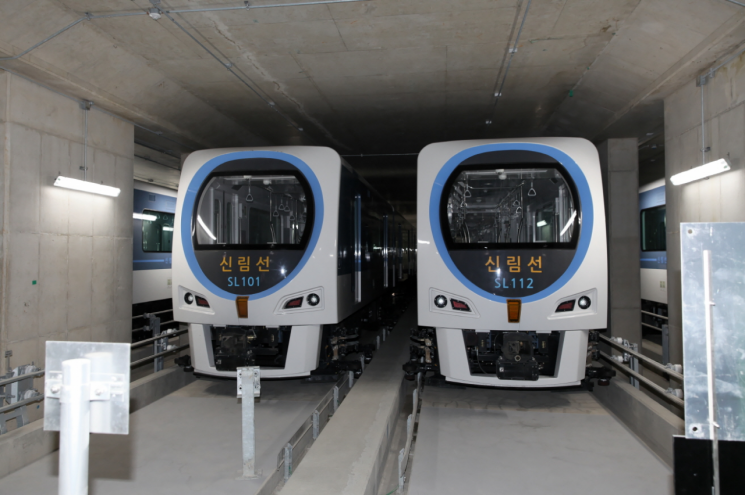
[Asia Economy Reporter Lim Cheol-young] The Seoul Metropolitan Government announced on the 24th that the ‘Sillim Line Urban Railway,’ connecting Yeouido Saetgang Station to the main gate of Seoul National University, will begin operation from 5:30 a.m. on the 28th. On the 27th at 10 a.m., a day before the opening, an inauguration ceremony for the Sillim Line Urban Railway will be held at Boramae Park, attended by Acting Mayor Jo In-dong and Baek Seung-geun, Chairman of the Metropolitan Transportation Committee of the Ministry of Land, Infrastructure and Transport, among others.
The Sillim Line Urban Railway is a total 7.8 km route connecting 11 stations, including 4 transfer stations, from Yeouido Saetgang Station in the southwestern area of Seoul to Gwanaksan (Seoul National University) Station. It starts at Saetgang Station on Line 9 and passes through Daebang Station on Line 1, Boramae Station on Line 7, and Sillim Station on Line 2, finally connecting to Gwanaksan (Seoul National University) Station.
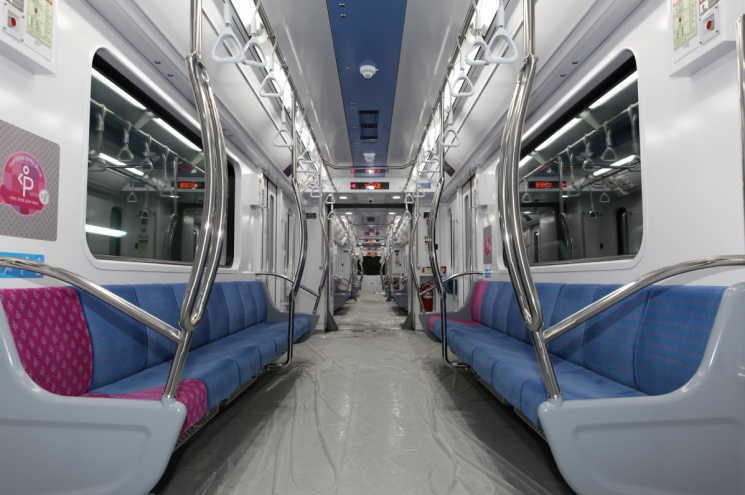
The commuting time from Yeouido Saetgang Station to Gwanaksan (Seoul National University) Station, which previously took over 35 minutes by bus, will be reduced to 16 minutes. The train interval is 3.5 minutes during peak hours and 4 to 10 minutes during off-peak hours, with a maximum operating speed of 60 km/h. It can transport up to 130,000 passengers daily (10 train sets x 50 trips x 268 passengers). One train set (3 cars) can accommodate up to 48 seated passengers and 220 standing passengers (110 capacity), totaling 268 passengers. The fare is the same as the existing subway when using a transportation card (1,250 KRW for adults, 720 KRW for teenagers, 450 KRW for children) and applies the metropolitan area integrated transfer discount system.
A total of 10 train sets will be operated, with 2 sets prepared as spares. One train set consists of 3 cars. Each car has 2 doors on both the left and right sides, so 6 doors (per train set) open when arriving at a station. Except for Sillim Station (island platform), all 10 stations have side platforms facing each other across the train.
The Sillim Line Urban Railway is a revenue-type private investment project (BTO, Build Transfer Operate) where a private operator constructed the line under an implementation agreement signed in August 2015, transferred ownership to Seoul upon completion, and will operate it directly for 30 years to generate revenue from fares. With this opening, traffic congestion in the southwestern Seoul area (Yeongdeungpo-gu, Dongjak-gu, Gwanak-gu) will be alleviated, and the network with existing urban railways will be enhanced, significantly improving transportation in the southwestern region.
The Sillim Line Urban Railway features ▲ Korea’s first domestically developed signaling system ▲ enhanced electromagnetic ionization devices that sterilize bacteria ▲ Seoul’s first rubber-tired trains ▲ ‘One Station, One Route’ accessibility for transportation-vulnerable groups. Electromagnetic ionization devices installed at each station improve indoor air quality by capturing 54% more pollutants compared to previous systems and reduce harmful substances, odors, and formaldehyde by 89-98%. Notably, bacteria are sterilized using ultraviolet (UV) light and oxidizing agents.
To suit the terrain of the Sillim Line Urban Railway, which has many sharp curves along the Dorimcheon Stream, Seoul’s first rubber-tired trains have been introduced. Compared to steel-wheeled trains, which can generate noise due to severe friction with the tracks on sharp curves, rubber-tired trains produce less noise, providing a more comfortable transportation environment for users. Unlike conventional trains, rubber-tired trains do not run on tracks but use concrete running paths and guide rails, eliminating derailment risks. Additionally, their braking distance is shorter, allowing more precise stopping than track-based trains.
Elevators have been installed inside and outside all stations to ensure that transportation-vulnerable groups such as the disabled and elderly can board the subway without assistance, securing ‘One Station, One Route’ accessibility throughout the Sillim Line Urban Railway. Furthermore, all stations are equipped with rest facilities for pregnant women, including sofas and diaper changing tables.
Crime Prevention Design Applied, Psychological Deterrence and Response to Crime... Artworks Selected by Citizen Participation Voting
The stations feature a simple design that is bright, sophisticated, and open. Safety zones applying crime prevention design have been installed on all platforms to psychologically deter crime in advance and enable quick response if a crime occurs.
Artworks that are more approachable to citizens have been installed at six stations, providing visual attractions. The artworks were selected through a public contest, reviewed by art experts, and voted on by a citizen participation group. The artworks are installed at Saetgang Station, the gateway to Yeouido, the center of Korean politics and finance; Daebang Station, a transfer station connecting Yeouido and the southwestern region on Line 1; Boramae Station, a major east-west-north-south transportation hub; Sillim Station, a busy transfer station with high subway foot traffic; Seowon Station, a residential area densely populated by people in their 20s and 30s; and Gwanaksan (Seoul National University) Station, near Gwanaksan Park and Seoul National University.
Before opening, the Seoul Metropolitan Government conducted citizen monitoring rides to check for discomfort regarding ride quality and safety, allowing citizens to directly identify any issues. To ensure safety, comprehensive test operations, including facility verification tests and trial runs, were conducted under conditions identical to actual operation.
Lee Jeong-hwa, Director of the Seoul City Urban Infrastructure Headquarters, said, “The Sillim Line Urban Railway, connected to existing subway Lines 1, 2, 7, and 9, will greatly improve transportation convenience in southwestern Seoul. The travel time from Yeouido Saetgang Station to Gwanaksan (Seoul National University) Station is only 16 minutes, which is expected to enhance citizens’ quality of life significantly.”
© The Asia Business Daily(www.asiae.co.kr). All rights reserved.
![Clutching a Stolen Dior Bag, Saying "I Hate Being Poor but Real"... The Grotesque Con of a "Human Knockoff" [Slate]](https://cwcontent.asiae.co.kr/asiaresize/183/2026021902243444107_1771435474.jpg)
















