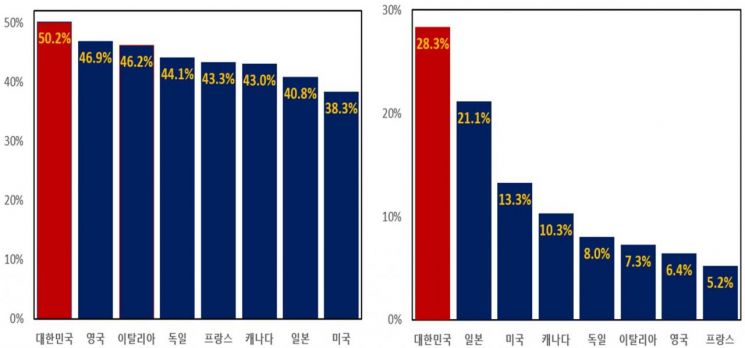
 Intermediate goods import ratio of our country (left) and dependence on China international comparison
[Asia Economy Reporter Choi Dae-yeol] It has been revealed that the dependence on imported intermediate goods in the production activities of Korean companies exceeds half. There are concerns that the heavy reliance on certain countries such as China could lead to greater shocks if problems arise.
According to the results of a survey on the status of intermediate goods imports conducted by the Korea Employers Federation on the 23rd, the proportion of intermediate goods in total imports was 50.2% (based on 2020). In particular, dependence on specific countries such as China has increased. When broken down by country, the share of the top five countries rose from 57.6% in 2010 to 63.0% in 2020.
Dependence on intermediate goods imports from Japan decreased from 21.0% in 2010 to 12.8% in 2020. On the other hand, dependence on China significantly increased from 19.4% to 28.3%.
The high external dependence is also notable compared to the other Group of Seven (G7) countries. When examining the proportion of intermediate goods imports in total imports, all other countries except Korea were below 50%. The highest was the United Kingdom at 46.9%, followed by Italy at 46.2%, Germany at 44.1%, and France at 43.3%. Japan was at 40.8%, and the United States at 38.3%.
Dependence on China was also highest in Korea. The second highest, Japan, was at 21.1%, showing a difference of more than 8 percentage points from Korea. The United States and Canada were at 13.3% and 10.3%, respectively, while Germany, Italy, the United Kingdom, and France all had single-digit percentages. The Korea Employers Federation explained, "While the G7 countries’ dependence on China increased by 0.8 percentage points over 10 years, Korea’s increase was significantly larger."
They added, "If problems occur in the production of intermediate goods overseas, domestic industries could suffer greater shocks than major competitors. This especially means vulnerability to China-originated risks such as the US-China trade conflict, the urea solution crisis, and lockdown measures."
The share of industrial raw materials in total imports was 30.2%, which is lower than the United Kingdom or Italy but higher than other countries. Dependence on industrial raw materials imported from China was the highest among the G7 countries.
Ha Sang-woo, head of the Economic Research Department at the Korea Employers Federation, said, "In addition to the recent surge in raw material prices due to global supply chain issues and the Ukraine crisis, the sharp rise in the won-dollar exchange rate has further increased the production cost burden on Korean companies, which have a high proportion of imports of primary products like crude oil and intermediate goods. While joining the Indo-Pacific Economic Framework (IPEF) is welcome in terms of strengthening global supply chain cooperation, thorough measures must be reviewed to prepare for any contingencies considering the high dependence on Chinese intermediate goods imports."
© The Asia Business Daily(www.asiae.co.kr). All rights reserved.
![Clutching a Stolen Dior Bag, Saying "I Hate Being Poor but Real"... The Grotesque Con of a "Human Knockoff" [Slate]](https://cwcontent.asiae.co.kr/asiaresize/183/2026021902243444107_1771435474.jpg)















